U.S. flag

An official website of the United States government

Images

Coastal and Marine Hazards and Resources Program images.

Filter Total Items: 2413
3 different views created using multibeam bathymetry data show the fault in bright colors
Perspective views of multibeam bathymetry data acquired by the USGS

Perspective views of multibeam bathymetry data acquired by the USGS aboard the R/V Medeia. Shallower depths in red. Arrows point to the distinct line in the seafloor associated with the Queen Charlotte-Fairweather fault.

View of steep forested hills from a bay, with fog drifting over the hilltops and obscuring the sky
Resurrection Bay on August 8, 2016

Resurrection Bay on August 8, 2016. The water appeared calm in the shelter of the inner bay, but closer to the entrance, swells coming in from the Gulf of Alaska were breaking on a small beach where the three boaters had capsized.

Resurrection Bay on August 8, 2016. The water appeared calm in the shelter of the inner bay, but closer to the entrance, swells coming in from the Gulf of Alaska were breaking on a small beach where the three boaters had capsized.

WARC staff members teach students at World Wetlands Day

USGS Wetland and Aquatic Research Center's Coastal Wetlands Planning, Protection and Restoration Act (CWPPRA) outreach office staff were on hand at the World Wetlands Day celebration hosted by the Bayou Terrebonne Waterlife Museum and South Louisiana Wetlands Discovery Center as local students learned about the different types of wetlands in Louisiana.

USGS Wetland and Aquatic Research Center's Coastal Wetlands Planning, Protection and Restoration Act (CWPPRA) outreach office staff were on hand at the World Wetlands Day celebration hosted by the Bayou Terrebonne Waterlife Museum and South Louisiana Wetlands Discovery Center as local students learned about the different types of wetlands in Louisiana.

Two maps; the left hand one shows brown land, blue water, and red arrows. The right hand one shows colored survey tracklines
Maps with key features and shaded relief of the study area

Left: Key features in and around the Gulf of Alaska. A black rectangle outlines our 2016 study area along the Queen Charlotte-Fairweather fault. Red arrows indicate relative tectonic plate motions. Right: A shaded relief map of the 2016 study area. Rainbow colors show seafloor depths acquired by the USGS in 2015 and 2016. Red indicates shallower depths.

Left: Key features in and around the Gulf of Alaska. A black rectangle outlines our 2016 study area along the Queen Charlotte-Fairweather fault. Red arrows indicate relative tectonic plate motions. Right: A shaded relief map of the 2016 study area. Rainbow colors show seafloor depths acquired by the USGS in 2015 and 2016. Red indicates shallower depths.

Calcareous planispiral estuarine foraminifera Cribroelphidium poeyanum from Grand Bay
Calcareous estuarine foraminifera Cribroelphidium poeyanum

Scanning electron microscope (SEM) image of calcareous planispiral estuarine foraminifera Cribroelphidium poeyanum collected from Grand Bay estuary.

browse graphic of the data locations
Browse graphic of data

Browse graphic of the sediment textuer and geomorphology data of the sea floor from Fenwick Island, MD to FIsherman's Island, VA

Browse graphic of the sediment textuer and geomorphology data of the sea floor from Fenwick Island, MD to FIsherman's Island, VA

Samples Repository Collections map interface

Map interface of Cores, grabs, dredges, slides, and other samples, primarily of marine, estuarine, and lacustrine sediments, curated at the USGS Woods Hole Coastal and Marine Science Center.

Map interface of Cores, grabs, dredges, slides, and other samples, primarily of marine, estuarine, and lacustrine sediments, curated at the USGS Woods Hole Coastal and Marine Science Center.

The pilot and plane used to take air photos for the USGS

Pilot Bob Van Wagenen and the Cessna 182R he flies when taking air photos for the USGS Remote Sensing Coastal Change Project.

Diver in an underwater cave.
Diver collecting samples

David Brankovits collecting water samples in Molnar Janos Cave in Budapest, Hungary.

Map showing the amount of sea-level rise that will double the chances

Map showing the amount of sea-level rise that will double the chances of today’s “50-year floods,” which have a 2 percent chance of happening in any year. Warmer colors indicate areas at greater risk.

A scientist explains an illustration on a poster presentation to a congressman in a suit
Elizabeth Pendleton describes USGS work to map the Mass. seafloor
Images of Matanzas, Florida, from before and after Hurricane Matthew, and DEM showing the associated change
Orthomosaic and DEM images of Matanzas, Florida

Orthomosaic images of Matanzas, Florida, from (a) before and (b) after Hurricane Matthew, and (c) a digital elevation model (DEM) showing the associated topographic change. Note, these results were produced by applying Structure-from-Motion (SfM) to NOAA oblique photographs, but similar results can be obtained using UAS aerial imagery.

Orthomosaic images of Matanzas, Florida, from (a) before and (b) after Hurricane Matthew, and (c) a digital elevation model (DEM) showing the associated topographic change. Note, these results were produced by applying Structure-from-Motion (SfM) to NOAA oblique photographs, but similar results can be obtained using UAS aerial imagery.

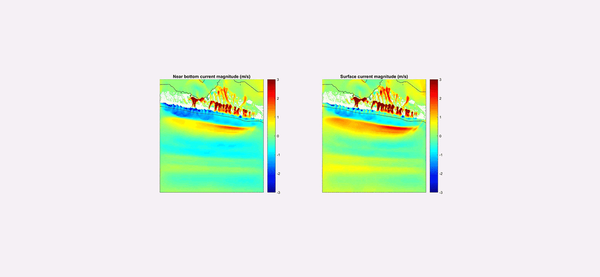
A short animation contrasts the difference between near-bottom current magnitude and surface current magnitude, showing waves of
A short animation contrasts the sand movement during Hurricane Sandy

 USGS scientists built a model that reproduces the waves, currents (shown in meters per second [m/s]), and sand movement at Fire Island during Hurricane Sandy’s passage (Warner and others, 2017).

Three panels with bright colors showing underwater bathymetry features
Perspective views of multibeam bathymetry data acquired by the USGS

Perspective views of multibeam bathymetry data acquired by the USGS aboard the R/V Medeia. Shallower depths in red. Arrows point to the distinct line in the seafloor associated with the Queen Charlotte-Fairweather fault.

Was this page helpful?