



Florida’s Fading Coral Reefs Could Sharply Increase Coastal Flood Risk
Coral reefs do more than support vibrant marine ecosystems—they also act as natural breakwaters, protecting coastlines from storm-driven waves. New USGS-led research shows that as Florida’s coral reefs continue to degrade, the loss of this natural protection could dramatically increase flooding risk for coastal communities in southeast Florida.
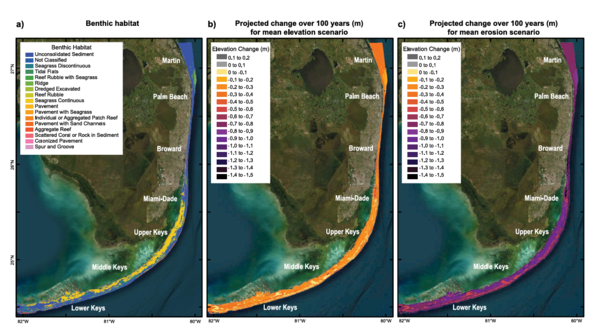
Over the past several decades, coral reef degradation has lowered the shallow seafloor offshore of Florida, allowing waves to reach the coast with greater energy. To understand what further reef loss could mean in the future, this study modeled coastal flooding under several storm scenarios, comparing present-day reef conditions with projections of more degraded reefs. The authors then assessed how many people, buildings, roads, and economic assets would be affected.
The results show that continued degradation of Florida’s coral reefs could annually increase flooding to more than 8.7 square kilometers of land and nearly 5,000 kilometers of roads. More than 7,300 people would be affected, and damages to approximately 1,400 buildings could total more than \$412 million. Annual economic disruptions—including lost business activity and infrastructure impacts—are projected to reach \$438 million.
In relative terms, coral reef degradation would raise the annual risk of flooding to people by 42 percent and to buildings by 47 percent. About 17 percent of Florida’s coastline would face damages and economic losses exceeding $1 million per kilometer each year, highlighting how unevenly the impacts are distributed along the coast but potentially guiding efforts to preserve the coral reefs that protect the adjacent coastal communities.
The findings underscore the often-overlooked role of coral reefs as coastal infrastructure. While seawalls and other engineered defenses are commonly discussed in flood planning, healthy reefs reduce wave energy naturally, lowering flood heights before water ever reaches land.
By identifying coastal areas where reef loss would have the greatest consequences, the study provides valuable guidance for managers and planners. Protecting and restoring coral reefs is a cost-effective way to reduce future flood risk while also preserving an ecosystem that boosts the economy through fisheries, tourism, and recreational activities.
Related

Coral Reef Project
Related