



Submarine groundwater discharge cools heat-stressed reefs in Hawai'i
A new publication describes the wide-ranging potential for groundwater flow into the coast to reduce heat stress and bleaching of corals that are experiencing increasing mortality around the world as ocean temperatures warm.
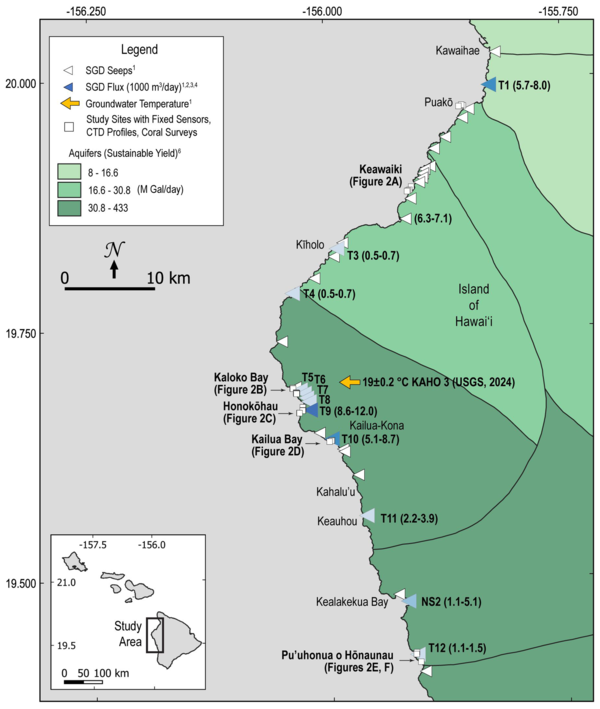
Researchers from USGS, in partnership with the National Park Service, University of Hawaii, University of California at Berkeley, Stanford University, NOAA, Hawaiʻi Department of Aquatic Resources, The Kohala Center, and several west Hawaiʻi Island families, measured nearshore water temperatures and coral health metrics for three years along the western shoreline of the Island of Hawai’i. They found that groundwater seeps create localized areas of cooler water, with temperatures ranging between 1-5 degrees C cooler than offshore and deeper marine waters. Areas of cool-water refugia experienced less bleaching, improved coral health indicators, and higher coral recovery following extensive bleaching from extreme marine heat waves.
The findings suggest that improved management to reduce contamination of groundwater from human activities, like excess nutrient runoff, would further help coral reefs and associated wildlife cope with growing stressors including rising sea surface temperatures.
"By integrating long-term thermal datasets, spatial surveys, and benthic assessments, this research provides the strongest evidence to date of how hydrogeologic processes bolster coral resilience," said USGS Research Oceanographer Ferdinand Oberle, co-author of the study. "It reframes submarine groundwater discharge from a subtle background influence to a critical ecological driver of reef survival under accelerating climate stress. The study also underscores the importance of coastal aquifer management as a reef-protection strategy."
USGS Research Geologist Eric Grossman, lead author of the study, added, "Improved groundwater management is important for people in arid regions like west Hawaii that rely on groundwater for municipal supplies and that are facing a statewide drought, projections of more intense drought and salinity intrusion by sea level rise in the future, and growing pressures associated with urban development."
Read the study, Submarine groundwater discharge creates cold‐water refugia that can mitigate exposure of heat stress in nearshore corals, in Frontiers in Marine Science.
Related

Nutrient Loading and Coral Health at Ofu, American Samoa

Coral Reef Project
Related
Nutrient Loading and Coral Health at Ofu, American Samoa