



Contaminant Transport and Effects
Contaminant Transport and Effects
Filter Total Items: 98

Groundwater Discharge is a Pathway for Phytoestrogen and Herbicide Entry to Streams in the Chesapeake Bay Watershed
Groundwater discharge zones are important spawning areas for fish because they provide a thermally stable habitat. Research at three streams in the Chesapeake Bay Watershed with areas of focused groundwater discharge revealed that groundwater also is a source of phytoestrogens and herbicides that could result in fish exposure during sensitive life stages.

Assessment of Mercury and Selenium Accumulation in Upper Colorado River Basin Fish
More than 50 years of existing mercury and selenium concentrations in native and nonnative fish species residing in streams within the Upper Colorado River Basin were compiled and analyzed to provide an understanding of concentrations among different species, sampling years, and locations to determine potential health risks. Concentrations of mercury and selenium were above health benchmarks in 13...

Ecotoxicology and Ecological Risks of Per‐ and Polyfluoroalkyl Substances
Ecotoxicology and ecological risks of per- and polyfluoroalkyl substances are summarized to highlight critical gaps and uncertainties, and to provide potential approaches to fill those gaps, including the development of targeted monitoring programs and cross-disciplinary approaches.

Advanced PFAS Measurement Methods
Environmental Health Program scientists, in collaboration with other USGS scientists, are developing complementary field and laboratory methods and capabilities to detect and quantify a range of target and nontarget per- and polyfluoroalkyl substances (PFAS) and indicator compounds at low levels (parts per trillion) in a variety of environmental matrices. The PFAS Integrated Science Team is...

Bioaccumulation of Mercury in Fish Varied by Species and Location in the Chesapeake Bay Watershed—Summary of Existing Data and a Roadmap for Integrated Monitoring
Fish mercury data from State monitoring programs and research studies within the Chesapeake Bay were compiled and summarized to provide a comprehensive overview of the variation in fish mercury concentrations among species and habitats within the watershed. These data are put into context with existing health benchmarks for humans, birds, and fish. Scientists also provide a roadmap for an...

Flood Redistributes Mercury in Grand Canyon Aquatic Food Webs
S cientists coupled the concepts of energy flow through food webs with measurements of mercury in organic matter and animals to estimate mercury fluxes and fate during an experimental flood in the Colorado River. The flood redistributed mercury in simple, upstream food webs but not in more complex, downstream food webs.

Science to Understand Low-Level Exposures to Neonicotinoid Pesticides, their Metabolites, and Chlorinated Byproducts in Drinking Water
Scientists reported the discovery of three neonicotinoid pesticides in drinking water and their potential for transformation and removal during water treatment. The research provides new insights into the persistence of neonicotinoids and their potential for transformation during water treatment and distribution, while also identifying granulated activated carbon as a potentially effective...
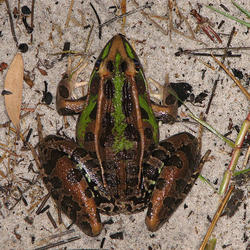
Clothianidin Exposure Associated with Changes in Tadpole Behavior
During a laboratory exposure study, tadpole movement decreased with increased concentrations of clothianidin, a neonicotinoid pesticide. Decreased movement could affect a tadpole’s ability to forage, escape predation, and metamorphose before ponds dry.

Technique Used to Distinguish Natural Background from Human-Caused Enrichment of Trace Elements in Soils
Human activities can enrich toxic trace elements like uranium and arsenic in the environment, but these elements also are from natural sources and occur at background levels. Scientists utilized a technique that identifies the background and the elemental fingerprint of human-caused enrichment and tested the new technique on data collected near uranium mines in Arizona.

U.S. Geological Survey Research Scientist Recognized for Advancing Exposure Science
U.S. Geological Survey (USGS) Scientist Dana Kolpin was presented the International Environmental Award by Reciphram celebrating his research on the occurrence, sources, fate, and effects of environmental contaminants such as pharmaceuticals and pesticides.

Dragonfly Larvae are Effective Bioindicators of Mercury Exposure in Fish and Amphibians—Results of Citizen Science in 100 National Parks and Protected Places
Mercury concentrations were measured in dragonfly larvae across more than 450 sites in 100 national parks and protected places as part of a partnership among Federal agencies, academic researchers, and more than 4,000 citizen scientists. Mercury concentrations in dragonfly larvae were positively correlated with mercury concentrations in fish and amphibians living in the same aquatic environments...

Framework for Examining Stream Ecosystem Health in Areas of Shale Gas Development—A Multi-Parameter Watershed-Based Case Study in Pennsylvania
In a case study of 25 headwater streams in Pennsylvania, no statistically significant associations were determined between shale gas development and geochemical tracers of produced waters or measures of microbial and macroinvertebrate community composition. Although the results are specific to the region studied, the integrated biological and geochemical framework provides a tool for examining...