



Contaminant Transport and Effects
Contaminant Transport and Effects
Filter Total Items: 98

Photomicroscopy and Flow Cytometry Core Technology Team
About the Research The Photomicroscopy and Flow Cytometry Core Technology Team (CTT) as part of the Environmental Health Program works to develop and apply biomarkers to evaluate the potential impacts of environmental contaminants at cellular and molecular levels. Because molecular and biochemical responses of cells are preceded by chemical changes in nuclei, cytoplasm, membranes, and...

Functional and Molecular Bioassay Core Technology Team
About the Research The Functional and Molecular Bioassay Core Technology Team (CTT) as part of the Environmental Health Program utilizes reporter assays, quantitative gene expression analyses, and high-throughput sequencing methods to produce functional endpoints across a broad scope of environmental topics and sample matrices.

Spatiotemporal conditions of vegetation and invasive plant species on mine lands.
To support the Department of Interior's bureaus, states, and local communities, we are developing 1) a document highlighting remote sensing approaches that can be leveraged for site prioritization, recovery design, and long-term assessments of recovery trends, and 2) data products of vegetation conditions, change, recovery potential, and risk of exotic plant invasion on mine lands. We will...

Drinking Water and Wastewater Infrastructure Science Team
The team studies toxicants and pathogens in water resources from their sources, through watersheds, aquifers, and infrastructure to human and wildlife exposures. That information is used to develop decision tools that protect human and wildlife health.

Per-and Polyfluoroalkyl Substances (PFAS) Integrated Science Team
Increasing scientific and public awareness of the widespread distribution of per- and poly-fluoroalkyl substances (PFAS) in U.S. drinking-water supplies, aquatic and terrestrial ecosystems, wildlife, and humans has raised many public health and resource management questions that U.S. Geological Survey's (USGS) science can inform. The USGS Environmental Health Program's PFAS Integrated Science Team...

Pesticides Detected in Bees, Flowers, Soil, and Air within Pollinator-Attractive Row-Crop Border Plantings
Field study in California describes the potential for pollinator-attractive field borders in agricultural areas to become a pesticide exposure pathway to bees through soil, air, and plants.

PFAS Transport, Exposure, and Effects
The team is determining the movement and behavior of per- and poly-fluoroalkyl substances (PFAS) from their sources in the environment, as they move through exposure pathways in ecosystems including watersheds and aquifers, their incorporation into food webs, and molecular to population scale effects on fish and wildlife. These studies are accomplished at a variety of spatial scales from regional...

U.S. Geological Survey Per- and Polyfluoroalkyl Substances Science Strategy Identifies Science Gaps and Opportunities
USGS recently (2022) released a strategic vision document that identifies science gaps and opportunities for per- and polyfluoroalkyl substances (PFAS) monitoring, assessment, and research activities (sampling protocols and analytical methods, environmental sources and source apportionment, environmental occurrence, environmental fate and transport, human and wildlife exposure routes...

Study Provides a Data Resource for Per- and Polyfluoroalkyl Substances in Streams Within Iowa Agricultural Watersheds
Per- and poly fl uoroalkyl substances (PFAS) were detected in streams within agricultural areas (an often-unmeasured landscape) across Iowa. The data from this study provide one resource to understand the extent of PFAS concentrations in water resources from diverse landscapes throughout the United States.
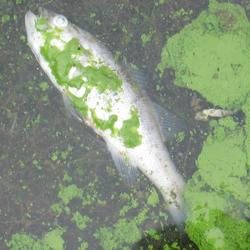
Toxins and Harmful Algal Blooms Science Team
The team develops advanced methods to study factors driving algal toxin production, how and where wildlife or humans are exposed to toxins, and ecotoxicology. That information is used to develop decision tools to understand if toxin exposure leads to adverse health effects in order to protect human and wildlife health.

Large Fraction of Unidentified Organofluorine in a Coastal Watershed has Implications for River to Marine Ecosystems
A group of scientists investigated per- and polyfluoroalkyl substances (PFAS) in watersheds on Cape Cod and identified a unique signature for aqueous film forming foams (AFFF) from legacy firefighting and fire training. A combination of statistical modeling and laboratory measurements indicates that unidentified organofluorine constitutes a large fraction of PFAS in the river systems that...

Ecologically-Driven Exposure Pathways Science Team
The Ecologically-Driven Exposure Pathways Integrated Science Team identifies how ecological pathways and physiological processes within a single organism can alter exposure and toxicity of contaminants and pathogens and seek to understand outcomes at different scales from individuals to populations and ecosystems.