



Health Risks
Health Risks
Filter Total Items: 74

Satellite Tracking of Birds in Alaska Points to Distant Sources of Lead and Mercury Exposure
U.S. Geological Survey (USGS) scientists measured lead in blood from tundra swans that nest in Alaska and then followed the migration of these birds using satellite telemetry. Levels of lead in blood were higher in adults than young swans,suggesting exposure to lead occurs on wintering areas and/or during migration, rather than on the summer breeding grounds in Alaska. The lowest blood levels were...

Metals in Acid Mine Drainage Affect Aquatic Insects
Studies conducted in subalpine streams in Colorado by U.S. Geological Survey (USGS) scientists found that aqueous metals resulting from acid mine drainage and natural weathering can almost eliminate adult insect emergence from streams, even at metal levels too low to reduce aquatic larval densities. This pattern suggests that adult insects might be a more sensitive indicator of metals than...

Toxins Produced by Molds Measured in U.S. Streams
A team of scientists from the U.S. Geological Survey (USGS) and the Agroscope Reckenholz-Tanikon Research Station, Switzerland, found that some mycotoxins are common in U. S. stream waters. Mycotoxins are toxic compounds produced by molds (fungi) that can cause disease and even death in humans and animals. Mycotoxins can grow on a wide variety of crops.

Complex Response to Decline in Atmospheric Deposition of Mercury
U.S. Geological Survey (USGS) scientists found that mercury concentrations in shallow waters and methylmercury (MeHg) concentrations in fish in four lakes in Voyageurs National Park, Minnesota, were not consistent with decreases in the wet atmospheric deposition of mercury recorded at nearby monitoring stations for over a decade. Methylmercury is a toxic form of mercury (Hg) that accumulates and...

Common Weed Killer is Widespread in the Environment
U.S. Geological Survey (USGS) scientists report that glyphosate, known commercially by many trade names, and its degradation product AMPA (aminomethylphosphonic acid) are transported off-site from agricultural and urban sources and occur widely in the environment. This study is the largest and most comprehensive assessment of the environmental occurrence of glyphosate and AMPA in the United States...

Biological Activity of Steroid Hormones in U.S. Streams
Testing of U.S. streams has detected glucocorticoid and androgen biological activity. In a collaborative study between the National Cancer Institute (NCI), Laboratory of Receptor Biology and Gene Expression, the U.S. Geological Survey (USGS), and others, scientists studied the potential for the biological activity in streams of glucocorticoids and androgens hormones—both potential endocrine...

Contaminants Affect Fish and Wildlife in the Chesapeake Bay
“Legacy contaminants” and “contaminants of emerging concern” that persist in the environment are affecting the health of fish and wildlife in the Chesapeake Bay and its watershed. State continue to report impaired water resources due to the persistence and toxicity of some previously banned pollutants. In addition, other contaminants of emerging concern are released to the environment at levels...

Chemical Combo and Intersex Fish Found at Smallmouth Bass Nesting Sites
Chemical contaminants including herbicides, veterinary pharmaceuticals, and biogenic hormones have been detected at fish nesting sites in the Potomac River watershed where endocrine disruption in smallmouth bass ( Micropterus dolomieu) was also observed. Although these contaminants are known to originate from a variety of human and animal-waste sources, results of a recent U.S. Geological Survey (...

Complex Mixture of Contaminants Persists in Streams Miles from the Source
Natural processes in stream ecosystems such as dilution and microbial degradation are known to attenuate some contaminants to below levels that can cause harm to ecosystems. However, a team of U.S. Geological Survey (USGS) scientists has shown that many chemicals discharged from municipal wastewater treatment facilities persist for miles downstream at levels known, or suspected, to cause adverse...

Hormones in Land-Applied Biosolids Could Affect Aquatic Organisms
Hormones from biosolids applied to fields may be present in rainfall runoff at concentrations that are high enough to impact the health of aquatic organisms if the runoff reaches streams, report scientists from the U.S. Geological Survey (USGS) and Colorado State University in Environmental Science and Technology. Artificial rainfall runoff from agricultural test plots where biosolids were applied...

USGS Publishes its First Environmental Health Science Strategy
The new U.S. Geological Survey (USGS) Environmental Health Science Strategy is one of seven recently released science strategies that span the portfolio of USGS science. Climate and Land Use Change Core Science Systems Ecosystems Energy and Mineral Resources Environmental Health Natural Hazards Water
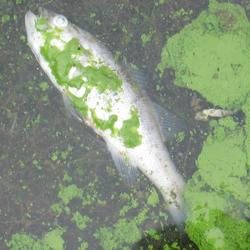
Algal Blooms Consistently Produce Complex Mixtures of Cyanotoxins and Co-Occur with Taste-and-Odor Causing Compounds in 23 Midwestern Lakes
U.S. Geological Survey (USGS) scientists studying the effects of harmful algal blooms on lake water quality found that blooms of blue-green algae (cyanobacteria) in Midwestern lakes produced mixtures of cyanotoxins and taste-and-odor causing compounds, which co-occurred in lake water samples. Cyanotoxins can cause allergic and/or respiratory issues, attack the liver and kidneys, or affect the...