



Sunset looking west down the valley of the Riviere Momance in southwest Haiti. Peacefulness of the sunset contrasts with the widespread destruction and fatalities caused by the January 2010 earthquake.
Images
Earthquake Hazards Program images.
Filter Total Items: 574

Haitian Sunset
Sunset looking west down the valley of the Riviere Momance in southwest Haiti. Peacefulness of the sunset contrasts with the widespread destruction and fatalities caused by the January 2010 earthquake.

Serene Among the Chaos
Serene scene of Haitian Fishermen at sunrise belies the nearby chaos and destruction caused by the January 2010 earthquake.
Serene scene of Haitian Fishermen at sunrise belies the nearby chaos and destruction caused by the January 2010 earthquake.

Surviving the Haiti Earthquake
Haitian woman carrying supplies amid the destruction from the January 2010 Haiti earthquake.
Haitian woman carrying supplies amid the destruction from the January 2010 Haiti earthquake.

NetQuakes Instrument in Place
NetQuakes strong-motion instruments enable seismologists to collect extensive data in urban areas where installing traditional seismographs is not practical. This instrument (in blue, to the right of the upended chairs) takes up very little space in a San Francisco Bay Area resident's garage.
NetQuakes strong-motion instruments enable seismologists to collect extensive data in urban areas where installing traditional seismographs is not practical. This instrument (in blue, to the right of the upended chairs) takes up very little space in a San Francisco Bay Area resident's garage.

Earthquake Drill in Japan
Children participating in an earthquake drill on April 23, 2009, at the British School in Tokyo, Showa Campus. The drill is based on the Japanese Earthquake Early Warning System.
Children participating in an earthquake drill on April 23, 2009, at the British School in Tokyo, Showa Campus. The drill is based on the Japanese Earthquake Early Warning System.

Earthquake Drill in Japan
Children participating in an earthquake drill on April 23, 2009, at the British School in Tokyo, Showa Campus. The drill is based on the Japanese Earthquake Early Warning System.
Children participating in an earthquake drill on April 23, 2009, at the British School in Tokyo, Showa Campus. The drill is based on the Japanese Earthquake Early Warning System.

Secretary Salazar Speaking on Recovery Funds for Earthquake Networks
Secretary Salazar Speaking on Recovery Funds for Earthquake NetworksSecretary of the Interior Ken Salazar announced the U.S. Geological Survey will fund \$29.4 million in earthquake network upgrades nationwide through the American Recovery and Reinvestment Act of 2009.
Secretary Salazar Speaking on Recovery Funds for Earthquake Networks
Secretary Salazar Speaking on Recovery Funds for Earthquake NetworksSecretary of the Interior Ken Salazar announced the U.S. Geological Survey will fund \$29.4 million in earthquake network upgrades nationwide through the American Recovery and Reinvestment Act of 2009.

Lidar shaded relief map of the Hayward Fault and UC Berkeley stadium
Lidar shaded relief map of the Hayward Fault and UC Berkeley stadiumA filtered vertical laser image, taken using a technique called light detection and ranging (LIDAR), of part of the Hayward Fault (red lines) in the City of Berkeley. The fault passes through the University of California Berkeley football stadium (left), and past earthquake movements have significantly offset Hamilton Gulch (center).
Lidar shaded relief map of the Hayward Fault and UC Berkeley stadium
Lidar shaded relief map of the Hayward Fault and UC Berkeley stadiumA filtered vertical laser image, taken using a technique called light detection and ranging (LIDAR), of part of the Hayward Fault (red lines) in the City of Berkeley. The fault passes through the University of California Berkeley football stadium (left), and past earthquake movements have significantly offset Hamilton Gulch (center).

ShakeMaps for the 1868 Hayward Quake and the 1989 Loma Prieta Quake
ShakeMaps for the 1868 Hayward Quake and the 1989 Loma Prieta QuakeShakeMap showing the inferred intensity of ground shaking in the 1868 earthquake (measured as MMI, or Modified Mercalli Intensity), compared to a ShakeMap for the 1989 magnitude 6.9 Loma Prieta earthquake.
ShakeMaps for the 1868 Hayward Quake and the 1989 Loma Prieta Quake
ShakeMaps for the 1868 Hayward Quake and the 1989 Loma Prieta QuakeShakeMap showing the inferred intensity of ground shaking in the 1868 earthquake (measured as MMI, or Modified Mercalli Intensity), compared to a ShakeMap for the 1989 magnitude 6.9 Loma Prieta earthquake.
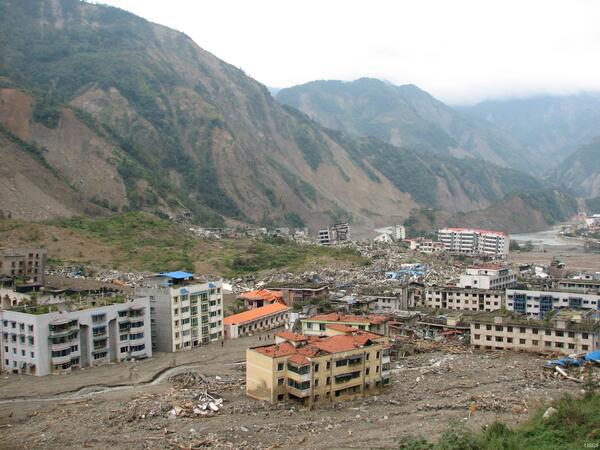
Damage from 2008 Great Sichuan Earthquake in China
Damage from 2008 Great Sichuan Earthquake in ChinaThe May 12, 2008, Great Sichuan Earthquake, also called the Wenchuan Earthquake, occurred at 14:28 local time, in Sichuan Province, China. The earthquake magnitudes were Mw = 7.9 (USGS), Ms = 8.0 (Chinese Earthquake Administration). The epicenter was 80 km west-northwest of Chengdu, the capital city of Sichuan province.
Damage from 2008 Great Sichuan Earthquake in China
Damage from 2008 Great Sichuan Earthquake in ChinaThe May 12, 2008, Great Sichuan Earthquake, also called the Wenchuan Earthquake, occurred at 14:28 local time, in Sichuan Province, China. The earthquake magnitudes were Mw = 7.9 (USGS), Ms = 8.0 (Chinese Earthquake Administration). The epicenter was 80 km west-northwest of Chengdu, the capital city of Sichuan province.

Jiangyou to Jianxin
Emergency tents have been set up along a roadway that connects Jiangyou and Jianxin.
Emergency tents have been set up along a roadway that connects Jiangyou and Jianxin.

Jiangyou to Jianxin
The emergency tents given to the Chinese after the 12 May 2008 earthquake serve as living spaces for those who cannot stay in their homes.
The emergency tents given to the Chinese after the 12 May 2008 earthquake serve as living spaces for those who cannot stay in their homes.

Jianxin
An elderly Jianxin woman in her emergency shelter.
An elderly Jianxin woman in her emergency shelter.

Jianxin
A Jianxin shrine damaged in the 12 May 2008 earthquake.
A Jianxin shrine damaged in the 12 May 2008 earthquake.

Jiangyou
Citizens of Jiangyou set up their emergency tents inside a concrete structure after the 12 May 2008 earthquake.
Citizens of Jiangyou set up their emergency tents inside a concrete structure after the 12 May 2008 earthquake.

Jianxin
The citizens of Jianxin have already started reconstruction after the 12 May 2008 earthquake.
The citizens of Jianxin have already started reconstruction after the 12 May 2008 earthquake.

Sichuan Mountains
The 12 May 2008 earthquake was strong enough to pull apart this road in China.
The 12 May 2008 earthquake was strong enough to pull apart this road in China.

Malu
Japan helped the Chinese in the wake of the 12 May 2008 earthquake.
Japan helped the Chinese in the wake of the 12 May 2008 earthquake.

Zhuyuan
Emergency tents off the side of a road in Zhuyuan were erected after the 12 May 2008 earthquake.
Emergency tents off the side of a road in Zhuyuan were erected after the 12 May 2008 earthquake.

Guanzhang
The 12 May 2008 earthquake in China was strong enough to destroy this building in Guanzhang.
The 12 May 2008 earthquake in China was strong enough to destroy this building in Guanzhang.

Malu to Guanzhang
The 12 May 2008 earthquake in China caused many rockslides, like this one along the road from Malu to Guanzhang.
The 12 May 2008 earthquake in China caused many rockslides, like this one along the road from Malu to Guanzhang.