



Environmental Toxicology
Environmental Toxicology
Filter Total Items: 93

Antibiotics in Groundwater Affect Natural Bacteria
U.S. Geological Survey (USGS) scientists have documented adverse health effects on populations of native soil bacteria exposed to levels of the antibiotic (SMX) below those used to treat diseases (subtherapeutic). Because SMX has been found in environmental waters by many previous studies, the scientists conducted laboratory exposure experiments to determine the effect of SMX on native bacteria...

Endocrine Disrupting Chemicals in the Slick Scum that Covers Stones in Streams
The slick scum or biofilm that covers most rocks in streams can accumulate contaminants that disrupt reproductive and other endocrine systems in fish. This is the finding of a team of U.S. Geological Survey (USGS) and University of Colorado Boulder scientists as described in a recent article in Environmental Science and Technology ( Writer and others, 2011). Biofilms are a mixture of algae...

Evidence of Endocrine Disruption Unexpectedly Found in Minnesota Lakes
Endocrine disrupting chemicals and indicators of endocrine disruption were found in several Minnesota lakes with surrounding urban, residential, agricultural, and forested land uses. The lakes do not directly receive discharges from industries or wastewater-treatment plants; however, they are used for recreation, and they receive water from widely scattered sources. The presence of both male and...

Estrogenic Contaminants from Plants and Fungi Found in Iowa Streams
An international group of scientists from the U.S. Geological Survey (USGS) and Agroscope Reckenholz-Tänikon, Research Station ART (Switzerland) have documented the common occurrence of six phytoestrogens and two mycotoxins in streams across Iowa. Phytoestrogens (derived from plants) and mycotoxins (derived from fungi) are naturally occurring compounds. Scientists have known that phytoestrogens...

Mixtures of Pesticides Detected in Crab Embryos
Crab embryos from two Northern California salt marshes accumulate mixtures of currently used as well as discontinued pesticides, according to a study published by U.S. Geological Survey (USGS) and University of California scientists in the journal Environmental Toxicology and Chemistry.

Understudied Fungicides Common in U.S. Streams Draining Agricultural Land
U.S. Geological Survey (USGS) scientists have detected one or more fungicides in 20 of 29 streams across the United States that were sampled during 2005 and 2006 in areas where soybeans are grown. The number of fungicides used has increased significantly since 2002, and very little is known about their occurrence in the environment. For some of the fungicides this is the first data documenting...
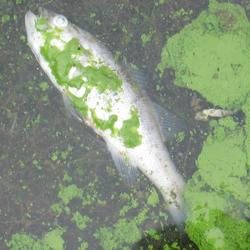
Algal Blooms Consistently Produce Complex Mixtures of Cyanotoxins and Co-Occur with Taste-and-Odor Causing Compounds in 23 Midwestern Lakes
U.S. Geological Survey (USGS) scientists studying the effects of harmful algal blooms on lake water quality found that blooms of blue-green algae (cyanobacteria) in Midwestern lakes produced mixtures of cyanotoxins and taste-and-odor causing compounds, which co-occurred in lake water samples. Cyanotoxins can cause allergic and/or respiratory issues, attack the liver and kidneys, or affect the...

Hormones Degrade in the Environment!
In two separate studies, U.S. Geological Survey (USGS) scientists demonstrated that hormones such as estrogen can biodegrade in stream and groundwater environments. This is an important finding because the science, regulatory, and environmental communities have concerns about the environmental fate of endocrine-disrupting chemicals, such as hormones, in the human wastewaters discharged to the...

Antidepressants in Stream Waters! Are They in the Fish Too?
For some fish living downstream of sewage treatment plants the answer is yes. U.S. Geological Survey (USGS) scientists and their colleagues published a paper in Environmental Science and Technology documenting that specific antidepressants and their degradates found in wastewater discharged into streams by municipal wastewater treatment plants are taken up into the bodies of fish living downstream...

Manufacturing Facilities Release Pharmaceuticals to the Environment
In a 2004-2009 study, U.S. Geological Survey (USGS) scientists found that pharmaceutical manufacturing facilities can be a significant source of pharmaceuticals to the environment. Effluents from two wastewater treatment plants (WWTPs) that receive discharge from pharmaceutical manufacturing facilities (PMFs) had 10 to 1000 times higher concentrations of pharmaceuticals than effluents from 24...

Tackling Fish Endocrine Disruption
Intersex, the presence of both male and female characteristics within the same fish, is being observed in fish in more streams across the Nation. Intersex is one manifestation of endocrine disruption in fish. Endocrine disruption can result in adverse effects on the development of the brain and nervous system, the growth and function of the reproductive system, and the response to stressors in the...

Measuring Antidepressants, Fungicides, and Insecticides in the Environment
U.S. Geological Survey (USGS) scientists are developing new laboratory analytical methods to measure contaminants in samples of environmental water, sediment, and soil. The work is part of a continuing effort to provide information on new and understudied contaminants to water-resource managers, environmental regulators, and the public. The new methods are used by USGS scientists and others to...