



FAQs
This webpage contains a list of selected USGS frequently asked questions (FAQs) and short answers to those questions for topics likely to be of interest in the USGS Region 7: Upper Colorado River Basin area. Left-click on the titles or images below to see answers to these FAQs. Please contact us if you have additional questions.

How are bats affected by wind turbines? How are bats affected by wind turbines?
Dead bats are found beneath wind turbines all over the world. It’s estimated that tens to hundreds of thousands die at wind turbines each year in North America alone. Unfortunately, it’s not yet clear why this is happening. It’s possible that wind turbines interfere with seasonal migration and mating patterns in some species of bats. More than three-quarters of the bat fatalities at wind turbines...
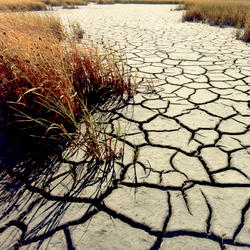
What causes drought? What causes drought?
A drought is a period of drier-than-normal conditions that results in water-related problems. The amount of precipitation at a particular location varies from year to year, but over a period of years the average amount is fairly constant. In the deserts of the Southwest, the average precipitation is less than 3 inches per year. In contrast, the average precipitation in the Northwest is more than...

We had a "100-year flood" two years in a row. How can that be? We had a "100-year flood" two years in a row. How can that be?
The term "100-year flood" is used to describe the recurrence interval of floods. The 100-year recurrence interval means that a flood of that magnitude has a one percent chance of occurring in any given year. In other words, the chances that a river will flow as high as the 100-year flood stage this year is 1 in 100. Statistically, each year begins with the same 1-percent chance that a 100-year...

Why are bats important? Why are bats important?
By eating insects, bats save U.S. agriculture billions of dollars per year in pest control. Some studies have estimated that service to be worth over 3.7 billion dollars per year, and possibly as much as 53 billion dollars per year. This value does not, however, take into account the volume of insects eaten by bats in forest ecosystems and the degree to which that benefits industries like lumber...

Does an increase in the 100-year flood estimate originate from climate or land-use change? Does an increase in the 100-year flood estimate originate from climate or land-use change?
Climate variability (dry cycles to wet cycles) and land-use change play a significant role, but there is a large amount of uncertainty around the flood quantile estimates (the value of discharge corresponding to the 100-year flood), particularly if there isn’t a long record of observed data at a stream location. Learn more: The 100-Year Flood The 100-Year Flood--It's All About Chance

What is a 1,000-year flood? What is a 1,000-year flood?
The term “1,000-year flood” means that, statistically speaking, a flood of that magnitude (or greater) has a 1 in 1,000 chance of occurring in any given year. In terms of probability, the 1,000-year flood has a 0.1% chance of happening in any given year. These statistical values are based on observed data.

What is groundwater? What is groundwater?
Groundwater is water that can be found under the Earth’s surface, in the ground. Some people think groundwater is like a large lake or river underground, but that isn’t the case. Groundwater is more like the liquid trapped in a sponge, or the liquid in a glass of ice water. When permeable layers of rock, sand, or gravel store and transmit enough groundwater to provide usable quantities to wells...

What is an invasive species and why are they a problem? What is an invasive species and why are they a problem?
An invasive species is an introduced, nonnative organism (disease, parasite, plant, or animal) that begins to spread or expand its range from the site of its original introduction and that has the potential to cause harm to the environment, the economy, or to human health. A few well-known examples include the unintentional introduction of the West Nile virus, chestnut blight, the South American...

How important is groundwater? How important is groundwater?
Groundwater, which is in aquifers below the surface of the Earth, is one of the Nation's most important natural resources. Groundwater is the source of about 37 percent of the water that county and city water departments supply to households and businesses (public supply). It provides drinking water for more than 90 percent of the rural population who do not get their water delivered to them from...

If the ground filters water, is groundwater always clean? If the ground filters water, is groundwater always clean?
Water drawn from a well was once precipitation that fell onto Earth's surface. It seeped into the ground and, over time, occupied the porous space in some subsurface material. Big particles that are in surface streams, such as leaf chunks, will not be seen in groundwater. So, yes, big particles are filtered out by the ground, along with some minerals and chemicals that are too small to see...

What are metamorphic rocks? What are metamorphic rocks?
Metamorphic rocks started out as some other type of rock, but have been substantially changed from their original igneous, sedimentary, or earlier metamorphic form. Metamorphic rocks form when rocks are subjected to high heat, high pressure, hot mineral-rich fluids or, more commonly, some combination of these factors. Conditions like these are found deep within the Earth or where tectonic plates...

How can I find the depth to the water table in a specific location? How can I find the depth to the water table in a specific location?
The depth to the water table can change (rise or fall) depending on the time of year. During the late winter and spring when accumulated snow starts to melt and spring rainfall is plentiful, water on the surface infiltrates into the ground and the water table rises. When water-loving plants start to grow again in the spring and precipitation gives way to hot, dry summers, the water table falls...