
Carolyn Ruppel, PhD
Carolyn is an emerita ST Research Geophysicist who led the USGS Gas Hydrates Project from 2010 to early 2025. Gas Hydrate scientists in Woods Hole and Denver study the resource and environmental aspects of natural hydrates. Carolyn studies marine methane seeps, the interaction of hydrates with the ocean-atmosphere system, subsea permafrost, hydrate reservoir dynamics, and marine thermal regimes.
Research
Highlighted Journal Articles, Data Releases, and Geonarratives
- Gas Hydrate in Nature
- Hydrate formation on marine seep bubbles and the implications for water column…
- Categorizing active marine acoustic sources based on their potential to affect …
- Elevated levels of radiocarbon in methane dissolved in seawater reveal likely l…
- Preliminary global database of known and inferred gas hydrate locations
- Methane seeps on the U.S. Atlantic margin: An updated inventory and interpretat…
My primary research focus is on the interaction between methane hydrates (and methane seeps) on one hand and the ocean-atmosphere system on the other. I focus particularly on the US marine margins, especially the Atlantic, Gulf of Mexico, and Arctic (Beaufort) margins. I also work on energy issues related to gas hydrates (including delineating their distribution in marine sediments; e.g., the 2018 MATRIX seismic program on US Atlantic margin), the coexistence of permafrost (including subsea) and hydrates (Beaufort Sea), and reservoir properties of hydrate-bearing sediments. As a side specialty, I assist with programmatic environmental compliance for USGS marine acoustics surveys. I have served at least part-time in a senior advisory capacity in the USGS Chief Scientist's Office since mid-2022. During my career, I have also worked on marine heat flow data acquisition and analysis, other aspects of the hydrogeology of gas hydrate systems, and coastal zone hydrogeophysics (particularly tidal pumping, inductive EM data, and saline intrusion in surficial aquifers). My earliest work focused on numerical modeling of large scale tectonic processes and associated particle tracking, continental rifting, and marine analogs for continental tectonic processes.
Professional Experience
March 2025, Emerita ST scientist
January 2025 (temporary detail), Acting Chief Scientist, U.S. Geological Survey
November 2024, ST-rank Research Geophysicist, U.S. Geological Survey
Feb 2023 - March 2025: Part-Time Acting Senior Science Advisor to the USGS Chief Scientist
July 2022 - Feb 2023: Acting Senior Science Advisor to the USGS Chief Scientist (detail)
2010-present: Chief, USGS Gas Hydrates Project
2006-2023: Research Geophysicist, U.S. Geological Survey
2006-2019: Visiting Scientist, MIT, Dept. of Earth, Atmospheric & Planetary Sciences
2003-2006: Program manager (faculty rotater), National Science Foundation, Ocean Sciences (MG&G and Ocean Drilling Program)
2000-2002: Coordinator, Georgia Tech Focused Research Program on Methane Hydrates
2000-2006: Associate Professor (tenured) of Geophysics, Georgia Tech
1994-2000: Assistant Professor of Geophysics, Georgia Tech
1992-1993: Postdoctoral Scholar and Postdoctoral Research, Woods Hole Oceanographic Institution
Education and Certifications
Massachusetts Institute of Technology, Ph.D., 1992, Geophysics and Geology (with Marcia McNutt)
Massachusetts Institute of Technology, M.S., 1986, Earth sciences (with Leigh Royden and Kip Hodges)
Affiliations and Memberships*
Panel member, National Academy of Sciences, Community on Ocean Acoustics Education and Expertise (study completion in 2024)
Member, Science Advisory Board, University of Tromso, Centre of Excellence for Ice, Cryosphere, Carbon and Climate, 2023-
Member, Arctic Icebreaker Coordinating Committee (UNOLS), 2015-2020
Chief Scientist, 8 research cruises (3 Arctic), 2010-2019
Member, Advisory Board, University of Tromso, Centre of Excellence for Arctic Gas Hydrate, Environment and Climate (CAGE) 2014-present
Strategic Plan Committee, Coastal & Marine Geology Program, USGS, 2014-2019
Arctic subgroup (appointed CMGP representative), Subcommittee on Ocean Science and Technology (SOST), OSTP, 2015-16
Mentor, Graduate Women at MIT (GWAMIT), 2013-2016
USGS Technical lead, NSF-USGS Programmatic Environmental Impact Statement for Marine Seismics, 2008-2012
Lead organizer, Catching climate change in progress, circum-Arctic Ocean drilling workshop, December 2011 (sponsored by US Science Support Program for IODP)
Lead proponent, IODP Pre-Proposal 797, Late Pleistocene to contemporary climate change on the Alaskan Beaufort Margin (ABM)
Organizer and convener, USGS-DOE Climate-Hydrates workshop, Boston, MA, March 2011
Originator and Chair, Gordon Research Conference on Natural Gas Hydrates, inaugural conference held June 2010.
Interagency Technical Coordinating Committee, DOE Methane Hydrates R&D Program, 2010-present
The Future of Natural Gas, MIT Energy Initiative, affiliated author (methane hydrates), 2008-2011
National Research Council, Scientific Ocean Drilling (SOD) review, presentation on Gas Hydrates and SOD, 2010
IODP Operations Task Force, 2008-2009
IODP Science Planning Committee (SPC), 2006-2009
Organizer, DOE-USGS Symposium/Meeting on Gas Hydrates and Climate Change (held at MIT), February 2008
Honors and Awards
Distinguished Served Award, U.S. Department of Interior, 2024
National Science Foundation, Director's Award for Program Management, 2005 (Chixulub seismic program)
JOI/USSAC Distinguished Lecturer, Ocean Drilling Program, 1999-2000
Science and Products
IMMeRSS-- Interagency Mission for Methane Research on Seafloor Seeps
Gas Hydrates- Atlantic Margin Methane Seeps
Environmental Compliance
Gas Hydrates-Environment Interactions
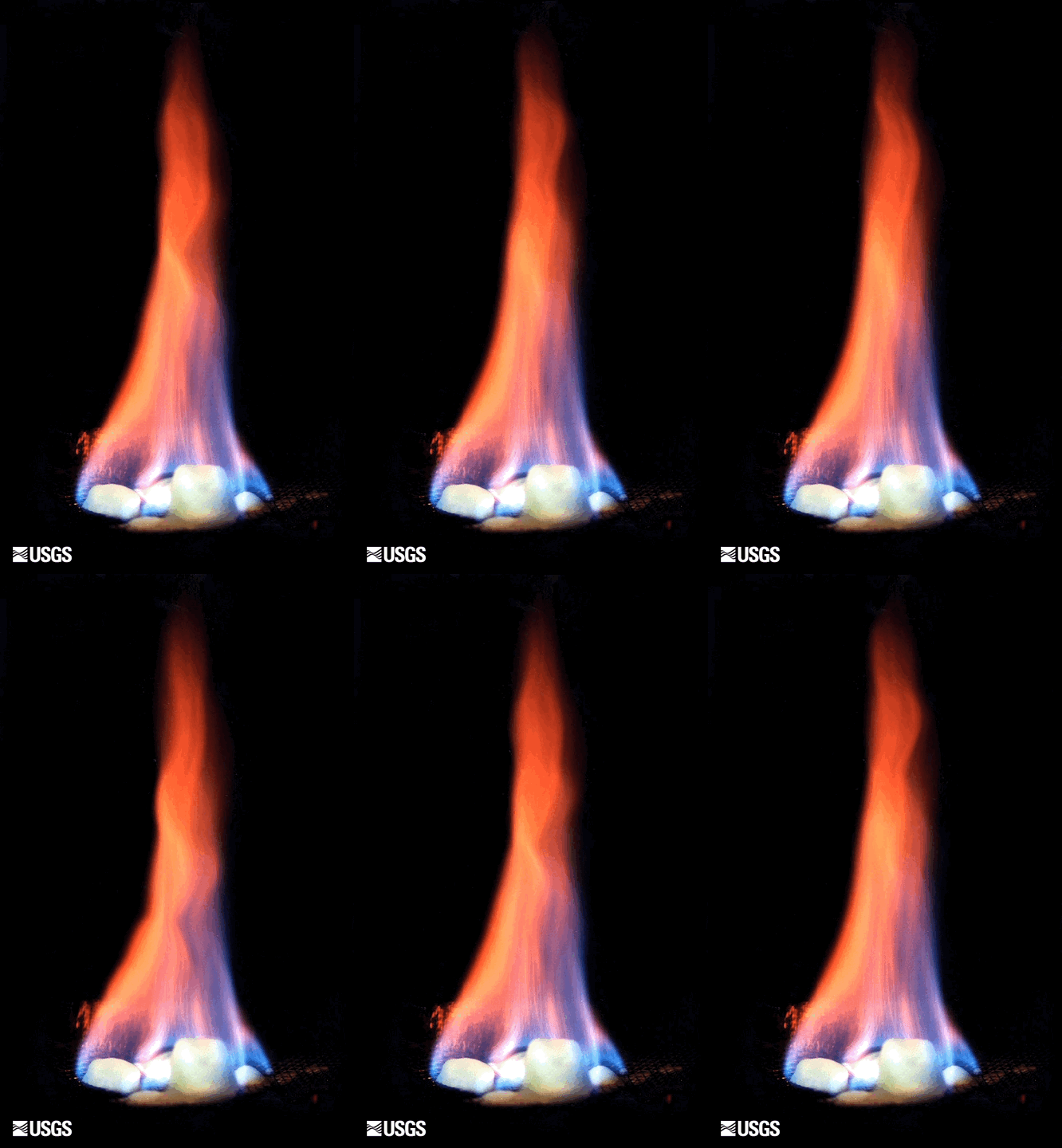
Gas Hydrates- Energy
Gas Hydrates - Primer
Marine Geophysical Data Collected to Support Methane Seep Research Along the U.S. Atlantic Continental Shelf Break and Upper Continental Slope Between the Baltimore and Keller Canyons During U.S. Geological Survey Field Activities 2017-001-FA and 2017-002 Marine Geophysical Data Collected to Support Methane Seep Research Along the U.S. Atlantic Continental Shelf Break and Upper Continental Slope Between the Baltimore and Keller Canyons During U.S. Geological Survey Field Activities 2017-001-FA and 2017-002
Thermal Data and Navigation for T-3 (Fletcher's) Ice Island Arctic Ocean Heat Flow Studies, 1963-73 (ver. 1.1 December 2022) Thermal Data and Navigation for T-3 (Fletcher's) Ice Island Arctic Ocean Heat Flow Studies, 1963-73 (ver. 1.1 December 2022)
Post-expedition report for USGS T-3 Ice Island heat flow measurements in the High Arctic Ocean, 1963-1973 Post-expedition report for USGS T-3 Ice Island heat flow measurements in the High Arctic Ocean, 1963-1973
Stable isotopic insights into Bathymodiolus childressi at two seeps in the US Atlantic margin, data release Stable isotopic insights into Bathymodiolus childressi at two seeps in the US Atlantic margin, data release
Geochemical analysis of authigenic carbonates and chemosynthetic mussels at Atlantic Margin seeps Geochemical analysis of authigenic carbonates and chemosynthetic mussels at Atlantic Margin seeps
Minimal offshore extent of ice-bearing (subsea) permafrost on the U.S. Beaufort Sea margin Minimal offshore extent of ice-bearing (subsea) permafrost on the U.S. Beaufort Sea margin
U.S. Atlantic margin gas hydrates U.S. Atlantic margin gas hydrates
Gas hydrates on Alaskan marine margins Gas hydrates on Alaskan marine margins
Elevated levels of radiocarbon in methane dissolved in seawater reveal likely local contamination from nuclear powered vessels Elevated levels of radiocarbon in methane dissolved in seawater reveal likely local contamination from nuclear powered vessels
Hydrate formation on marine seep bubbles and the implications for water column methane dissolution Hydrate formation on marine seep bubbles and the implications for water column methane dissolution
Estimating the impact of seep methane oxidation on ocean pH and dissolved inorganic radiocarbon along the U.S. mid‐Atlantic Bight Estimating the impact of seep methane oxidation on ocean pH and dissolved inorganic radiocarbon along the U.S. mid‐Atlantic Bight
Gas hydrates in sustainable chemistry Gas hydrates in sustainable chemistry
Non-USGS Publications**
**Disclaimer: The views expressed in Non-USGS publications are those of the author and do not represent the views of the USGS, Department of the Interior, or the U.S. Government.
USGS scientists contribute to new gas hydrates monograph USGS scientists contribute to new gas hydrates monograph
Science and Products
IMMeRSS-- Interagency Mission for Methane Research on Seafloor Seeps
Gas Hydrates- Atlantic Margin Methane Seeps
Environmental Compliance
Gas Hydrates-Environment Interactions
Gas Hydrates- Energy
Gas Hydrates - Primer
Marine Geophysical Data Collected to Support Methane Seep Research Along the U.S. Atlantic Continental Shelf Break and Upper Continental Slope Between the Baltimore and Keller Canyons During U.S. Geological Survey Field Activities 2017-001-FA and 2017-002 Marine Geophysical Data Collected to Support Methane Seep Research Along the U.S. Atlantic Continental Shelf Break and Upper Continental Slope Between the Baltimore and Keller Canyons During U.S. Geological Survey Field Activities 2017-001-FA and 2017-002
Thermal Data and Navigation for T-3 (Fletcher's) Ice Island Arctic Ocean Heat Flow Studies, 1963-73 (ver. 1.1 December 2022) Thermal Data and Navigation for T-3 (Fletcher's) Ice Island Arctic Ocean Heat Flow Studies, 1963-73 (ver. 1.1 December 2022)
Post-expedition report for USGS T-3 Ice Island heat flow measurements in the High Arctic Ocean, 1963-1973 Post-expedition report for USGS T-3 Ice Island heat flow measurements in the High Arctic Ocean, 1963-1973
Stable isotopic insights into Bathymodiolus childressi at two seeps in the US Atlantic margin, data release Stable isotopic insights into Bathymodiolus childressi at two seeps in the US Atlantic margin, data release
Geochemical analysis of authigenic carbonates and chemosynthetic mussels at Atlantic Margin seeps Geochemical analysis of authigenic carbonates and chemosynthetic mussels at Atlantic Margin seeps
Minimal offshore extent of ice-bearing (subsea) permafrost on the U.S. Beaufort Sea margin Minimal offshore extent of ice-bearing (subsea) permafrost on the U.S. Beaufort Sea margin
U.S. Atlantic margin gas hydrates U.S. Atlantic margin gas hydrates
Gas hydrates on Alaskan marine margins Gas hydrates on Alaskan marine margins
Elevated levels of radiocarbon in methane dissolved in seawater reveal likely local contamination from nuclear powered vessels Elevated levels of radiocarbon in methane dissolved in seawater reveal likely local contamination from nuclear powered vessels
Hydrate formation on marine seep bubbles and the implications for water column methane dissolution Hydrate formation on marine seep bubbles and the implications for water column methane dissolution
Estimating the impact of seep methane oxidation on ocean pH and dissolved inorganic radiocarbon along the U.S. mid‐Atlantic Bight Estimating the impact of seep methane oxidation on ocean pH and dissolved inorganic radiocarbon along the U.S. mid‐Atlantic Bight
Gas hydrates in sustainable chemistry Gas hydrates in sustainable chemistry
Non-USGS Publications**
**Disclaimer: The views expressed in Non-USGS publications are those of the author and do not represent the views of the USGS, Department of the Interior, or the U.S. Government.
USGS scientists contribute to new gas hydrates monograph USGS scientists contribute to new gas hydrates monograph
*Disclaimer: Listing outside positions with professional scientific organizations on this Staff Profile are for informational purposes only and do not constitute an endorsement of those professional scientific organizations or their activities by the USGS, Department of the Interior, or U.S. Government