



A USGS scientist examines microorganisms from salamander skin to investigate for potential pathogens.
Daniel A Grear
Dan Grear is a Wildlife Disease Ecologist at the National Wildlife Health Center.
I am interested in mechanisms that cause heterogeneities in pathogen transmission in wild animal disease systems and at the interface of wildlife, domestic animal, and human health. I lead investigations into wildlife mortality events and research that incorporates field studies with theoretical modeling of disease systems to identify key mechanisms that drive transmission dynamic.
Science and Products

Batrachochytrium salamandrivorans (Bsal)
Batrachochytrium salamandrivorans ( Bsal ) is an emerging pathogen capable of causing significant morbidity and mortality in salamanders.

Batrachochytrium salamandrivorans (Bsal) Surveillance
Scientists of the USGS National Wildlife Health Center (NWHC) in collaboration with partners have developed risk assessments for Batrachochytrium salamandrivorans ( Bsal ) in the United States and are sampling high-risk locations for the fungus.
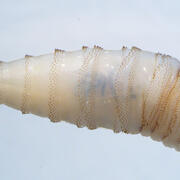
Preparing for Potential Emergence of New World Screwworm in the U.S.
The USGS National Wildlife Health Center (NWHC) is supporting the Department of the Interior’s (DOI) preparedness planning for New World screwworm (NWS), a re-emerging parasitic disease that is spreading north from Central America.

Forecasting Mosquito Phenology in a Shifting Climate: Synthesizing Continental-scale Monitoring Data
Climate change is expected to have significant effects on the phenology of vectors of arthropod-borne diseases, particularly mosquitoes. However, forecasting the direction and magnitude of future phenological shifts requires a more detailed understanding of the climate drivers of mosquito phenology. Addressing this knowledge gap is particularly salient for mosquitoes, as they have the...

Avian Influenza
Avian influenza is a viral disease caused by various strains of avian influenza viruses that can be classified as low pathogenic avian influenza (LPAI) or highly pathogenic avian influenza (HPAI). It remains a global disease with potential high consequence with the potential to threaten wildlife, agriculture, and human health.
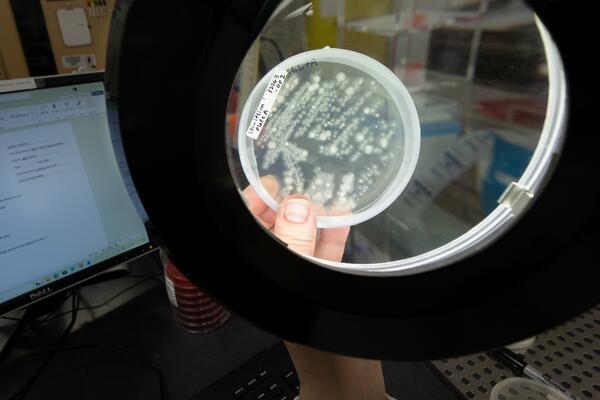
Scientists investigate pathogens in salamanders
A USGS scientist examines microorganisms from salamander skin to investigate for potential pathogens.
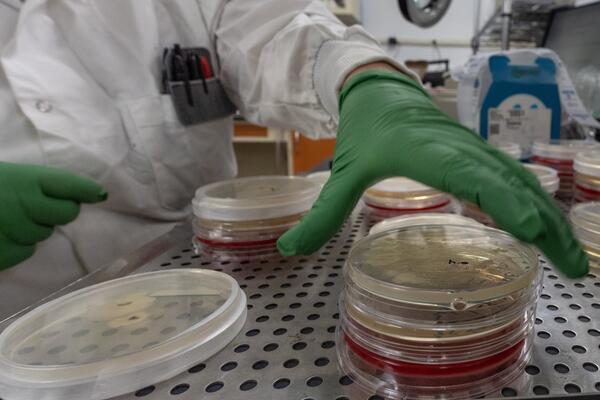
Scientists investigate pathogens in salamanders
A USGS scientist reaches for a microbiological plate with cultures from salamander skin to investigate for potential pathogens.
A USGS scientist reaches for a microbiological plate with cultures from salamander skin to investigate for potential pathogens.
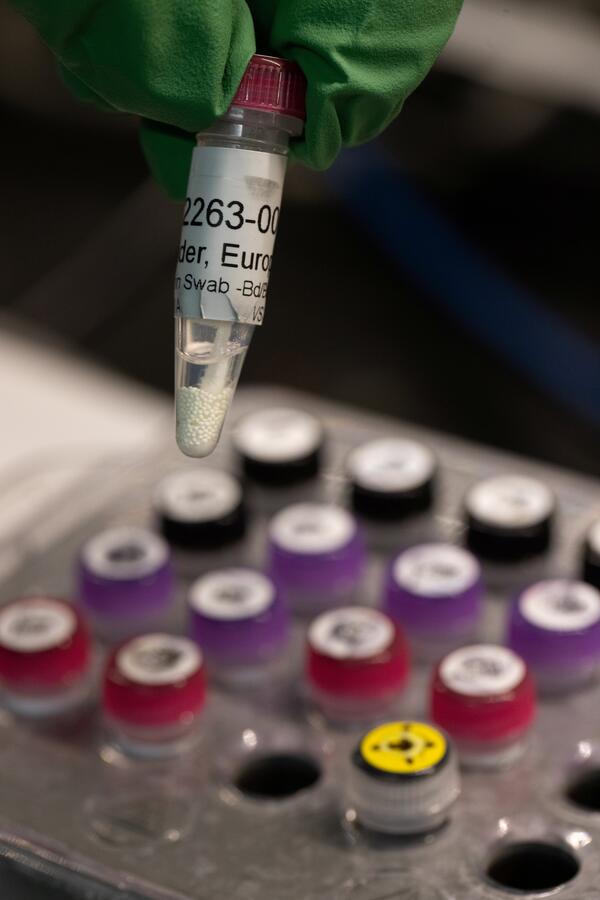
Scientists investigate pathogens in salamanders
A USGS scientist prepares to analyze a skin swab from a salamander to investigate for potential pathogens.
A USGS scientist prepares to analyze a skin swab from a salamander to investigate for potential pathogens.
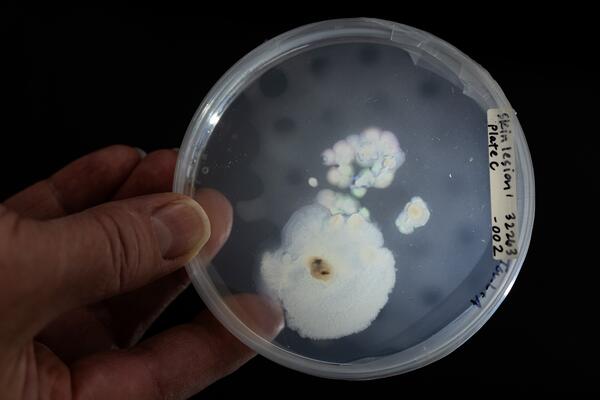
Scientists investigate pathogens in salamanders
A USGS scientist examines a skin sample from a salamander as part of a study to investigate for potential pathogens.
A USGS scientist examines a skin sample from a salamander as part of a study to investigate for potential pathogens.
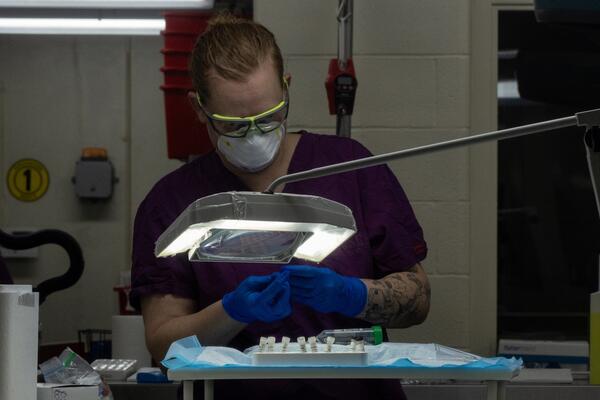
Scientists investigate pathogens in salamanders
A USGS scientist examines salamanders as part of a study to investigate for potential pathogens.
A USGS scientist examines salamanders as part of a study to investigate for potential pathogens.

Eastern newt (Notophthalmus viridescens) in Wisconsin
Eastern newt (Notophthalmus viridescens) in WisconsinEastern newt (Notophthalmus viridescens) in Wisconsin.
Eastern newt (Notophthalmus viridescens) in Wisconsin
Eastern newt (Notophthalmus viridescens) in WisconsinEastern newt (Notophthalmus viridescens) in Wisconsin.
Science and Products
Batrachochytrium salamandrivorans (Bsal)
Batrachochytrium salamandrivorans ( Bsal ) is an emerging pathogen capable of causing significant morbidity and mortality in salamanders.
Batrachochytrium salamandrivorans (Bsal) Surveillance
Scientists of the USGS National Wildlife Health Center (NWHC) in collaboration with partners have developed risk assessments for Batrachochytrium salamandrivorans ( Bsal ) in the United States and are sampling high-risk locations for the fungus.
Preparing for Potential Emergence of New World Screwworm in the U.S.
The USGS National Wildlife Health Center (NWHC) is supporting the Department of the Interior’s (DOI) preparedness planning for New World screwworm (NWS), a re-emerging parasitic disease that is spreading north from Central America.
Forecasting Mosquito Phenology in a Shifting Climate: Synthesizing Continental-scale Monitoring Data
Climate change is expected to have significant effects on the phenology of vectors of arthropod-borne diseases, particularly mosquitoes. However, forecasting the direction and magnitude of future phenological shifts requires a more detailed understanding of the climate drivers of mosquito phenology. Addressing this knowledge gap is particularly salient for mosquitoes, as they have the...
Avian Influenza
Avian influenza is a viral disease caused by various strains of avian influenza viruses that can be classified as low pathogenic avian influenza (LPAI) or highly pathogenic avian influenza (HPAI). It remains a global disease with potential high consequence with the potential to threaten wildlife, agriculture, and human health.
Scientists investigate pathogens in salamanders
A USGS scientist examines microorganisms from salamander skin to investigate for potential pathogens.
A USGS scientist examines microorganisms from salamander skin to investigate for potential pathogens.
Scientists investigate pathogens in salamanders
A USGS scientist reaches for a microbiological plate with cultures from salamander skin to investigate for potential pathogens.
A USGS scientist reaches for a microbiological plate with cultures from salamander skin to investigate for potential pathogens.
Scientists investigate pathogens in salamanders
A USGS scientist prepares to analyze a skin swab from a salamander to investigate for potential pathogens.
A USGS scientist prepares to analyze a skin swab from a salamander to investigate for potential pathogens.
Scientists investigate pathogens in salamanders
A USGS scientist examines a skin sample from a salamander as part of a study to investigate for potential pathogens.
A USGS scientist examines a skin sample from a salamander as part of a study to investigate for potential pathogens.
Scientists investigate pathogens in salamanders
A USGS scientist examines salamanders as part of a study to investigate for potential pathogens.
A USGS scientist examines salamanders as part of a study to investigate for potential pathogens.
Eastern newt (Notophthalmus viridescens) in Wisconsin
Eastern newt (Notophthalmus viridescens) in WisconsinEastern newt (Notophthalmus viridescens) in Wisconsin.
Eastern newt (Notophthalmus viridescens) in Wisconsin
Eastern newt (Notophthalmus viridescens) in WisconsinEastern newt (Notophthalmus viridescens) in Wisconsin.
*Disclaimer: Listing outside positions with professional scientific organizations on this Staff Profile are for informational purposes only and do not constitute an endorsement of those professional scientific organizations or their activities by the USGS, Department of the Interior, or U.S. Government