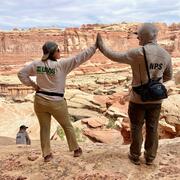
Mike Duniway, Ph.D.
Dr. Michael (Mike) Duniway is a soil scientist focused on soils and soil processes in dryland environments. His work provides crucial information for stakeholders, agencies and the public to assess and manage lands across the Colorado Plateau and southwest US.
In his research and outreach activities, Dr. Duniway seeks to provide information for land managers and owners to facilitate sustainable land-use activities. He works closely with federal and state agency partners and others in designing research studies, conducting technology transfer, and outreach activities. His research focuses include understanding the impacts of drought on Colorado Plateau rangelands, evaluating the recovery of oil and gas pads and seeking opportunities for improved reclamation practices, and developing new maps and tools for land management. In his work, he is interested in maintaining and balancing the important ecosystem services these landscapes provide, including clean water and air, food and fiber, tourism and cultural values, and energy.
Professional Experience
2011-Present: Research Ecologist, USGS Southwest Biological Science Center, Moab, UT
2010-2011: Research Soil Scientist, US Department of Agriculture Agricultural Research Service, Jornada, Las Cruces, NM
2006-2010: Research Soil Scientist (post doc), US Department of Agriculture Agricultural Research Service, Jornada, Las Cruces, NM
2012-Present: Adjunct Faculty, Utah State University, Logan, UT
2007-Present: Adjunct Faculty, NM State University, Las Cruces, NM
Education and Certifications
Ph.D., 2006 — Agronomy (Soil Science), New Mexico State University, Las Cruces, NM
B.S., 1994 — Environmental Resource Science, University of California, Davis, CA
Science and Products
Assessment of rangeland ecosystem conditions in Grand Canyon-Parashant National Monument, Arizona Assessment of rangeland ecosystem conditions in Grand Canyon-Parashant National Monument, Arizona
Bridging the research-management gap: Landscape ecology in practice on public lands in the western United States Bridging the research-management gap: Landscape ecology in practice on public lands in the western United States
Supporting the development and use of native plant materials for restoration on the Colorado Plateau (Fiscal Year 19 Report) Supporting the development and use of native plant materials for restoration on the Colorado Plateau (Fiscal Year 19 Report)
Inoculation and habitat amelioration efforts in biological soil crust recovery vary by desert and soil texture Inoculation and habitat amelioration efforts in biological soil crust recovery vary by desert and soil texture
Grazing-induced changes to biological soil crust cover mediate hillslope erosion in a long-term exclosure experiment Grazing-induced changes to biological soil crust cover mediate hillslope erosion in a long-term exclosure experiment
Microsite enhancements for soil stabilization and rapid biocrust colonization in degraded drylands Microsite enhancements for soil stabilization and rapid biocrust colonization in degraded drylands
Addressing barriers to improve biocrust colonization and establishment in dryland restoration Addressing barriers to improve biocrust colonization and establishment in dryland restoration
Induced biological soil crust controls on wind erodibility and dust (PM10) emissions Induced biological soil crust controls on wind erodibility and dust (PM10) emissions
Digital mapping of ecological land units using a nationally scalable modeling framework Digital mapping of ecological land units using a nationally scalable modeling framework
Transient population dynamics impede restoration and may promote ecosystem transformation after disturbance Transient population dynamics impede restoration and may promote ecosystem transformation after disturbance
Salinity yield modeling of the Upper Colorado River Basin using 30-meter resolution soil maps and random forests Salinity yield modeling of the Upper Colorado River Basin using 30-meter resolution soil maps and random forests
Shrub persistence and increased grass mortality in response to drought in dryland systems Shrub persistence and increased grass mortality in response to drought in dryland systems
Non-USGS Publications**
**Disclaimer: The views expressed in Non-USGS publications are those of the author and do not represent the views of the USGS, Department of the Interior, or the U.S. Government.
Science and Products
Assessment of rangeland ecosystem conditions in Grand Canyon-Parashant National Monument, Arizona Assessment of rangeland ecosystem conditions in Grand Canyon-Parashant National Monument, Arizona
Bridging the research-management gap: Landscape ecology in practice on public lands in the western United States Bridging the research-management gap: Landscape ecology in practice on public lands in the western United States
Supporting the development and use of native plant materials for restoration on the Colorado Plateau (Fiscal Year 19 Report) Supporting the development and use of native plant materials for restoration on the Colorado Plateau (Fiscal Year 19 Report)
Inoculation and habitat amelioration efforts in biological soil crust recovery vary by desert and soil texture Inoculation and habitat amelioration efforts in biological soil crust recovery vary by desert and soil texture
Grazing-induced changes to biological soil crust cover mediate hillslope erosion in a long-term exclosure experiment Grazing-induced changes to biological soil crust cover mediate hillslope erosion in a long-term exclosure experiment
Microsite enhancements for soil stabilization and rapid biocrust colonization in degraded drylands Microsite enhancements for soil stabilization and rapid biocrust colonization in degraded drylands
Addressing barriers to improve biocrust colonization and establishment in dryland restoration Addressing barriers to improve biocrust colonization and establishment in dryland restoration
Induced biological soil crust controls on wind erodibility and dust (PM10) emissions Induced biological soil crust controls on wind erodibility and dust (PM10) emissions
Digital mapping of ecological land units using a nationally scalable modeling framework Digital mapping of ecological land units using a nationally scalable modeling framework
Transient population dynamics impede restoration and may promote ecosystem transformation after disturbance Transient population dynamics impede restoration and may promote ecosystem transformation after disturbance
Salinity yield modeling of the Upper Colorado River Basin using 30-meter resolution soil maps and random forests Salinity yield modeling of the Upper Colorado River Basin using 30-meter resolution soil maps and random forests
Shrub persistence and increased grass mortality in response to drought in dryland systems Shrub persistence and increased grass mortality in response to drought in dryland systems
Non-USGS Publications**
**Disclaimer: The views expressed in Non-USGS publications are those of the author and do not represent the views of the USGS, Department of the Interior, or the U.S. Government.