



The 3D Hydrography Program continues to make incremental progress. Notable progress has been made, including the release of HydroAdd3D as both an API and a web interface, the availability of Flow Network Derivative attributes in the 3DHP service, and on-going publication of new 3DHP data, including hydro-enforced DEMs.
Steve Aichele
Steve Aichele is the Hydrography Management and Planning Lead with the U.S. Geological Survey National Geospatial Program.
Steve has worked for the USGS since 1996, spending 10 years as a project chief with the Michigan Water Science Center and 10 years with the National Geospatial Program. In Michigan, his projects typically involved water quality work and groundwater-surface water interactions. With NGP, Steve's work has primarily focused on making geospatial data and services more accessible to hydrologists.
Science and Products
Filter Total Items: 28
July 28, 2026, USGS Hydrography Community Call
The 3D Hydrography Program continues to make incremental progress. Notable progress has been made, including the release of HydroAdd3D as both an API and a web interface, the availability of Flow Network Derivative attributes in the 3DHP service, and on-going publication of new 3DHP data, including hydro-enforced DEMs.
National Tribal Webinar on the USGS 3D Elevation Program and 3D Hydrography Program
National Tribal Webinar on the USGS 3D Elevation Program and 3D Hydrography ProgramThis video summarizes the 3DEP and 3DHP programs for a Tribal audience, providing an overview of the program and its goals and methods. The presentation includes information about topics of possible concern to Tribes, and points of contact to address questions and concerns.
National Tribal Webinar on the USGS 3D Elevation Program and 3D Hydrography Program
National Tribal Webinar on the USGS 3D Elevation Program and 3D Hydrography ProgramThis video summarizes the 3DEP and 3DHP programs for a Tribal audience, providing an overview of the program and its goals and methods. The presentation includes information about topics of possible concern to Tribes, and points of contact to address questions and concerns.
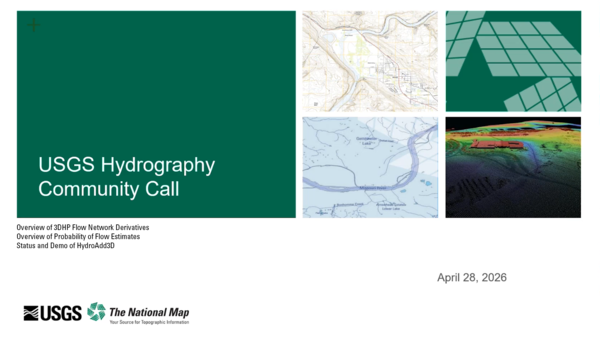
April 2026 USGS Hydrography Community Call
The call will cover USGS Hydrography Program information:
The call will cover USGS Hydrography Program information:
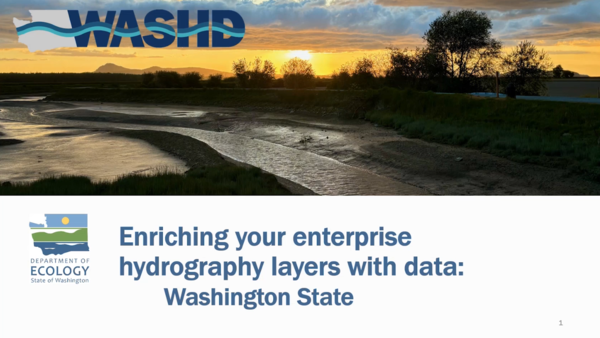
January 27, 2026 USGS Hydrography Community Call: Enriching your enterprise hydrography layers with data: Washington State
January 27, 2026 USGS Hydrography Community Call: Enriching your enterprise hydrography layers with data: Washington StateOur presenter will be Josh Greenberg, the Washington Hydrography Data Steward (WASHD).
January 27, 2026 USGS Hydrography Community Call: Enriching your enterprise hydrography layers with data: Washington State
January 27, 2026 USGS Hydrography Community Call: Enriching your enterprise hydrography layers with data: Washington StateOur presenter will be Josh Greenberg, the Washington Hydrography Data Steward (WASHD).
December 16, 2025 USGS Hydrography Community Call
The topic will be “3DHP Overview and Status – FY25 Accomplishments and FY26 Plans”
Presenter is Steve Aichele, National Geospatial Program Hydrography Planning and Management Lead
The topic will be “3DHP Overview and Status – FY25 Accomplishments and FY26 Plans”
Presenter is Steve Aichele, National Geospatial Program Hydrography Planning and Management Lead
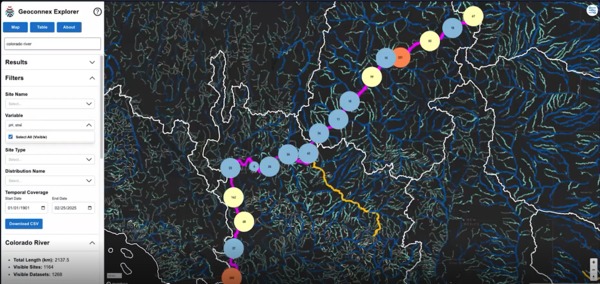
July 22, 2025 USGS Hydrography Community Call
Steve Aichele, the National Geospatial Program Hydrography Management and Planning Lead, announced publication of the Holston River, TN hydrologic unit 10 (0601010403) in the 3D Hydrography Program web map services and provided update on HydroAdd planned release of the Beta version (August 2025) and version 1.0 (September 2025).
Steve Aichele, the National Geospatial Program Hydrography Management and Planning Lead, announced publication of the Holston River, TN hydrologic unit 10 (0601010403) in the 3D Hydrography Program web map services and provided update on HydroAdd planned release of the Beta version (August 2025) and version 1.0 (September 2025).
April 22, 2025 USGS Hydrography Community Call: 3D Hydrography Program Announcements and "Updating historical flow permanence classifications with probabilistic continuous-value estimates” Presentation
April 22, 2025 USGS Hydrography Community Call: 3D Hydrography Program Announcements and "Updating historical flow permanence classifications with probabilistic continuous-value estimates” PresentationSteve Aichele, the National Geospatial Program Hydrography Management and Planning Lead, announced release of the Elevation Derived Hydrography Specification 2024 Revision A3 and updates on the following:
April 22, 2025 USGS Hydrography Community Call: 3D Hydrography Program Announcements and "Updating historical flow permanence classifications with probabilistic continuous-value estimates” Presentation
April 22, 2025 USGS Hydrography Community Call: 3D Hydrography Program Announcements and "Updating historical flow permanence classifications with probabilistic continuous-value estimates” PresentationApril 22, 2025 USGS Hydrography Community Call: 3D Hydrography Program Announcements and "Updating historical flow permanence classifications with probabilistic continuous-value estimates” Presentation
April 22, 2025 USGS Hydrography Community Call: 3D Hydrography Program Announcements and "Updating historical flow permanence classifications with probabilistic continuous-value estimates” PresentationSteve Aichele, the National Geospatial Program Hydrography Management and Planning Lead, announced release of the Elevation Derived Hydrography Specification 2024 Revision A3 and updates on the following:

January 28, 2025 USGS Hydrography Community Call: 3D Hydrography Program Announcements and “HydroAdd3D Sneak Peak”
January 28, 2025 USGS Hydrography Community Call: 3D Hydrography Program Announcements and “HydroAdd3D Sneak Peak”Steve Aichele, the National Geospatial Program Hydrography Management and Planning Lead, announced release of updated Elevation Derived Hydrography Specifications and publication of the following products and services:
January 28, 2025 USGS Hydrography Community Call: 3D Hydrography Program Announcements and “HydroAdd3D Sneak Peak”
January 28, 2025 USGS Hydrography Community Call: 3D Hydrography Program Announcements and “HydroAdd3D Sneak Peak”Steve Aichele, the National Geospatial Program Hydrography Management and Planning Lead, announced release of updated Elevation Derived Hydrography Specifications and publication of the following products and services:

December 2024 USGS Hydrography Community Call: Delivering and Using 3D Hydrography Program (3DHP) Data
December 2024 USGS Hydrography Community Call: Delivering and Using 3D Hydrography Program (3DHP) DataThe 3D Hydrography Program (3DHP) database will initially be populated with the National Hydrography Dataset (NHD) features, mapped to the new data model. The NHD-source features will be replaced with hydrography derived from the 3D Elevation Program (3DEP) lidar and IfSAR data as it becomes available.
December 2024 USGS Hydrography Community Call: Delivering and Using 3D Hydrography Program (3DHP) Data
December 2024 USGS Hydrography Community Call: Delivering and Using 3D Hydrography Program (3DHP) DataThe 3D Hydrography Program (3DHP) database will initially be populated with the National Hydrography Dataset (NHD) features, mapped to the new data model. The NHD-source features will be replaced with hydrography derived from the 3D Elevation Program (3DEP) lidar and IfSAR data as it becomes available.

The 3D Hydrography Program at one year – what was accomplished in FY24, what is planned for FY25?
The 3D Hydrography Program at one year – what was accomplished in FY24, what is planned for FY25?Federal Fiscal Year 2024 was the first full operational year for the 3D Hydrography Program. We made significant progress in a number of areas, publishing final versions of legacy products, and developing processes for the new program. This presentation will provide an overview of what was accomplished in FY24 and what is planned for FY25.
The 3D Hydrography Program at one year – what was accomplished in FY24, what is planned for FY25?
The 3D Hydrography Program at one year – what was accomplished in FY24, what is planned for FY25?Federal Fiscal Year 2024 was the first full operational year for the 3D Hydrography Program. We made significant progress in a number of areas, publishing final versions of legacy products, and developing processes for the new program. This presentation will provide an overview of what was accomplished in FY24 and what is planned for FY25.
USGS-NFHP Webinar - The National Map and the 3D Hydrography Program
USGS-NFHP Webinar - The National Map and the 3D Hydrography ProgramThe USGS-NFHP Webinar on the 3D Hydrography Program (3DHP) and The National Map (TNM) provided a deep dive into the current state and future direction of USGS hydrography and elevation data, focusing on the replacement of legacy datasets with highly accurate, 3D-enabled data.
USGS-NFHP Webinar - The National Map and the 3D Hydrography Program
USGS-NFHP Webinar - The National Map and the 3D Hydrography ProgramThe USGS-NFHP Webinar on the 3D Hydrography Program (3DHP) and The National Map (TNM) provided a deep dive into the current state and future direction of USGS hydrography and elevation data, focusing on the replacement of legacy datasets with highly accurate, 3D-enabled data.

A Statewide Hydraulic Modeling Tool for Stream Crossing Projects in Massachusetts
A Statewide Hydraulic Modeling Tool for Stream Crossing Projects in MassachusettsThe U.S. Geological Survey and the University of Massachusetts at Amherst (UMass Amherst), in cooperation with the Massachusetts Department of Environmental Protection (MassDEP), began a series of studies in 2019 to develop a web-based statewide hydraulic modeling tool to provide preliminary culvert designs for stream-crossing projects in Massachusetts.
A Statewide Hydraulic Modeling Tool for Stream Crossing Projects in Massachusetts
A Statewide Hydraulic Modeling Tool for Stream Crossing Projects in MassachusettsThe U.S. Geological Survey and the University of Massachusetts at Amherst (UMass Amherst), in cooperation with the Massachusetts Department of Environmental Protection (MassDEP), began a series of studies in 2019 to develop a web-based statewide hydraulic modeling tool to provide preliminary culvert designs for stream-crossing projects in Massachusetts.

Understanding the Transition from NHDPlus HR to 3DHP
Understanding the Transition from NHDPlus HR to 3DHPThe new 3D Hydrography Program (3DHP) is the focus of USGS efforts to acquire and produce detailed surface-water mapping information, such as lakes, ponds, rivers and streams.
Understanding the Transition from NHDPlus HR to 3DHP
Understanding the Transition from NHDPlus HR to 3DHPThe new 3D Hydrography Program (3DHP) is the focus of USGS efforts to acquire and produce detailed surface-water mapping information, such as lakes, ponds, rivers and streams.

Watershed Boundary Dataset (WBD) Transitioning to 3DHP
Watershed Boundary Dataset (WBD) Transitioning to 3DHPThe U.S. Geological Survey (USGS) Watershed Boundary Dataset (WBD) is a national hydrologic unit (HU) geospatial dataset that defines surface drainage areas for the United States. This dataset provides a foundation for local, regional, and national applications to manage, archive, exchange, and analyze data by HU.
Watershed Boundary Dataset (WBD) Transitioning to 3DHP
Watershed Boundary Dataset (WBD) Transitioning to 3DHPThe U.S. Geological Survey (USGS) Watershed Boundary Dataset (WBD) is a national hydrologic unit (HU) geospatial dataset that defines surface drainage areas for the United States. This dataset provides a foundation for local, regional, and national applications to manage, archive, exchange, and analyze data by HU.

Development of a Geographic Information System Methodology for the Public Drinking Water Source Water Assessment Program in Tennessee
Development of a Geographic Information System Methodology for the Public Drinking Water Source Water Assessment Program in TennesseePresenters are Rebecca Ransom and David Ladd with the USGS Lower Mississippi Gulf Water Science Center in Nashville, TN.
Development of a Geographic Information System Methodology for the Public Drinking Water Source Water Assessment Program in Tennessee
Development of a Geographic Information System Methodology for the Public Drinking Water Source Water Assessment Program in TennesseePresenters are Rebecca Ransom and David Ladd with the USGS Lower Mississippi Gulf Water Science Center in Nashville, TN.

USACE Huntington Use of USGS Data and Services
The US Army Corps of Engineers (USACE) office in Huntington, WV provides a number of floodplain management services. These include base flood elevation (BFE) evaluations, watershed modeling, project planning, and responding to numerous technical questions.
The US Army Corps of Engineers (USACE) office in Huntington, WV provides a number of floodplain management services. These include base flood elevation (BFE) evaluations, watershed modeling, project planning, and responding to numerous technical questions.

Strategies for improving the Washington State Hydrography Dataset (WASHD)
Strategies for improving the Washington State Hydrography Dataset (WASHD)Joshua Greenberg works at the Washington Department of Ecology as the Hydrography Steward. He has been very active in supporting professional GIS organizations within Washington, including being on the board of the local ASPRS chapter, WAGISA (WAURISA), and WAGIC co-chair. Josh earned his B.A.
Strategies for improving the Washington State Hydrography Dataset (WASHD)
Strategies for improving the Washington State Hydrography Dataset (WASHD)Joshua Greenberg works at the Washington Department of Ecology as the Hydrography Steward. He has been very active in supporting professional GIS organizations within Washington, including being on the board of the local ASPRS chapter, WAGISA (WAURISA), and WAGIC co-chair. Josh earned his B.A.
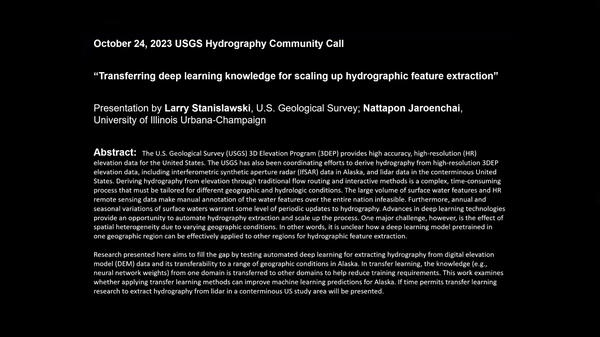
Transferring Deep Learning Knowledge for Scaling Up Hydrographic Feature Extraction
Transferring Deep Learning Knowledge for Scaling Up Hydrographic Feature ExtractionThe U.S. Geological Survey (USGS) 3D Elevation Program (3DEP) provides high accuracy, high-resolution (HR) elevation data for the United States.
Transferring Deep Learning Knowledge for Scaling Up Hydrographic Feature Extraction
Transferring Deep Learning Knowledge for Scaling Up Hydrographic Feature ExtractionThe U.S. Geological Survey (USGS) 3D Elevation Program (3DEP) provides high accuracy, high-resolution (HR) elevation data for the United States.

3DHP v2023 Data Model and Database Contents
The presenter is Dave Blodgett. Dave is a Civil Engineer with the USGS Water Mission Area and is also on assignment to NGTOC's Topographic Applied Research Team.
The presenter is Dave Blodgett. Dave is a Civil Engineer with the USGS Water Mission Area and is also on assignment to NGTOC's Topographic Applied Research Team.

Towards an Internet of Water: Creating a community search index for water data
Towards an Internet of Water: Creating a community search index for water dataOur topic will be "Towards an Internet of Water: Creating a community search index for water data.” The presenter will be Kyle Onda, Director, Internet of Water with the Center for Geospatial Solutions, Lincoln Institute of Land Policy.
Summary:
Towards an Internet of Water: Creating a community search index for water data
Towards an Internet of Water: Creating a community search index for water dataOur topic will be "Towards an Internet of Water: Creating a community search index for water data.” The presenter will be Kyle Onda, Director, Internet of Water with the Center for Geospatial Solutions, Lincoln Institute of Land Policy.
Summary:

The 3D Hydrography Program – transition status July 25, 2023
The 3D Hydrography Program – transition status July 25, 2023Agenda:
Science and Products
Filter Total Items: 28
July 28, 2026, USGS Hydrography Community Call
The 3D Hydrography Program continues to make incremental progress. Notable progress has been made, including the release of HydroAdd3D as both an API and a web interface, the availability of Flow Network Derivative attributes in the 3DHP service, and on-going publication of new 3DHP data, including hydro-enforced DEMs.
The 3D Hydrography Program continues to make incremental progress. Notable progress has been made, including the release of HydroAdd3D as both an API and a web interface, the availability of Flow Network Derivative attributes in the 3DHP service, and on-going publication of new 3DHP data, including hydro-enforced DEMs.
National Tribal Webinar on the USGS 3D Elevation Program and 3D Hydrography Program
National Tribal Webinar on the USGS 3D Elevation Program and 3D Hydrography ProgramThis video summarizes the 3DEP and 3DHP programs for a Tribal audience, providing an overview of the program and its goals and methods. The presentation includes information about topics of possible concern to Tribes, and points of contact to address questions and concerns.
National Tribal Webinar on the USGS 3D Elevation Program and 3D Hydrography Program
National Tribal Webinar on the USGS 3D Elevation Program and 3D Hydrography ProgramThis video summarizes the 3DEP and 3DHP programs for a Tribal audience, providing an overview of the program and its goals and methods. The presentation includes information about topics of possible concern to Tribes, and points of contact to address questions and concerns.
April 2026 USGS Hydrography Community Call
The call will cover USGS Hydrography Program information:
The call will cover USGS Hydrography Program information:
January 27, 2026 USGS Hydrography Community Call: Enriching your enterprise hydrography layers with data: Washington State
January 27, 2026 USGS Hydrography Community Call: Enriching your enterprise hydrography layers with data: Washington StateOur presenter will be Josh Greenberg, the Washington Hydrography Data Steward (WASHD).
January 27, 2026 USGS Hydrography Community Call: Enriching your enterprise hydrography layers with data: Washington State
January 27, 2026 USGS Hydrography Community Call: Enriching your enterprise hydrography layers with data: Washington StateOur presenter will be Josh Greenberg, the Washington Hydrography Data Steward (WASHD).
December 16, 2025 USGS Hydrography Community Call
The topic will be “3DHP Overview and Status – FY25 Accomplishments and FY26 Plans”
Presenter is Steve Aichele, National Geospatial Program Hydrography Planning and Management Lead
The topic will be “3DHP Overview and Status – FY25 Accomplishments and FY26 Plans”
Presenter is Steve Aichele, National Geospatial Program Hydrography Planning and Management Lead
July 22, 2025 USGS Hydrography Community Call
Steve Aichele, the National Geospatial Program Hydrography Management and Planning Lead, announced publication of the Holston River, TN hydrologic unit 10 (0601010403) in the 3D Hydrography Program web map services and provided update on HydroAdd planned release of the Beta version (August 2025) and version 1.0 (September 2025).
Steve Aichele, the National Geospatial Program Hydrography Management and Planning Lead, announced publication of the Holston River, TN hydrologic unit 10 (0601010403) in the 3D Hydrography Program web map services and provided update on HydroAdd planned release of the Beta version (August 2025) and version 1.0 (September 2025).
April 22, 2025 USGS Hydrography Community Call: 3D Hydrography Program Announcements and "Updating historical flow permanence classifications with probabilistic continuous-value estimates” Presentation
April 22, 2025 USGS Hydrography Community Call: 3D Hydrography Program Announcements and "Updating historical flow permanence classifications with probabilistic continuous-value estimates” PresentationSteve Aichele, the National Geospatial Program Hydrography Management and Planning Lead, announced release of the Elevation Derived Hydrography Specification 2024 Revision A3 and updates on the following:
April 22, 2025 USGS Hydrography Community Call: 3D Hydrography Program Announcements and "Updating historical flow permanence classifications with probabilistic continuous-value estimates” Presentation
April 22, 2025 USGS Hydrography Community Call: 3D Hydrography Program Announcements and "Updating historical flow permanence classifications with probabilistic continuous-value estimates” PresentationApril 22, 2025 USGS Hydrography Community Call: 3D Hydrography Program Announcements and "Updating historical flow permanence classifications with probabilistic continuous-value estimates” Presentation
April 22, 2025 USGS Hydrography Community Call: 3D Hydrography Program Announcements and "Updating historical flow permanence classifications with probabilistic continuous-value estimates” PresentationSteve Aichele, the National Geospatial Program Hydrography Management and Planning Lead, announced release of the Elevation Derived Hydrography Specification 2024 Revision A3 and updates on the following:
January 28, 2025 USGS Hydrography Community Call: 3D Hydrography Program Announcements and “HydroAdd3D Sneak Peak”
January 28, 2025 USGS Hydrography Community Call: 3D Hydrography Program Announcements and “HydroAdd3D Sneak Peak”Steve Aichele, the National Geospatial Program Hydrography Management and Planning Lead, announced release of updated Elevation Derived Hydrography Specifications and publication of the following products and services:
January 28, 2025 USGS Hydrography Community Call: 3D Hydrography Program Announcements and “HydroAdd3D Sneak Peak”
January 28, 2025 USGS Hydrography Community Call: 3D Hydrography Program Announcements and “HydroAdd3D Sneak Peak”Steve Aichele, the National Geospatial Program Hydrography Management and Planning Lead, announced release of updated Elevation Derived Hydrography Specifications and publication of the following products and services:
December 2024 USGS Hydrography Community Call: Delivering and Using 3D Hydrography Program (3DHP) Data
December 2024 USGS Hydrography Community Call: Delivering and Using 3D Hydrography Program (3DHP) DataThe 3D Hydrography Program (3DHP) database will initially be populated with the National Hydrography Dataset (NHD) features, mapped to the new data model. The NHD-source features will be replaced with hydrography derived from the 3D Elevation Program (3DEP) lidar and IfSAR data as it becomes available.
December 2024 USGS Hydrography Community Call: Delivering and Using 3D Hydrography Program (3DHP) Data
December 2024 USGS Hydrography Community Call: Delivering and Using 3D Hydrography Program (3DHP) DataThe 3D Hydrography Program (3DHP) database will initially be populated with the National Hydrography Dataset (NHD) features, mapped to the new data model. The NHD-source features will be replaced with hydrography derived from the 3D Elevation Program (3DEP) lidar and IfSAR data as it becomes available.
The 3D Hydrography Program at one year – what was accomplished in FY24, what is planned for FY25?
The 3D Hydrography Program at one year – what was accomplished in FY24, what is planned for FY25?Federal Fiscal Year 2024 was the first full operational year for the 3D Hydrography Program. We made significant progress in a number of areas, publishing final versions of legacy products, and developing processes for the new program. This presentation will provide an overview of what was accomplished in FY24 and what is planned for FY25.
The 3D Hydrography Program at one year – what was accomplished in FY24, what is planned for FY25?
The 3D Hydrography Program at one year – what was accomplished in FY24, what is planned for FY25?Federal Fiscal Year 2024 was the first full operational year for the 3D Hydrography Program. We made significant progress in a number of areas, publishing final versions of legacy products, and developing processes for the new program. This presentation will provide an overview of what was accomplished in FY24 and what is planned for FY25.
USGS-NFHP Webinar - The National Map and the 3D Hydrography Program
USGS-NFHP Webinar - The National Map and the 3D Hydrography ProgramThe USGS-NFHP Webinar on the 3D Hydrography Program (3DHP) and The National Map (TNM) provided a deep dive into the current state and future direction of USGS hydrography and elevation data, focusing on the replacement of legacy datasets with highly accurate, 3D-enabled data.
USGS-NFHP Webinar - The National Map and the 3D Hydrography Program
USGS-NFHP Webinar - The National Map and the 3D Hydrography ProgramThe USGS-NFHP Webinar on the 3D Hydrography Program (3DHP) and The National Map (TNM) provided a deep dive into the current state and future direction of USGS hydrography and elevation data, focusing on the replacement of legacy datasets with highly accurate, 3D-enabled data.
A Statewide Hydraulic Modeling Tool for Stream Crossing Projects in Massachusetts
A Statewide Hydraulic Modeling Tool for Stream Crossing Projects in MassachusettsThe U.S. Geological Survey and the University of Massachusetts at Amherst (UMass Amherst), in cooperation with the Massachusetts Department of Environmental Protection (MassDEP), began a series of studies in 2019 to develop a web-based statewide hydraulic modeling tool to provide preliminary culvert designs for stream-crossing projects in Massachusetts.
A Statewide Hydraulic Modeling Tool for Stream Crossing Projects in Massachusetts
A Statewide Hydraulic Modeling Tool for Stream Crossing Projects in MassachusettsThe U.S. Geological Survey and the University of Massachusetts at Amherst (UMass Amherst), in cooperation with the Massachusetts Department of Environmental Protection (MassDEP), began a series of studies in 2019 to develop a web-based statewide hydraulic modeling tool to provide preliminary culvert designs for stream-crossing projects in Massachusetts.
Understanding the Transition from NHDPlus HR to 3DHP
Understanding the Transition from NHDPlus HR to 3DHPThe new 3D Hydrography Program (3DHP) is the focus of USGS efforts to acquire and produce detailed surface-water mapping information, such as lakes, ponds, rivers and streams.
Understanding the Transition from NHDPlus HR to 3DHP
Understanding the Transition from NHDPlus HR to 3DHPThe new 3D Hydrography Program (3DHP) is the focus of USGS efforts to acquire and produce detailed surface-water mapping information, such as lakes, ponds, rivers and streams.
Watershed Boundary Dataset (WBD) Transitioning to 3DHP
Watershed Boundary Dataset (WBD) Transitioning to 3DHPThe U.S. Geological Survey (USGS) Watershed Boundary Dataset (WBD) is a national hydrologic unit (HU) geospatial dataset that defines surface drainage areas for the United States. This dataset provides a foundation for local, regional, and national applications to manage, archive, exchange, and analyze data by HU.
Watershed Boundary Dataset (WBD) Transitioning to 3DHP
Watershed Boundary Dataset (WBD) Transitioning to 3DHPThe U.S. Geological Survey (USGS) Watershed Boundary Dataset (WBD) is a national hydrologic unit (HU) geospatial dataset that defines surface drainage areas for the United States. This dataset provides a foundation for local, regional, and national applications to manage, archive, exchange, and analyze data by HU.
Development of a Geographic Information System Methodology for the Public Drinking Water Source Water Assessment Program in Tennessee
Development of a Geographic Information System Methodology for the Public Drinking Water Source Water Assessment Program in TennesseePresenters are Rebecca Ransom and David Ladd with the USGS Lower Mississippi Gulf Water Science Center in Nashville, TN.
Development of a Geographic Information System Methodology for the Public Drinking Water Source Water Assessment Program in Tennessee
Development of a Geographic Information System Methodology for the Public Drinking Water Source Water Assessment Program in TennesseePresenters are Rebecca Ransom and David Ladd with the USGS Lower Mississippi Gulf Water Science Center in Nashville, TN.
USACE Huntington Use of USGS Data and Services
The US Army Corps of Engineers (USACE) office in Huntington, WV provides a number of floodplain management services. These include base flood elevation (BFE) evaluations, watershed modeling, project planning, and responding to numerous technical questions.
The US Army Corps of Engineers (USACE) office in Huntington, WV provides a number of floodplain management services. These include base flood elevation (BFE) evaluations, watershed modeling, project planning, and responding to numerous technical questions.
Strategies for improving the Washington State Hydrography Dataset (WASHD)
Strategies for improving the Washington State Hydrography Dataset (WASHD)Joshua Greenberg works at the Washington Department of Ecology as the Hydrography Steward. He has been very active in supporting professional GIS organizations within Washington, including being on the board of the local ASPRS chapter, WAGISA (WAURISA), and WAGIC co-chair. Josh earned his B.A.
Strategies for improving the Washington State Hydrography Dataset (WASHD)
Strategies for improving the Washington State Hydrography Dataset (WASHD)Joshua Greenberg works at the Washington Department of Ecology as the Hydrography Steward. He has been very active in supporting professional GIS organizations within Washington, including being on the board of the local ASPRS chapter, WAGISA (WAURISA), and WAGIC co-chair. Josh earned his B.A.
Transferring Deep Learning Knowledge for Scaling Up Hydrographic Feature Extraction
Transferring Deep Learning Knowledge for Scaling Up Hydrographic Feature ExtractionThe U.S. Geological Survey (USGS) 3D Elevation Program (3DEP) provides high accuracy, high-resolution (HR) elevation data for the United States.
Transferring Deep Learning Knowledge for Scaling Up Hydrographic Feature Extraction
Transferring Deep Learning Knowledge for Scaling Up Hydrographic Feature ExtractionThe U.S. Geological Survey (USGS) 3D Elevation Program (3DEP) provides high accuracy, high-resolution (HR) elevation data for the United States.
3DHP v2023 Data Model and Database Contents
The presenter is Dave Blodgett. Dave is a Civil Engineer with the USGS Water Mission Area and is also on assignment to NGTOC's Topographic Applied Research Team.
The presenter is Dave Blodgett. Dave is a Civil Engineer with the USGS Water Mission Area and is also on assignment to NGTOC's Topographic Applied Research Team.
Towards an Internet of Water: Creating a community search index for water data
Towards an Internet of Water: Creating a community search index for water dataOur topic will be "Towards an Internet of Water: Creating a community search index for water data.” The presenter will be Kyle Onda, Director, Internet of Water with the Center for Geospatial Solutions, Lincoln Institute of Land Policy.
Summary:
Towards an Internet of Water: Creating a community search index for water data
Towards an Internet of Water: Creating a community search index for water dataOur topic will be "Towards an Internet of Water: Creating a community search index for water data.” The presenter will be Kyle Onda, Director, Internet of Water with the Center for Geospatial Solutions, Lincoln Institute of Land Policy.
Summary:
The 3D Hydrography Program – transition status July 25, 2023
The 3D Hydrography Program – transition status July 25, 2023Agenda: