Depths of located earthquakes during July 8 - August 25, 2025, seismic swarm at Mount Rainier, WA
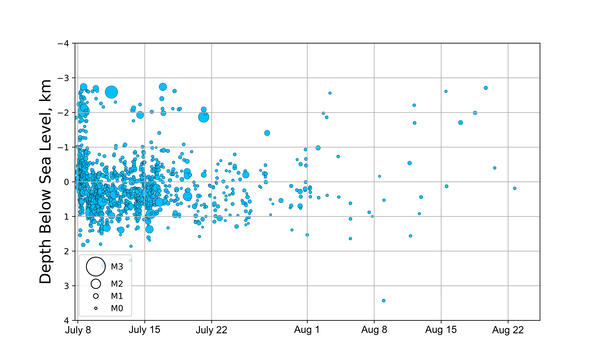
linkDepth of earthquakes during the July 8 - August 25, 2025, seismic swarm at Mount Rainier, WA.
An official website of the United States government
Here's how you know
Official websites use .gov
A .gov website belongs to an official government organization in the United States.
Secure .gov websites use HTTPS
A lock () or https:// means you’ve safely connected to the .gov website. Share sensitive information only on official, secure websites.
Due to a lapse in appropriations, the majority of USGS websites may not be up to date and may not reflect current conditions. Websites displaying real-time data, such as Earthquake, Volcano, LANDSAT and Water information needed for public health and safety will be updated with limited support. Additionally, USGS will not be able to respond to inquiries until appropriations are enacted. For more information, please see www.doi.gov/shutdown.
I love earthquakes. I love volcanoes. And I know for a fact that volcano seismology is the best seismology.
As a research geophysicist at the Cascades Volcano Observatory, I undertake and facilitate research on Cascade Range Volcanoes; monitor seismicity on Cascade Range Volcanoes to assess volcanic hazard; and assist in planning, prioritization and execution of maintenance and growth of volcano monitoring networks in Oregon and Washington.
My education is in both geology and geophysics with a focus more recently on volcanoes. I have experience on both stratovolcanoes and basaltic volcanoes in Russia, Alaska, Washington, Oregon and Hawaii. I've worked in eruptive scenarios at Mount St. Helens in 2004-2008, Redoubt in 2008 and Kilauea from 2011 till 2020. In addition, I've held positions at the Nevada Seismological Network, the Pacific Northwest Seismic Network and the Hawaiian Volcano Observatory, which have all had components of network seismology to them.
2011 - 2016, USGS Hawaiian Volcano Observatory Seismic Network Manager/ Supervisory Geophysicist
Responsibilities: Maintain and improve real-time monitoring and operations of the seismic network at the Hawaiian Volcano Observatory. Interpret seismic data for changes in volcanic activity. Analyze earthquake data.
2004: University of Nevada, B.S. in Geophysics with high distinction 2004
2004: University of Nevada, B.S. in Geology with high distinction 2004
2009: University of Washington, Ph.D in Geophysics
2009: University of Washington, Network Seismology, Post Doc
2010: USGS Cascade Volcano Observatory, Volcano Seismology, Post Doc
Depth of earthquakes during the July 8 - August 25, 2025, seismic swarm at Mount Rainier, WA.
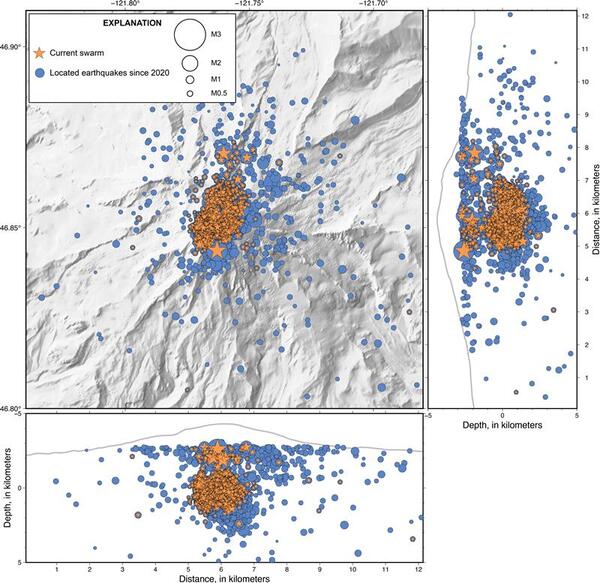
Seismicity beneath Mount Rainier, Washington, showing earthquakes during 2020-2025 in blue, and those that occurred as part of an earthquake swarm on July 8 - August 25, 2025, in orange.
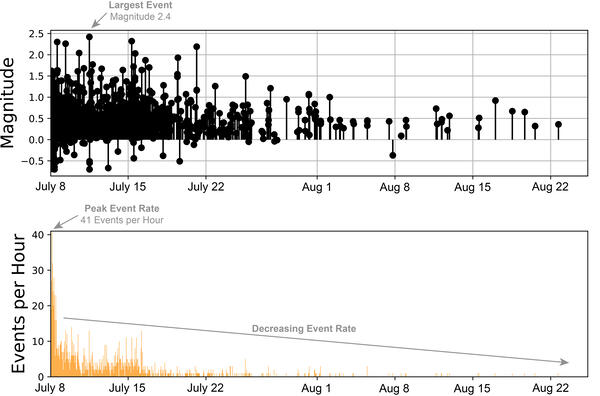
Plots of earthquake magnitudes (top) and numbers (bottom) over the course of the July 8 - August 25, 2025 seismic swarm at Mount Rainier, Washington. The swarm was greatest in terms of numbers of events on the morning of July 8. After that time, earthquake rates slowly decreased over the course of the following days.
Comparison of vertical GPS motion measured at station HUSB (top) with earthquake depth (bottom). Red line is a 60-day average of the cleaned GPS time series plotted in gray. Earthquakes are plotted with respect to their magnitudes. The swarm in 2004 represents the vast majority of earthquake in the vicinity of the deforming region.
Depth of earthquakes during the July 8 - August 25, 2025, seismic swarm at Mount Rainier, WA.
Seismicity beneath Mount Rainier, Washington, showing earthquakes during 2020-2025 in blue, and those that occurred as part of an earthquake swarm on July 8 - August 25, 2025, in orange.
Plots of earthquake magnitudes (top) and numbers (bottom) over the course of the July 8 - August 25, 2025 seismic swarm at Mount Rainier, Washington. The swarm was greatest in terms of numbers of events on the morning of July 8. After that time, earthquake rates slowly decreased over the course of the following days.
Comparison of vertical GPS motion measured at station HUSB (top) with earthquake depth (bottom). Red line is a 60-day average of the cleaned GPS time series plotted in gray. Earthquakes are plotted with respect to their magnitudes. The swarm in 2004 represents the vast majority of earthquake in the vicinity of the deforming region.