U.S. flag

An official website of the United States government

Images

Images intro.
Filter Total Items: 707
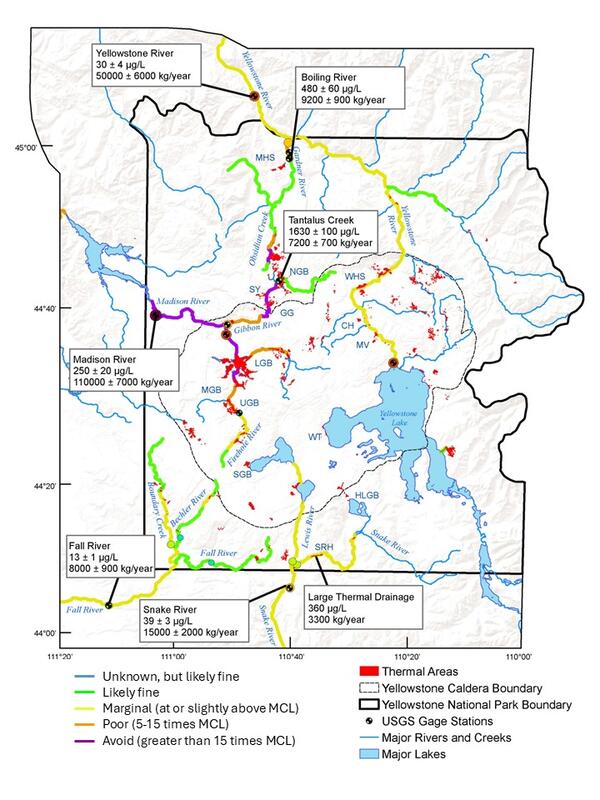
Pie diagram showing chloride flux measured in 2022 in rivers of Yellowstone National Park

Pie diagram showing the chloride flux, in kilotons per year (kt/yr), measured in 2022, with percentages for the four major rivers (Madison, Yellowstone, Snake, and Falls rivers) that drain Yellowstone National Park. Figure developed by Baine McCleskey.

Pie diagram showing the chloride flux, in kilotons per year (kt/yr), measured in 2022, with percentages for the four major rivers (Madison, Yellowstone, Snake, and Falls rivers) that drain Yellowstone National Park. Figure developed by Baine McCleskey.

Satellite, airborne, and ground-based images of an unnamed thermal feature in the Three River Junction thermal area in southwest Yellowstone National Park
Images of an unnamed thermal feature in the Three River Junction thermal area in southwest Yellowstone National Park

Images of an unnamed thermal feature in the Three River Junction thermal area in southwest Yellowstone National Park. A, WorldView-3 satellite image from September 2014. B, National Park Service (NPS) aerial photograph from 2017. Images A and B were acquired before the feature went largely dry in late 2019 or 2020. C, WorldView-3 satellite image from June 2020.

Images of an unnamed thermal feature in the Three River Junction thermal area in southwest Yellowstone National Park. A, WorldView-3 satellite image from September 2014. B, National Park Service (NPS) aerial photograph from 2017. Images A and B were acquired before the feature went largely dry in late 2019 or 2020. C, WorldView-3 satellite image from June 2020.

Seismicity in the Yellowstone region during 2022

Map of seismicity (red circles) in the Yellowstone region during 2022. Gray lines are roads, black dashed line shows the caldera boundary, Yellowstone National Park is outlined by black dot-dashed line, and gray dashed lines denote state boundaries.

Map of seismicity (red circles) in the Yellowstone region during 2022. Gray lines are roads, black dashed line shows the caldera boundary, Yellowstone National Park is outlined by black dot-dashed line, and gray dashed lines denote state boundaries.

3D rendering of the shear-wave-speed anomaly below Yellowstone

3D rendering of the shear-wave-speed anomaly (ɗVS) below Yellowstone. Regions of strongly reduced shear-wave speed most likely indicate volumes of partially molten crust. Iso-surfaces (surfaces of constant ɗVS) are shown in increments of 5%.

3D rendering of the shear-wave-speed anomaly (ɗVS) below Yellowstone. Regions of strongly reduced shear-wave speed most likely indicate volumes of partially molten crust. Iso-surfaces (surfaces of constant ɗVS) are shown in increments of 5%.

Seismic data coverage of the Yellowstone region and example of seismic noise records

Seismic data coverage of the Yellowstone region and example of seismic noise records. By cross-correlating signals of the background noise recorded at two seismic stations and stacking the signals over many days, useful seismic waveforms can be extracted.

Seismic data coverage of the Yellowstone region and example of seismic noise records. By cross-correlating signals of the background noise recorded at two seismic stations and stacking the signals over many days, useful seismic waveforms can be extracted.

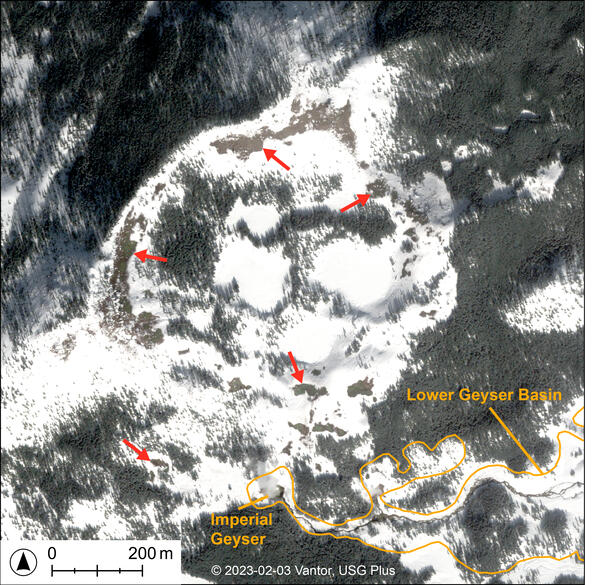
Google Earth image of the north part of Lower Geyser Basin, Yellowstone National Park, showing the site of the Fountain Hotel
Discharge and specific conductance measured in June 2022 at the Gardner River, Yellowstone National Park

Graph showing the discharge (blue) and specific conductance (black) measured at the Gardner River monitoring station in Yellowstone National Park during the June 10–13, 2022, flood.

Map of the US shaded by principal aquifer.  Wells that were sampled are symbolized with circles
Principal aquifers and wells assessed in nationwide NAWQA/GAMA groundwater quality study

Map showing principal aquifers (PAs) and wells that were sampled as part of a Nationwide assessment of the quality of groundwater used for public supply.  

Jamie Farrell presents Yellowstone as one of the first 100 IUGS Geological Heritage Sites

Jamie Farrell presents Yellowstone as one of the first 100 IUGS Geological Heritage Sites during the 60th anniversary IUGS meeting in Zumaia, Spain in October, 2022.  Photo by Marjorie Chan.

Certificate for Yellowstone as one of the first 100 IUGS Geological Heritage Sites

Document certifying The Yellowstone Volcanic and Hydrothermal System, USA, as one of the first 100 IUGS Geological Heritage Sites as declared during the 60th anniversary IUGS meeting held in Zumaia, Spain in October 2022.

Yellowstone interferogram from Sentinel-1 spanning September 29, 2021, to October 6, 2022

Interferogram created from data collected on September 29, 2021, and October 6, 2022, by the Sentinel-1 satellite system. Colored fringes indicate a change in distance (called range change) between the satellite and ground surface that is caused by surface deformation.

Interferogram created from data collected on September 29, 2021, and October 6, 2022, by the Sentinel-1 satellite system. Colored fringes indicate a change in distance (called range change) between the satellite and ground surface that is caused by surface deformation.

Barren ground with some equipment and solar panels in front of steaming pools.  Grassy meadow and forested area behind.
Multi-GAS station installed in the Mud Volcano area of Yellowstone National Park

Multi-GAS station installed in the Mud Volcano area of Yellowstone National Park under permit YELL-2022-SCI-7082.  The station was situated on stable, cool ground away from the edge of thermal features to ensure no impact to the features.

Multi-GAS station installed in the Mud Volcano area of Yellowstone National Park under permit YELL-2022-SCI-7082.  The station was situated on stable, cool ground away from the edge of thermal features to ensure no impact to the features.

Cutbank exposure near West DuNoir Creek, Wyoming, illustrates the differences between bedrock and surficial geologic mapping
Cutbank exposure near West DuNoir Creek, Wyoming

A cutbank exposure near West DuNoir Creek, Wyoming, illustrates the differences between bedrock and surficial geologic mapping. On bedrock maps this location is mapped as the Eocene (55–34 million years old) Indian Meadows Formation, which corresponds to the bedrock visible in the stream bed.

A cutbank exposure near West DuNoir Creek, Wyoming, illustrates the differences between bedrock and surficial geologic mapping. On bedrock maps this location is mapped as the Eocene (55–34 million years old) Indian Meadows Formation, which corresponds to the bedrock visible in the stream bed.

Photo of a newly eroded cliff along the Gardner River, Yellowstone National Park

Photo of a newly eroded cliff along the Gardner River, Yellowstone National Park, showing the unconsolidated layers of sandstone and gravel. USGS photo by David Roth, September 5, 2022.

Gardner River chloride flux monitoring site before and after the June 2022 flooding in Yellowstone National Park

Gardner River chloride flux monitoring site before and after the June 2022 flooding in Yellowstone National Park.  (Left) Site prior to June 2022 storm. Note that the riverbank is near to the base of the fallen tree. USGS photo by Blaine McCleskey, May 21, 2014.  (Right) Site after June 2022 storm. The probe is buried under ~4 feet of debris.

Gardner River chloride flux monitoring site before and after the June 2022 flooding in Yellowstone National Park.  (Left) Site prior to June 2022 storm. Note that the riverbank is near to the base of the fallen tree. USGS photo by Blaine McCleskey, May 21, 2014.  (Right) Site after June 2022 storm. The probe is buried under ~4 feet of debris.

Landsat 8 thermal infrared images of Yellowstone showing daily and seasonal differences.

Landsat 8 thermal infrared images of Yellowstone showing daily and seasonal differences.  In these greyscale images, bright pixels are warmer and dark pixels are cooler.  In the daytime images (A and C), you can see the effects of topography, with darker (cooler) pixels like shadows on north-facing slopes and brighter (warmer) pixels on sun-facing slopes.&

Landsat 8 thermal infrared images of Yellowstone showing daily and seasonal differences.  In these greyscale images, bright pixels are warmer and dark pixels are cooler.  In the daytime images (A and C), you can see the effects of topography, with darker (cooler) pixels like shadows on north-facing slopes and brighter (warmer) pixels on sun-facing slopes.&

Dr. Cathy Whitlock on Twin Butte Lake, Yellowstone National Park, with a freshly extruded sediment core

Dr. Cathy Whitlock (Montana State University) in the “core description boat” on Twin Butte Lake, Yellowstone National Park, with a freshly extruded one meter (3 feet) sediment core. Cores are described and measured in the field before being carefully wrapped for transport to the lab. Photo taken under NPS research permit YELL-2022-SCI-0009 by S.

Dr. Cathy Whitlock (Montana State University) in the “core description boat” on Twin Butte Lake, Yellowstone National Park, with a freshly extruded one meter (3 feet) sediment core. Cores are described and measured in the field before being carefully wrapped for transport to the lab. Photo taken under NPS research permit YELL-2022-SCI-0009 by S.

Pack mules carrying lake coring equipment to a small backcountry lake in Yellowstone National Park

A string of pack mules led by the National Park Service packers Hannah Miller and Ben Cunningham carrying lake coring equipment to a small backcountry lake in Yellowstone National Park; photo taken under NPS research permit YELL-2022-SCI-0009 by S. Hurwitz in August 2022.

Lake coring operations at Twin Buttes Lake, Yellowstone National Park

Lake coring operations at Twin Buttes Lake, Yellowstone National Park,  (a) Assembled lake coring platform being launched into the Twin Buttes Lake and (b) anchored in the core sampling location. Photos taken under NPS research permit YELL-2022-SCI-0009 by S. Hurwitz (a) and L. Harrison (b) in August 2022.

Lake coring operations at Twin Buttes Lake, Yellowstone National Park,  (a) Assembled lake coring platform being launched into the Twin Buttes Lake and (b) anchored in the core sampling location. Photos taken under NPS research permit YELL-2022-SCI-0009 by S. Hurwitz (a) and L. Harrison (b) in August 2022.

Hillside Springs group at the margin of the Summit Lake post-caldera rhyolite lava flow in Upper Geyser Basin, Yellowstone National Park

Hillside Springs group at the margin of the Summit Lake post-caldera rhyolite lava flow (the looming cliff) in Upper Geyser Basin, Yellowstone National Park.  In the past few thousand years, the springs have occasionally deposited travertine, which can be found at the bottom of the hill below the active springs.

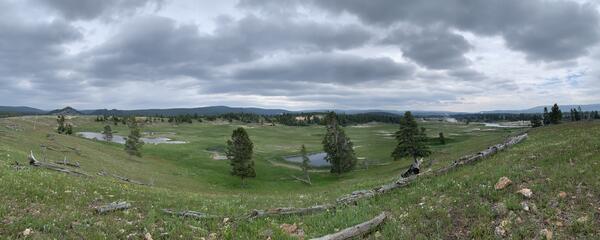
Extensive silica sinter breccia field along the Imperial Meadows Trail in the Lower Geyser Basin of Yellowstone National Park
Silica sinter breccia field along the Imperial Meadows Trail in the Lower Geyser Basin of Yellowstone National Park

Extensive silica sinter breccia field along the Imperial Meadows Trail in the Lower Geyser Basin of Yellowstone National Park looking southwest towards Twin Buttes. The inset image shows a place where a passing hiker’s footstep brushed away the white surface sinter, revealing bright green phototrophic microorganisms underneath (boot toe for scale).

Extensive silica sinter breccia field along the Imperial Meadows Trail in the Lower Geyser Basin of Yellowstone National Park looking southwest towards Twin Buttes. The inset image shows a place where a passing hiker’s footstep brushed away the white surface sinter, revealing bright green phototrophic microorganisms underneath (boot toe for scale).

Was this page helpful?