The Yellowstone borehole geophysical network, installed by UNAVCO in 2007–2008. The placement of the boreholes is focused primarily around the caldera, and the boreholes contain a mix of instruments, including strainmeters, seismometers, tiltmeters, and pore pressure sensors.
Images
The Yellowstone borehole geophysical network, installed by UNAVCO in 2007–2008. The placement of the boreholes is focused primarily around the caldera, and the boreholes contain a mix of instruments, including strainmeters, seismometers, tiltmeters, and pore pressure sensors.
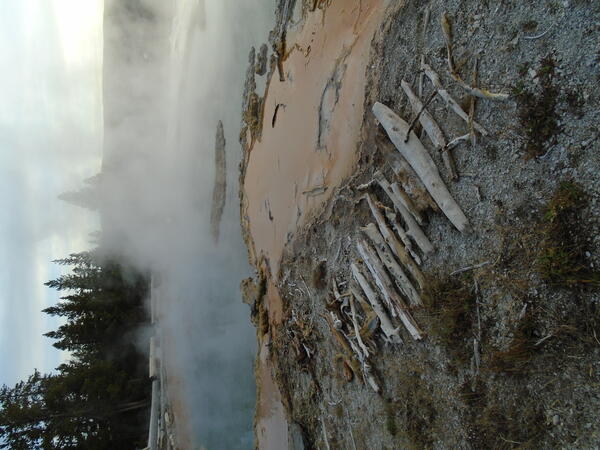
Imperial Geyser, Lower Geyser Basin, Yellowstone National Park
Imperial Geyser, Lower Geyser Basin, Yellowstone National ParkImperial Geyser, Lower Geyser Basin, Yellowstone National Park. USGS photo by Lauren Harrison, July 2021.
Imperial Geyser, Lower Geyser Basin, Yellowstone National Park
Imperial Geyser, Lower Geyser Basin, Yellowstone National ParkImperial Geyser, Lower Geyser Basin, Yellowstone National Park. USGS photo by Lauren Harrison, July 2021.
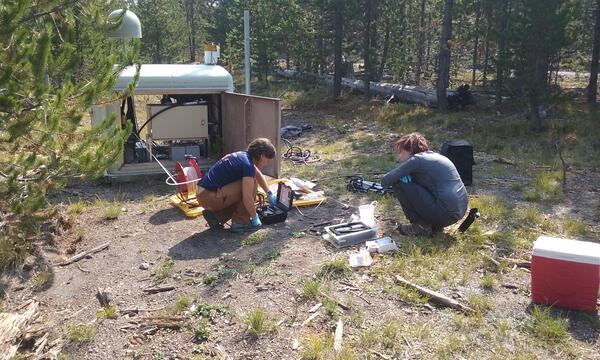
USGS scientists carrying field equipment to set up a gas monitoring station in Yellowstone National Park
USGS scientists carrying field equipment to set up a gas monitoring station in Yellowstone National ParkUSGS scientists Laura Dobeck and Sara Peek carrying field equipment to set up a gas monitoring station in Yellowstone National Park. USGS photo by Jennifer Lewicki, July 13, 2021.
USGS scientists carrying field equipment to set up a gas monitoring station in Yellowstone National Park
USGS scientists carrying field equipment to set up a gas monitoring station in Yellowstone National ParkUSGS scientists Laura Dobeck and Sara Peek carrying field equipment to set up a gas monitoring station in Yellowstone National Park. USGS photo by Jennifer Lewicki, July 13, 2021.
Low Flows at Little Snake River near Dixon streamgage
Low Flows at Little Snake River near Dixon streamgageLow Flows at Little Snake River near Dixon streamgage
Low Flows at Little Snake River near Dixon streamgage
Low Flows at Little Snake River near Dixon streamgageLow Flows at Little Snake River near Dixon streamgage
Little Snake River near Dixon low streamflow
Comparison of Porkchop Geyser in Sep 1984 (left) and Aug 1986 (right)
Comparison of Porkchop Geyser in Sep 1984 (left) and Aug 1986 (right)Comparison of Porkchop Geyser in September 1984 (left) and August 1986 (right). The Geyser entered a period of near-constant eruption in 1985, and the pool disappeared; it exploded on September 5, 1989.
Comparison of Porkchop Geyser in Sep 1984 (left) and Aug 1986 (right)
Comparison of Porkchop Geyser in Sep 1984 (left) and Aug 1986 (right)Comparison of Porkchop Geyser in September 1984 (left) and August 1986 (right). The Geyser entered a period of near-constant eruption in 1985, and the pool disappeared; it exploded on September 5, 1989.
View of Monument Geyser Basin in Yellowstone National Park, with one of the silica spire "monuments" (from which the basin gets its name) in the foreground. USGS photo by Mike Poland, May 15, 2021.
Roaring Mountain, an acid-sulfate thermal area about 5 miles south of Norris Geyser Basin along the Norris-Mammoth road. At times during the late 1800s and early 1900s, the sound of gas escaping from vents could be heard over a mile away, but today the thermal area is mostly quiet, although remains intensely hot with over 100 megawatts of geothermal radiative
The two dominant rock types found on Mount Everts, Yellowstone National Park
The two dominant rock types found on Mount Everts, Yellowstone National ParkPhotographs of the two dominant rock types found on Mount Everts: the Everts Formation (photo by Natali Kragh, May 18, 2021) and the Landslide Creek Formation (photo by Emma Kerins, May 2021). Notice the difference in scale between these two units, indicated by the pencil and field book.
The two dominant rock types found on Mount Everts, Yellowstone National Park
The two dominant rock types found on Mount Everts, Yellowstone National ParkPhotographs of the two dominant rock types found on Mount Everts: the Everts Formation (photo by Natali Kragh, May 18, 2021) and the Landslide Creek Formation (photo by Emma Kerins, May 2021). Notice the difference in scale between these two units, indicated by the pencil and field book.
Photographs of travertine in Yellowstone. A) Travertine terraces actively forming at Mammoth Hot Springs.
Location of major travertine deposits in Yellowstone National Park
Location of major travertine deposits in Yellowstone National ParkMap of Yellowstone National Park showing the location of major travertine deposits. The green dashed line is the outline of Yellowstone Caldera and red lines are major paved roads.
Location of major travertine deposits in Yellowstone National Park
Location of major travertine deposits in Yellowstone National ParkMap of Yellowstone National Park showing the location of major travertine deposits. The green dashed line is the outline of Yellowstone Caldera and red lines are major paved roads.
Crinoid fossil from northern Yellowstone National Park
Crinoid fossil from northern Yellowstone National ParkCrinoid fossil from a Paleozoic rock unit found in northern Yellowstone National Park.
Crinoid fossil from northern Yellowstone National Park
Crinoid fossil from northern Yellowstone National ParkCrinoid fossil from a Paleozoic rock unit found in northern Yellowstone National Park.
Steam vents along the Yellowstone River near Mud Volcano thermal area
Steam vents along the Yellowstone River near Mud Volcano thermal areaSteam vents along the Yellowstone River near Mud Volcano thermal area, Yellowstone National Park.
Steam vents along the Yellowstone River near Mud Volcano thermal area
Steam vents along the Yellowstone River near Mud Volcano thermal areaSteam vents along the Yellowstone River near Mud Volcano thermal area, Yellowstone National Park.
Mudpot located near Mud Volcano in Yellowstone National Park
Mudpot located near Mud Volcano in Yellowstone National ParkMudpot located in the Mud Volcano thermal area of Yellowstone National Park. This type of thermal feature indicates an acid-sulfate system.
Mudpot located near Mud Volcano in Yellowstone National Park
Mudpot located near Mud Volcano in Yellowstone National ParkMudpot located in the Mud Volcano thermal area of Yellowstone National Park. This type of thermal feature indicates an acid-sulfate system.
Thermal anomaly map of Yellowstone National Park based on a Landsat 8 nighttime thermal infrared image from 9 January 2021
Thermal anomaly map of Yellowstone National Park based on a Landsat 8 nighttime thermal infrared image from 9 January 2021Thermal anomaly map of Yellowstone National Park, based on a Landsat 8 nighttime thermal infrared image from 9 January 2021. The color ramp indicates the intensity of the above-background thermal anomaly for each thermal area. Lakes are blue. Yellowstone caldera and resurgent domes are outlined in black.
Thermal anomaly map of Yellowstone National Park based on a Landsat 8 nighttime thermal infrared image from 9 January 2021
Thermal anomaly map of Yellowstone National Park based on a Landsat 8 nighttime thermal infrared image from 9 January 2021Thermal anomaly map of Yellowstone National Park, based on a Landsat 8 nighttime thermal infrared image from 9 January 2021. The color ramp indicates the intensity of the above-background thermal anomaly for each thermal area. Lakes are blue. Yellowstone caldera and resurgent domes are outlined in black.
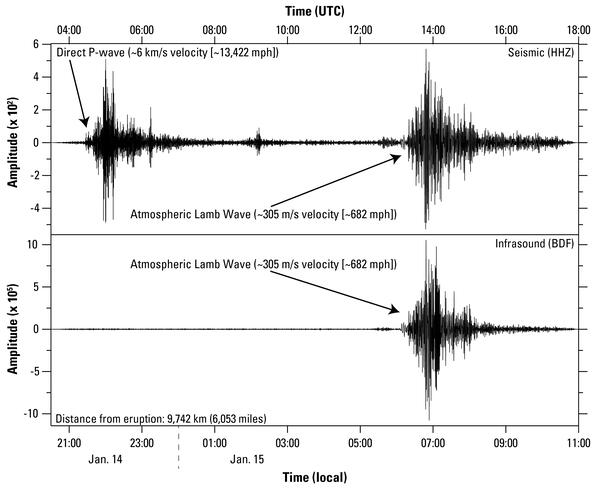
Steamboat Geyser eruption signals recorded by nearby monitoring instruments. The vertical pink lines mark when the signal first appears. (A) Seismic station YNM records a signal which slowly tapers as the eruption decreases in intensity. Spikes seen before the eruption are mostly due to human activity.
Eruptions of Steamboat Geyser over time. (A) Cumulative eruptions of Steamboat Geyser since 1960. Each dot represents an eruption. (B) Comparative plot of the cumulative eruptions in each active phase (1960s, 1980s, and 2018-). Data from GeyserTimes.
Map of seismicity in the Yellowstone region during 2020
Map of seismicity in the Yellowstone region during 2020Map of seismicity (red circles) in the Yellowstone region during 2020. Gray lines are roads, red line shows the caldera boundary, Yellowstone National Park is outlined by black dashed line, and gray dashed lines denote state boundaries.
Map of seismicity in the Yellowstone region during 2020
Map of seismicity in the Yellowstone region during 2020Map of seismicity (red circles) in the Yellowstone region during 2020. Gray lines are roads, red line shows the caldera boundary, Yellowstone National Park is outlined by black dashed line, and gray dashed lines denote state boundaries.
Section from the piston core YL92-1C, collected in south-central Yellowstone Lake
Section from the piston core YL92-1C, collected in south-central Yellowstone LakeSection from the piston core YL92-1C, collected in south-central Yellowstone Lake. The core is viewed horizontally, with the top of core to the left. The core section shown is from 5.21–5.63 meters (17–18.4 feet) depth.
Section from the piston core YL92-1C, collected in south-central Yellowstone Lake
Section from the piston core YL92-1C, collected in south-central Yellowstone LakeSection from the piston core YL92-1C, collected in south-central Yellowstone Lake. The core is viewed horizontally, with the top of core to the left. The core section shown is from 5.21–5.63 meters (17–18.4 feet) depth.
Swath bathymetric image of the Elliott’s Crater explosion crater
Swath bathymetric image of the Elliott’s Crater explosion craterSwath bathymetric image of the Elliott’s Crater explosion crater in Yellowstone Lake. Inset shows location of the crater and the swath image (red box) within the northern part of the lake.
Swath bathymetric image of the Elliott’s Crater explosion crater
Swath bathymetric image of the Elliott’s Crater explosion craterSwath bathymetric image of the Elliott’s Crater explosion crater in Yellowstone Lake. Inset shows location of the crater and the swath image (red box) within the northern part of the lake.
Research drilling in Yellowstone National Park. (A) is an image from Fenner (1936) of the drilling setup in the Upper Geyser Basin during the 1929 field season. (B) is an image from White et al. (1975) of the USGS drill rig set up in the Norris Geyser Basin in 1967-68 during a steam eruption.