



An explosive eruption of silica water erupts from Beehive Geyser located in the Upper Geyser Basin in Yellowstone National Park, Wyoming. The Upper Geyser Basin is also home to the famous Old Faithful geyser which sits just behind Beehive Geyser in the distance.
Images
Images intro.
Filter Total Items: 734

Beehive Geyser
An explosive eruption of silica water erupts from Beehive Geyser located in the Upper Geyser Basin in Yellowstone National Park, Wyoming. The Upper Geyser Basin is also home to the famous Old Faithful geyser which sits just behind Beehive Geyser in the distance.

River and Thermals
This photo shows a river with thermal views below the bridge near the Monument Geyser Trailhead in Yellowstone National Park, Wyoming.
This photo shows a river with thermal views below the bridge near the Monument Geyser Trailhead in Yellowstone National Park, Wyoming.

Yellowstone River from Brink of Lower Falls
Looking down from the lookout point at Brink of Lower Falls, over the Yellowstone River, as it flows south into the distance.
Looking down from the lookout point at Brink of Lower Falls, over the Yellowstone River, as it flows south into the distance.
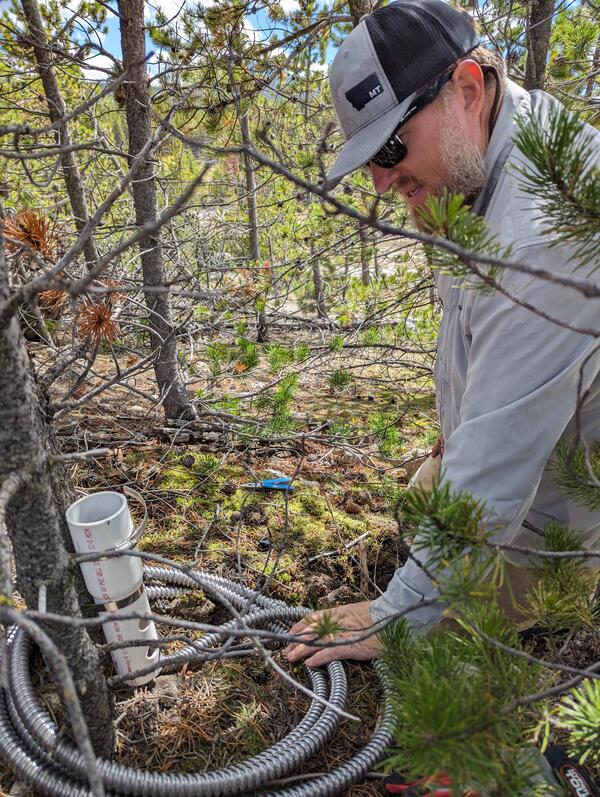
Infrasound sensor installation at Norris Geyser Basin
Infrasound sensor installation at Norris Geyser BasinDr.

Mudpot at Artists' Paintpots
This mudpot is located at the upper level of the trail at the Artists' Paintpots in Yellowstone National Park, Wyoming. Some people will smell rotten eggs, others might even pick up the scent of hickory-smoked ham.
This mudpot is located at the upper level of the trail at the Artists' Paintpots in Yellowstone National Park, Wyoming. Some people will smell rotten eggs, others might even pick up the scent of hickory-smoked ham.

Steamboat Geyser
"Tucked away in the Norris Geyser Basin is Steamboat Geyser, the world’s tallest active geyser. Its major eruptions shoot water more than 300 feet (91 m). Only Waimangu Geyser in New Zealand has rocketed to greater heights—but not in more than one hundred years.
"Tucked away in the Norris Geyser Basin is Steamboat Geyser, the world’s tallest active geyser. Its major eruptions shoot water more than 300 feet (91 m). Only Waimangu Geyser in New Zealand has rocketed to greater heights—but not in more than one hundred years.

Early Morning on the Gibbon River
A foggy, early morning view looking down the Gibbon River, off of Grand Loop Rd in Yellowstone National Park, Wyoming.
A foggy, early morning view looking down the Gibbon River, off of Grand Loop Rd in Yellowstone National Park, Wyoming.

Yellowstone River from Brink of Lower Falls
Looking down from the lookout point at Brink of Lower Falls, over the Yellowstone River, as it flows eastward through the "Grand Canyon of Yellowstone".
Looking down from the lookout point at Brink of Lower Falls, over the Yellowstone River, as it flows eastward through the "Grand Canyon of Yellowstone".

Silver Gate - Travertine
On the drive south of Mammoth Springs, you pass through Silver Gate which is a landslide deposit of travertine stone at least 400,000 years old.
On the drive south of Mammoth Springs, you pass through Silver Gate which is a landslide deposit of travertine stone at least 400,000 years old.

Artists' Painpots
Looking down on the lower portion of Artists' Paintpots in Yellowstone National Park, Wyoming. Artists' Paintpots is a hydrothermal area with many colorful mud pots, hot springs, and geysers.
Looking down on the lower portion of Artists' Paintpots in Yellowstone National Park, Wyoming. Artists' Paintpots is a hydrothermal area with many colorful mud pots, hot springs, and geysers.

Roaring Mountain
A view of Roaring Mountain in Yellowstone National Park, Wyoming. "Roaring Mountain is a large, acidic thermal area (solfatara) that contains many steam vents (fumaroles). In the late 1800s and early 1900s, the number, size, and power of the fumaroles was much greater than today." (NPS)
A view of Roaring Mountain in Yellowstone National Park, Wyoming. "Roaring Mountain is a large, acidic thermal area (solfatara) that contains many steam vents (fumaroles). In the late 1800s and early 1900s, the number, size, and power of the fumaroles was much greater than today." (NPS)

Kepler Cascades
Need time to concentrate or relax? Then listen to the natural sounds of Kepler Cascades in Yellowstone National Park, Wyoming. Kepler Cascades is located just a couple miles away from Old Faithful within Yellowstone National Park, Wyoming.
Need time to concentrate or relax? Then listen to the natural sounds of Kepler Cascades in Yellowstone National Park, Wyoming. Kepler Cascades is located just a couple miles away from Old Faithful within Yellowstone National Park, Wyoming.

Rustic Falls
Need time to concentrate or relax? Then listen to the natural sounds of Rustic Falls in Yellowstone National Park, Wyoming. Rustic Falls is a few miles south of Mammoth Hot Springs in Yellowstone National Park, Wyoming.
Need time to concentrate or relax? Then listen to the natural sounds of Rustic Falls in Yellowstone National Park, Wyoming. Rustic Falls is a few miles south of Mammoth Hot Springs in Yellowstone National Park, Wyoming.

Cinnamon Spouter
Cinnamon Spouter is located on the Black Sand Basin Trail in Yellowstone National Park, Wyoming.
Cinnamon Spouter is located on the Black Sand Basin Trail in Yellowstone National Park, Wyoming.

Mount Everts
Mount Everts, as seen from Mammoth Hot Springs near the North Entrance of Yellowstone National Park.
Mount Everts, as seen from Mammoth Hot Springs near the North Entrance of Yellowstone National Park.

Section of sediment core from Rush Lake, Lower Geyser Basin, Yellowstone National Park, showing different layers that accumulated over time
Section of sediment core from Rush Lake, Lower Geyser Basin, Yellowstone National Park, showing different layers that accumulated over timeSection of a sediment core from Rush Lake, Lower Geyser Basin, Yellowstone National Park.
Section of sediment core from Rush Lake, Lower Geyser Basin, Yellowstone National Park, showing different layers that accumulated over time
Section of sediment core from Rush Lake, Lower Geyser Basin, Yellowstone National Park, showing different layers that accumulated over timeSection of a sediment core from Rush Lake, Lower Geyser Basin, Yellowstone National Park.

GPS data from station P716, near Canyon Village, spanning 2005–2023
GPS data from station P716, near Canyon Village, spanning 2005–2023GPS data from station P716, near Canyon Village, spanning 2005–2023. Top plot shows motion in a north-south direction (positive change is north), middle is east-west motion (positive change is east), and bottom plot is up-down motion (positive change is up).
GPS data from station P716, near Canyon Village, spanning 2005–2023
GPS data from station P716, near Canyon Village, spanning 2005–2023GPS data from station P716, near Canyon Village, spanning 2005–2023. Top plot shows motion in a north-south direction (positive change is north), middle is east-west motion (positive change is east), and bottom plot is up-down motion (positive change is up).
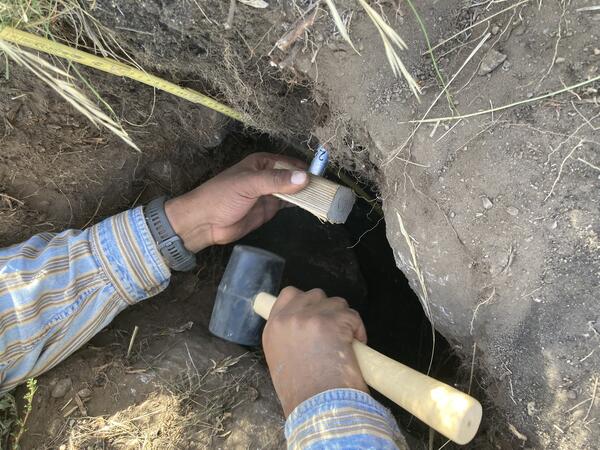
Extracting a bulk density soil sample
A scientist carefully collects a soil sample to determine soil density. Accurate soil density measurements are required for scaling soil carbon from the plot to the landscape.
A scientist carefully collects a soil sample to determine soil density. Accurate soil density measurements are required for scaling soil carbon from the plot to the landscape.

Eastern front of the Gallatin Range as viewed from Gardners Hole in Yellowstone National Park
Eastern front of the Gallatin Range as viewed from Gardners Hole in Yellowstone National ParkView to the southwest of the eastern front of the Gallatin Range from Gardners Hole. The East Gallatin-Reese Creek fault system runs along the base of the range at the prominent break-in-slope in the trees. Photo by James Mauch, Wyoming State Geological Survey, on August 29, 2023.
Eastern front of the Gallatin Range as viewed from Gardners Hole in Yellowstone National Park
Eastern front of the Gallatin Range as viewed from Gardners Hole in Yellowstone National ParkView to the southwest of the eastern front of the Gallatin Range from Gardners Hole. The East Gallatin-Reese Creek fault system runs along the base of the range at the prominent break-in-slope in the trees. Photo by James Mauch, Wyoming State Geological Survey, on August 29, 2023.

A portion of organic-rich lake mud recovered from Rush Lake, Lower Geyser Basin, Yellowstone National Park
A portion of organic-rich lake mud recovered from Rush Lake, Lower Geyser Basin, Yellowstone National ParkA portion of organic-rich lake mud recovered from Rush Lake, in the Lower Geyser Basin of Yellowstone National Park. Younger sediments are to the left and older sediments are to the right. The researcher is pointing to a thin, white layer—the Mazama ash, produced during the eruption 7600 years ago that formed Crater Lake in Oregon.
A portion of organic-rich lake mud recovered from Rush Lake, Lower Geyser Basin, Yellowstone National Park
A portion of organic-rich lake mud recovered from Rush Lake, Lower Geyser Basin, Yellowstone National ParkA portion of organic-rich lake mud recovered from Rush Lake, in the Lower Geyser Basin of Yellowstone National Park. Younger sediments are to the left and older sediments are to the right. The researcher is pointing to a thin, white layer—the Mazama ash, produced during the eruption 7600 years ago that formed Crater Lake in Oregon.

Medicine Bow LLFA Survey Map
A map of the airborne geophysical survey area in the Medicine Mountains region of Wyoming
A map of the airborne geophysical survey area in the Medicine Mountains region of Wyoming