Lava fountains from Fissure 20 in Kīlauea Volcano's lower East Rift Zone. Photo taken May 19, 2018, at 7:37 AM, HST.
Images
Kīlauea images of eruptive activity, field work, and more.
Lava fountains from Fissure 20 in Kīlauea Volcano's lower East Rift Zone. Photo taken May 19, 2018, at 7:37 AM, HST.
Helicopter overflight of Kīlauea's LERZ on May 19, 2018, around 8:1...
Helicopter overflight of Kīlauea's LERZ on May 19, 2018, around 8:1...Helicopter overflight of Kīlauea Volcano's lower East Rift zone on May 19, 2018, around 8:18 AM, HST. ‘A‘ā lava flows emerging from the elongated fissure 16-20 form channels. The flow direction in this picture is from upper center to the lower left.
Helicopter overflight of Kīlauea's LERZ on May 19, 2018, around 8:1...
Helicopter overflight of Kīlauea's LERZ on May 19, 2018, around 8:1...Helicopter overflight of Kīlauea Volcano's lower East Rift zone on May 19, 2018, around 8:18 AM, HST. ‘A‘ā lava flows emerging from the elongated fissure 16-20 form channels. The flow direction in this picture is from upper center to the lower left.
View from within the former USGS Hawaiian Volcano Observatory tower at the Uēkahuna bluff, Kīlauea
View from within the former USGS Hawaiian Volcano Observatory tower at the Uēkahuna bluff, KīlaueaA view of Halemaʻumaʻu from within the USGS Hawaiian Volcano Observatory tower at the Uēkahuna bluff in Hawaiʻi Volcanoes National Park. The tower, which has been removed, provided views of Kaluapele (Kīlauea's summit caldera), the upper portion of the rift zones, and Mauna Loa. USGS photo taken on May 18, 2018.
View from within the former USGS Hawaiian Volcano Observatory tower at the Uēkahuna bluff, Kīlauea
View from within the former USGS Hawaiian Volcano Observatory tower at the Uēkahuna bluff, KīlaueaA view of Halemaʻumaʻu from within the USGS Hawaiian Volcano Observatory tower at the Uēkahuna bluff in Hawaiʻi Volcanoes National Park. The tower, which has been removed, provided views of Kaluapele (Kīlauea's summit caldera), the upper portion of the rift zones, and Mauna Loa. USGS photo taken on May 18, 2018.
Lava from fissure 15 also covered the Pohiki water line.
Fissure activity increases overnight in LERZ, Kīlauea
Fissure activity increases overnight in LERZ, KīlaueaAerial view of the lowermost section of the active fissure system during an overflight early this morning. The view is looking toward the south; note ocean at top of photo. Fissure 17 is the on the left-hand side of photo; fissure 18 is in the middle; and fissure 20 are the two low fountaining areas in the middle right of photo.
Fissure activity increases overnight in LERZ, Kīlauea
Fissure activity increases overnight in LERZ, KīlaueaAerial view of the lowermost section of the active fissure system during an overflight early this morning. The view is looking toward the south; note ocean at top of photo. Fissure 17 is the on the left-hand side of photo; fissure 18 is in the middle; and fissure 20 are the two low fountaining areas in the middle right of photo.
Kīlauea LERZ Fissures & Flows, May 18 at 1:00 p.m.
Kīlauea LERZ Fissures & Flows, May 18 at 1:00 p.m.Map as of 1:00 pm HST, May 18. Shaded purple areas indicate lava flows erupted in 1840, 1955, 1960, and 2014-2015.
Kīlauea LERZ Fissures & Flows, May 18 at 1:00 p.m.
Kīlauea LERZ Fissures & Flows, May 18 at 1:00 p.m.Map as of 1:00 pm HST, May 18. Shaded purple areas indicate lava flows erupted in 1840, 1955, 1960, and 2014-2015.
View of the fissure system in Leilani Estates looking southwest (uprift). Fissure 17 is the lava fountain at bottom of photo, estimated to be about 50 m (164 ft) high with occasional bursts to about 100 m high (328 ft).
Kīlauea Volcano — Aerial of Lava Spatter (Fissure 17)
Kīlauea Volcano — Aerial of Lava Spatter (Fissure 17)This morning, the line of fountains on fissure 17 coalesced into a large fountain that was sending lava 50 meters (164 feet) into the air, with small bits of spatter thrown up to 100 meters (328 feet) high. At about 12:00 p.m. HST, HVO geologists flying over the area reported that fissure 17 was going strong
Kīlauea Volcano — Aerial of Lava Spatter (Fissure 17)
Kīlauea Volcano — Aerial of Lava Spatter (Fissure 17)This morning, the line of fountains on fissure 17 coalesced into a large fountain that was sending lava 50 meters (164 feet) into the air, with small bits of spatter thrown up to 100 meters (328 feet) high. At about 12:00 p.m. HST, HVO geologists flying over the area reported that fissure 17 was going strong
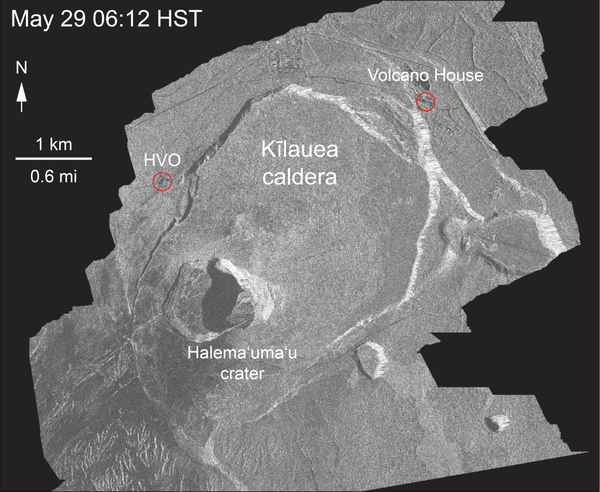
These radar amplitude images were acquired by the Italian Space Agency's Cosmo-SkyMed satellite system and show changes to the caldera area of Kīlauea Volcano that occurred between May 5 at 6:12 a.m. HST (left) and May 17 at 6:12 a.m. HST (right).
Fissure 18 generated a channelized lava flow that had advanced about 1 km (0.6 mi) along the west side of fissure 17 as of about noon today.
This image, captured during an HVO overflight around noon today, shows a lava flowthat crossed Pohoiki Road earlier.
Closer view of fissure 17 (middle photo) and fissure 18 (left side photo) during this morning's overflight of the area. View is toward the south.
The Fissure 17 flow front has slowed substantially with only small amounts of pasty "toothpaste" lava oozing out from the flow front. However lava continues to be erupted from the active fissure.
Radar image of the May 17, 2018 eruption of ash from Halema‘uma‘u
Radar image of the May 17, 2018 eruption of ash from Halema‘uma‘uRadar image of the May 17, 2018 eruption of ash from Halema‘uma‘u Crater. This image is a slice through the cloud at an altitude of 14,000 ft (4 km) above sea level at 4:12 a.m., HST. The colors scale is radar reflectivity, a measure of the size of the particles and their concentration within the ash cloud.
Radar image of the May 17, 2018 eruption of ash from Halema‘uma‘u
Radar image of the May 17, 2018 eruption of ash from Halema‘uma‘uRadar image of the May 17, 2018 eruption of ash from Halema‘uma‘u Crater. This image is a slice through the cloud at an altitude of 14,000 ft (4 km) above sea level at 4:12 a.m., HST. The colors scale is radar reflectivity, a measure of the size of the particles and their concentration within the ash cloud.
Major Cracks from Magma Intrusion — Kīlauea Volcano
Major Cracks from Magma Intrusion — Kīlauea VolcanoHVO geologist next to cracks on Nohea Street in Leilani Estates this morning. These cracks expanded significantly in the past day. Note the vertical offset across the cracks.
Major Cracks from Magma Intrusion — Kīlauea Volcano
Major Cracks from Magma Intrusion — Kīlauea VolcanoHVO geologist next to cracks on Nohea Street in Leilani Estates this morning. These cracks expanded significantly in the past day. Note the vertical offset across the cracks.
Aerial view of ground cracks on Pohoiki Road during an overflight of the eruptive fissurearea at about 7 a.m. HST. Cracks continued to open and widen, some with horizontal and vertical offsets, in the area during the past 24 hours.
Large cracks run through Leilani Avenue near the old junction with Pohoiki Road. Lava spatter from fissure 6 (out of view on the left) covers the road and volcanic gas rises from cracks in the ground. This area was covered by lava from renewed fissure 6 activity on May 20. USGS photo taken by L. DeSmither on May 17, 2018.
At about 07:00 a.m. HST, Fissure 17 as shown from the air. The HVO field crew reported that the spattering height and intensity at Fissure 17 seemed to have intensified slightly from yesterday, but the length of active spattering in the fissure is shorter.
Kīlauea Volcano - Rocks Hurled from Overlook Crater
Kīlauea Volcano - Rocks Hurled from Overlook CraterClose view of rock hurled from the Overlook crater during an explosive event last evening. The rock broke apart on impact, and was about 60 cm (24 in) before it hit the ground. The location is a few hundred meters (yards) south of the Overlook crater at the Halema‘uma‘u parking lot.
Kīlauea Volcano - Rocks Hurled from Overlook Crater
Kīlauea Volcano - Rocks Hurled from Overlook CraterClose view of rock hurled from the Overlook crater during an explosive event last evening. The rock broke apart on impact, and was about 60 cm (24 in) before it hit the ground. The location is a few hundred meters (yards) south of the Overlook crater at the Halema‘uma‘u parking lot.
Same area between fissures 16 and 20 at 9:33 a.m. By the time geologists reached the site on foot, the spattering had died down and they were only hearing gas rushing sounds.