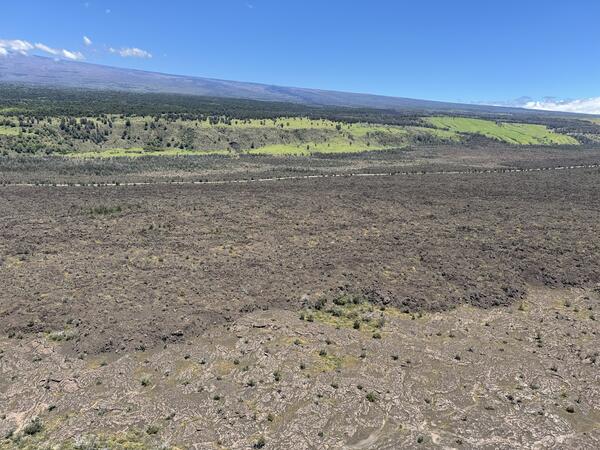
An aerial view of the Kaoiki fault on the south flank of Mauna Loa. Grassy slopes mark this fault, with Mauna Loa lava flows in the foreground and the slope of Mauna Loa in the background. This fault is prominently visible while driving Highway 11 in the Kaʻū Desert area of Hawaiʻi Volcanoes National Park. USGS photo by K. Mulliken.
Images
Mauna Loa images of eruptive activity, field work, and more.
An aerial view of the Kaoiki fault on the south flank of Mauna Loa. Grassy slopes mark this fault, with Mauna Loa lava flows in the foreground and the slope of Mauna Loa in the background. This fault is prominently visible while driving Highway 11 in the Kaʻū Desert area of Hawaiʻi Volcanoes National Park. USGS photo by K. Mulliken.
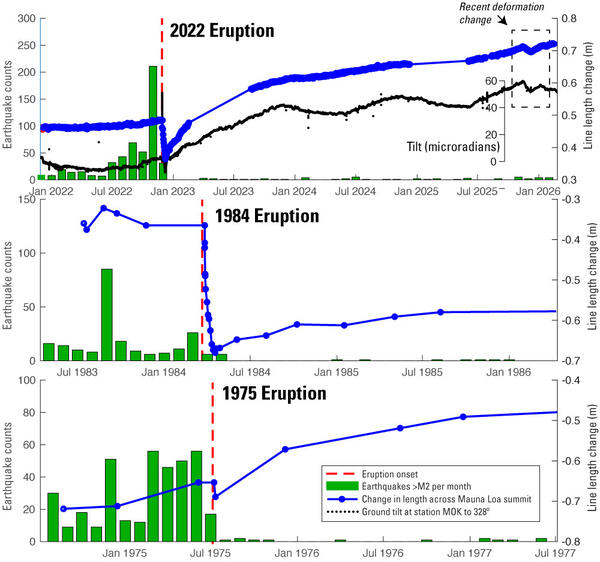
Graphs of ground deformation and earthquake data spanning three eruptions at Mauna Loa.
Graphs of ground deformation and earthquake data spanning three eruptions at Mauna Loa.Graphs of ground deformation and earthquake data spanning three eruptions at Mauna Loa.
Graphs of ground deformation and earthquake data spanning three eruptions at Mauna Loa.
Graphs of ground deformation and earthquake data spanning three eruptions at Mauna Loa.Graphs of ground deformation and earthquake data spanning three eruptions at Mauna Loa.
December 23, 2025 — Mauna Loa summit and Mauna Kea
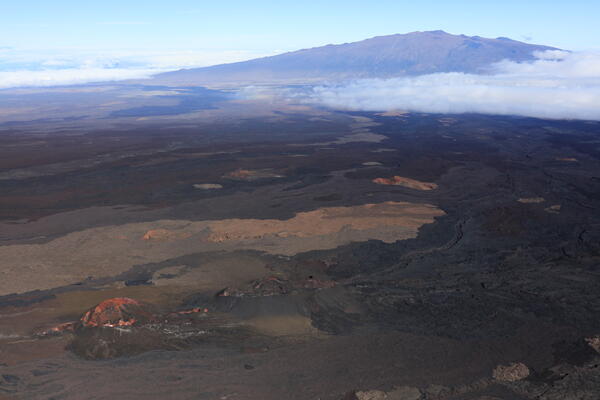
December 23, 2025 — Mauna Loa summit and Mauna KeaAt the end of their Mauna Loa summit overflight on December 23, USGS Hawaiian Volcano Observatory geologists passed the 2022 Northeast Rift Zone eruption site. In this photo, an older vent known as Steaming Cone is visible in the lower-left of the frame (red and white colors), with the 2022 fissure 3 cone just to the right of it (black and brown colors).
December 23, 2025 — Mauna Loa summit and Mauna Kea
December 23, 2025 — Mauna Loa summit and Mauna KeaAt the end of their Mauna Loa summit overflight on December 23, USGS Hawaiian Volcano Observatory geologists passed the 2022 Northeast Rift Zone eruption site. In this photo, an older vent known as Steaming Cone is visible in the lower-left of the frame (red and white colors), with the 2022 fissure 3 cone just to the right of it (black and brown colors).
December 2, 2025—Kīlauea, Mauna Loa, and Mauna Kea
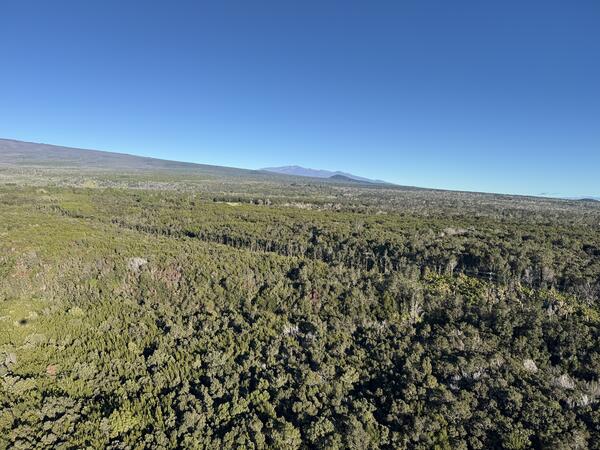
December 2, 2025—Kīlauea, Mauna Loa, and Mauna KeaThis aerial photograph shows Kīlauea, Mauna Loa and Mauna Kea. In the foreground is the forested area just north of Kīlauea caldera; the slope of Mauna Loa's Northeast Rift Zone rises to the left side of the image, while Mauna Kea is visible in the background. USGS photo by K. Mulliken.
December 2, 2025—Kīlauea, Mauna Loa, and Mauna Kea
December 2, 2025—Kīlauea, Mauna Loa, and Mauna KeaThis aerial photograph shows Kīlauea, Mauna Loa and Mauna Kea. In the foreground is the forested area just north of Kīlauea caldera; the slope of Mauna Loa's Northeast Rift Zone rises to the left side of the image, while Mauna Kea is visible in the background. USGS photo by K. Mulliken.
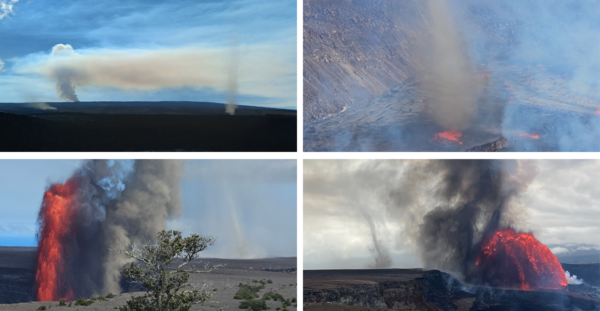
Upper left: a dusty lava puahiohio (at right in frame) above the main 2022 Mauna Loa lava flow on 2 December 2022, with the eruptive plume further in the background (at left in frame). Upper right: a lava puahiohio rips up the crust of the Kīlauea summit lava lake on 7 June 2023.
August 12, 2025 — Mauna Loa monitoring network maintenance
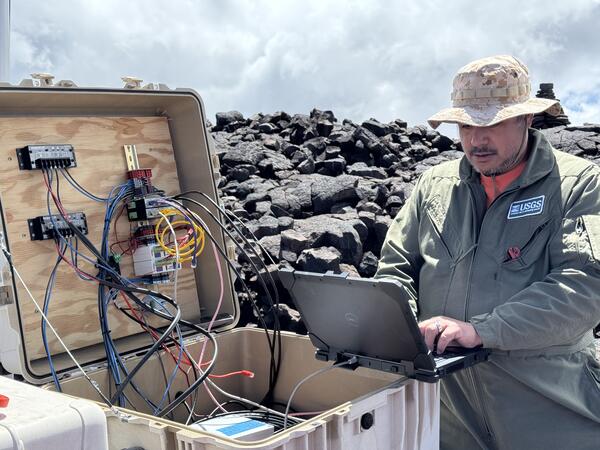
August 12, 2025 — Mauna Loa monitoring network maintenanceOn August 12, USGS-Hawaiian Volcano Observatory scientists visited the ML/MTcam monitoring site on the north side of Moku‘āweoweo—the summit caldera of Mauna Loa volcano. At the site, field engineers changed batteries, installed a new antenna, and replaced solar panels that had been damaged during winter storms. USGS photo by M. Cappos.
August 12, 2025 — Mauna Loa monitoring network maintenance
August 12, 2025 — Mauna Loa monitoring network maintenanceOn August 12, USGS-Hawaiian Volcano Observatory scientists visited the ML/MTcam monitoring site on the north side of Moku‘āweoweo—the summit caldera of Mauna Loa volcano. At the site, field engineers changed batteries, installed a new antenna, and replaced solar panels that had been damaged during winter storms. USGS photo by M. Cappos.
August 12, 2025 — Moku‘āweoweo caldera, Mauna Loa volcano
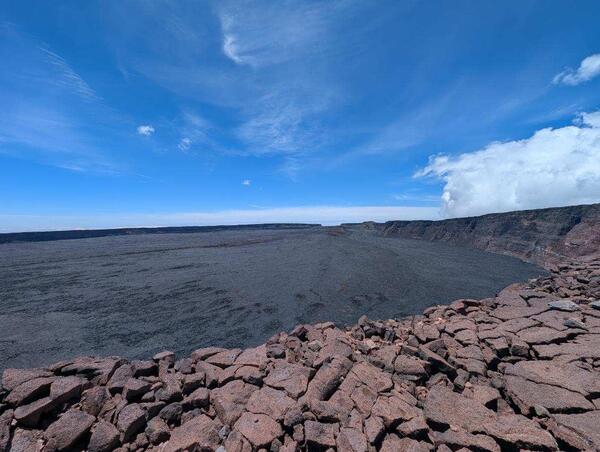
August 12, 2025 — Moku‘āweoweo caldera, Mauna Loa volcanoA view of Moku‘āweoweo, the summit caldera of Mauna Loa, taken from the north rim on August 12, 2025.
August 12, 2025 — Moku‘āweoweo caldera, Mauna Loa volcano
August 12, 2025 — Moku‘āweoweo caldera, Mauna Loa volcanoA view of Moku‘āweoweo, the summit caldera of Mauna Loa, taken from the north rim on August 12, 2025.
August 12, 2025 — Installing antenna at Mauna Loa monitoring station
August 12, 2025 — Installing antenna at Mauna Loa monitoring stationA USGS Hawaiian Volcano Observatory field engineer installs a new antenna at the monitoring station located just southwest of Moku‘āweoweo, where the MOcam and SPcam are located.
August 12, 2025 — Installing antenna at Mauna Loa monitoring station
August 12, 2025 — Installing antenna at Mauna Loa monitoring stationA USGS Hawaiian Volcano Observatory field engineer installs a new antenna at the monitoring station located just southwest of Moku‘āweoweo, where the MOcam and SPcam are located.
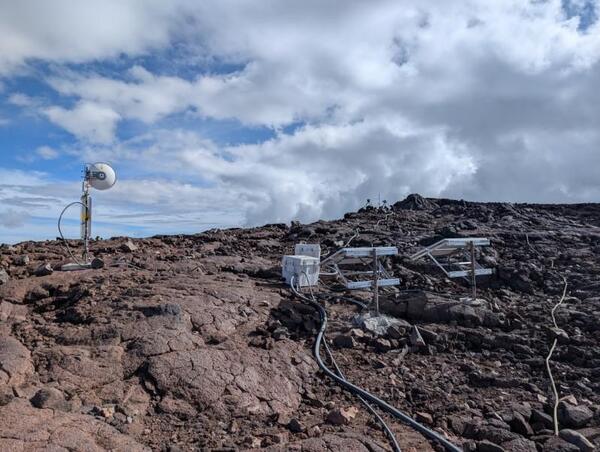
The SPcam (wide angle visual webcam) and MSTcam (thermal camera) are situated next to one another in the summit region of Mauna Loa. Both cameras look south to monitor the uppermost Southwest Rift Zone of Mauna Loa. USGS photo by M. Patrick.
An ahu (cairn) marks the south end of Mokuʻāweoweo, the caldera at the summit of Mauna Loa. This photo shows the cone that formed during the Mauna Loa summit eruption in 1949, in the upper right.
August 12, 2025 — Upgrading volcano monitoring webcams in the summit region of Mauna Loa
August 12, 2025 — Upgrading volcano monitoring webcams in the summit region of Mauna LoaA USGS Hawaiian Volcano Observatory field engineer updates the infrastructure at a remote station in the summit region of Mauna Loa. At this location, two webcams (MOcam and SPcam) were upgraded and a new thermal webcam, the MSTcam, was installed on Mauna Loa summit. USGS photo by M. Patrick.
August 12, 2025 — Upgrading volcano monitoring webcams in the summit region of Mauna Loa
August 12, 2025 — Upgrading volcano monitoring webcams in the summit region of Mauna LoaA USGS Hawaiian Volcano Observatory field engineer updates the infrastructure at a remote station in the summit region of Mauna Loa. At this location, two webcams (MOcam and SPcam) were upgraded and a new thermal webcam, the MSTcam, was installed on Mauna Loa summit. USGS photo by M. Patrick.
The MOcam webcam is situated in the south end of Mokuʻāweoweo, Mauna Loa's summit caldera, and it looks north to monitor the southern portion of the caldera floor. Nearby, the SPcam is pointed south to monitor the uppermost Southwest Rift Zone of Mauna Loa. USGS photo by M. Patrick.
July 17, 2025 — Tephra hill southwest of Halema‘uma‘u eruption, Mauna Loa in background
July 17, 2025 — Tephra hill southwest of Halema‘uma‘u eruption, Mauna Loa in backgroundThe tephra mound on the crater rim southwest of the active vents in Halemaʻumaʻu is nearly 100 feet (30 m) tall after 28 episodes of lava fountaining since December 23, 2024. The profile of the tephra mound nearly mirrors that of Mauna Loa, outlined behind it. USGS photo by K. Mulliken.
July 17, 2025 — Tephra hill southwest of Halema‘uma‘u eruption, Mauna Loa in background
July 17, 2025 — Tephra hill southwest of Halema‘uma‘u eruption, Mauna Loa in backgroundThe tephra mound on the crater rim southwest of the active vents in Halemaʻumaʻu is nearly 100 feet (30 m) tall after 28 episodes of lava fountaining since December 23, 2024. The profile of the tephra mound nearly mirrors that of Mauna Loa, outlined behind it. USGS photo by K. Mulliken.
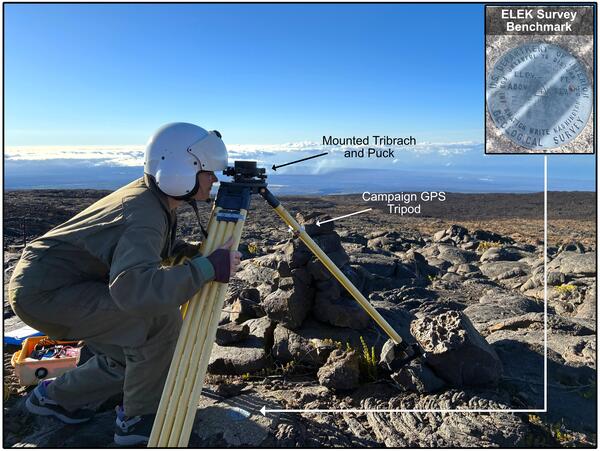
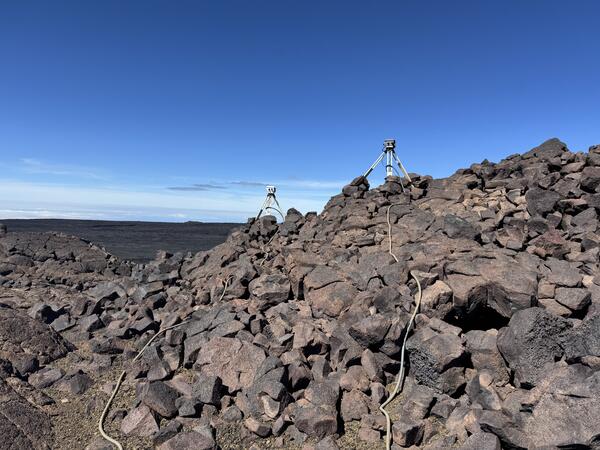
Campaign, also known as 'survey', GPS data augment the permanent, continuously recording GPS instruments in HVO's monitoring network. In this photo, a tripod mounted with a GPS antenna is temporarily installed over a benchmark the rim of Moku‘āweoweo, the caldera at the summit of Mauna Loa.
Interferometric Synthetic Aperture Radar (InSAR) image of Mauna Loa spanning November 16 to December 2, 2022
Interferometric Synthetic Aperture Radar (InSAR) image of Mauna Loa spanning November 16 to December 2, 2022Interferometric Synthetic Aperture Radar (InSAR) image of Mauna Loa spanning November 16 to December 2, 2022. Concentric patterns of colored fringes indicate the complex pattern of deformation during the 2022 Mauna Loa eruption. Lava flows are shown by light red areas and summit tiltmeter site locations are shown with white circles.
Interferometric Synthetic Aperture Radar (InSAR) image of Mauna Loa spanning November 16 to December 2, 2022
Interferometric Synthetic Aperture Radar (InSAR) image of Mauna Loa spanning November 16 to December 2, 2022Interferometric Synthetic Aperture Radar (InSAR) image of Mauna Loa spanning November 16 to December 2, 2022. Concentric patterns of colored fringes indicate the complex pattern of deformation during the 2022 Mauna Loa eruption. Lava flows are shown by light red areas and summit tiltmeter site locations are shown with white circles.
February 12, 2025 — Views of Mauna Kea during Kīlauea summit overflight
February 12, 2025 — Views of Mauna Kea during Kīlauea summit overflightClear weather during a Kīlauea summit monitoring overflight allowed for views of Mauna Kea in the distance, with the slope of Mauna Loa's Northeast Rift Zone visible on the left side of the image. Small amounts of snow from a recent storm remain visible on the slopes of Mauna Kea. USGS photo by P. Dotray.
February 12, 2025 — Views of Mauna Kea during Kīlauea summit overflight
February 12, 2025 — Views of Mauna Kea during Kīlauea summit overflightClear weather during a Kīlauea summit monitoring overflight allowed for views of Mauna Kea in the distance, with the slope of Mauna Loa's Northeast Rift Zone visible on the left side of the image. Small amounts of snow from a recent storm remain visible on the slopes of Mauna Kea. USGS photo by P. Dotray.
Hazy conditions caused by sulfur dioxide emissions from Kīlauea, Hawai‘i
Hazy conditions caused by sulfur dioxide emissions from Kīlauea, Hawai‘iHazy conditions caused by sulfur dioxide (SO2) emissions from Halema‘uma‘u crater, Kīlauea, Hawai‘i. USGS photo by Jennifer Lewicki, December 25, 2024.
Hazy conditions caused by sulfur dioxide emissions from Kīlauea, Hawai‘i
Hazy conditions caused by sulfur dioxide emissions from Kīlauea, Hawai‘iHazy conditions caused by sulfur dioxide (SO2) emissions from Halema‘uma‘u crater, Kīlauea, Hawai‘i. USGS photo by Jennifer Lewicki, December 25, 2024.
November 7, 2024 — Getting webcams back online at Mauna Loa summit
November 7, 2024 — Getting webcams back online at Mauna Loa summitHigh winds at the summit of Mauna Loa ripped several solar panels from their masts, damaging them. HVO staff performed a partial fix to the site to bring the summit webcams back online November 7, 2024. USGS photo by M. Patrick.
November 7, 2024 — Getting webcams back online at Mauna Loa summit
November 7, 2024 — Getting webcams back online at Mauna Loa summitHigh winds at the summit of Mauna Loa ripped several solar panels from their masts, damaging them. HVO staff performed a partial fix to the site to bring the summit webcams back online November 7, 2024. USGS photo by M. Patrick.
November 7, 2024 — Getting webcams back online at Mauna Loa summit
November 7, 2024 — Getting webcams back online at Mauna Loa summitHVO staff inspected the radio telemetry site at the summit of Mauna Loa and found wind damage to several components. Mauna Kea is in the background. USGS photo by M. Patrick.
November 7, 2024 — Getting webcams back online at Mauna Loa summit
November 7, 2024 — Getting webcams back online at Mauna Loa summitHVO staff inspected the radio telemetry site at the summit of Mauna Loa and found wind damage to several components. Mauna Kea is in the background. USGS photo by M. Patrick.
November 7, 2024 — Getting webcams back online at Mauna Loa summit
November 7, 2024 — Getting webcams back online at Mauna Loa summitMauna Loa summit webcams have been down for several months due to wind damage at the radio telemetry site. On November 7, 2024, HVO staff visited the site and performed a partial fix that brought the webcams back online. Further visits will be needed to repair damaged solar panels. USGS photo by M. Patrick.
November 7, 2024 — Getting webcams back online at Mauna Loa summit
November 7, 2024 — Getting webcams back online at Mauna Loa summitMauna Loa summit webcams have been down for several months due to wind damage at the radio telemetry site. On November 7, 2024, HVO staff visited the site and performed a partial fix that brought the webcams back online. Further visits will be needed to repair damaged solar panels. USGS photo by M. Patrick.
August 2, 2024—Sulfur Cone gas monitoring maintenance
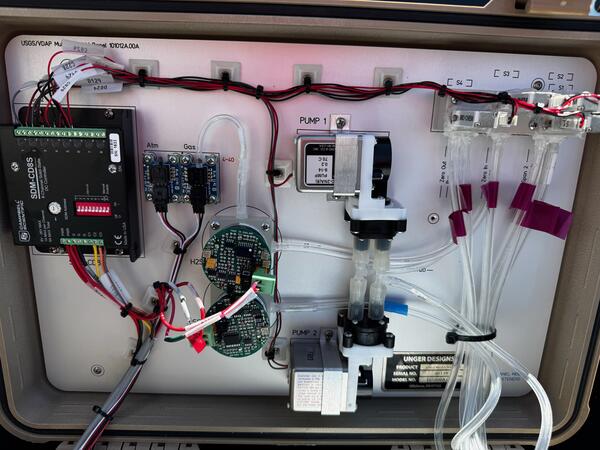
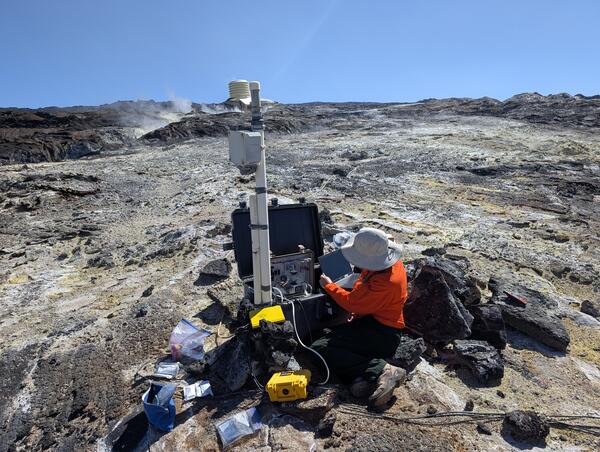
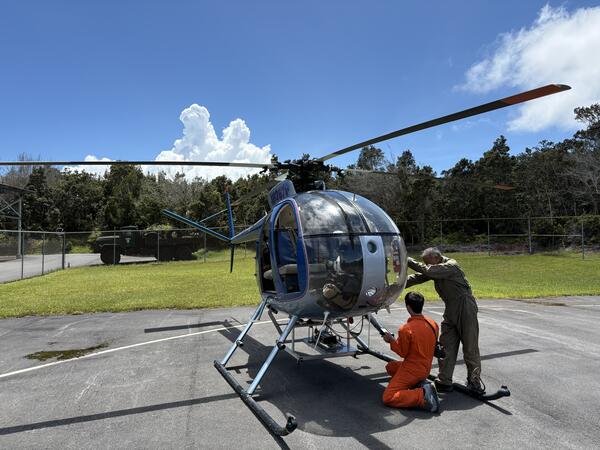
August 2, 2024—Sulfur Cone gas monitoring maintenanceOn August 2,2024, Hawaiian Volcano Observatory Gas Scientists flew via helicopter to the Sulfur Cone Multi-Gas instrumentation site on Mauna Loa's Southwest Rift Zone, which is at an elevation of 3,430 meters (11,240 feet) above sea level.
August 2, 2024—Sulfur Cone gas monitoring maintenance
August 2, 2024—Sulfur Cone gas monitoring maintenanceOn August 2,2024, Hawaiian Volcano Observatory Gas Scientists flew via helicopter to the Sulfur Cone Multi-Gas instrumentation site on Mauna Loa's Southwest Rift Zone, which is at an elevation of 3,430 meters (11,240 feet) above sea level.