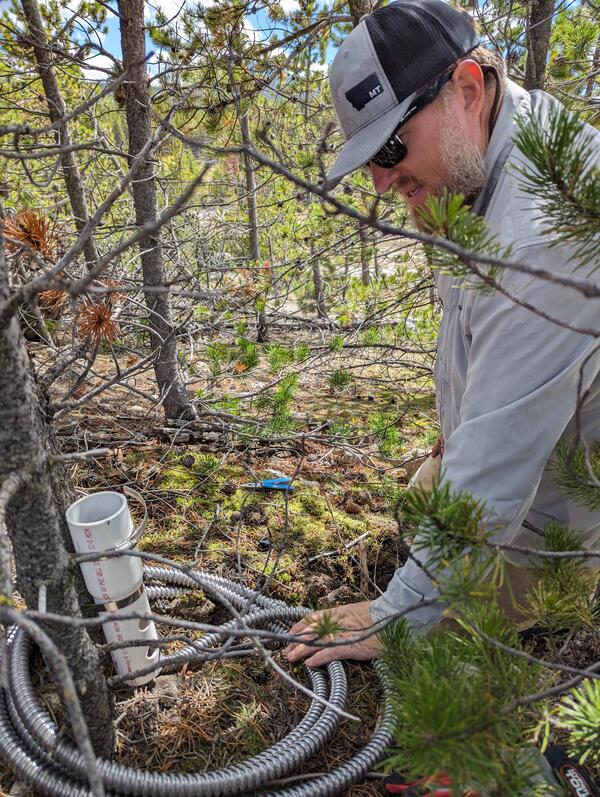
Infrasound sensor installation at Norris Geyser Basin
Infrasound sensor installation at Norris Geyser BasinDr.


Official websites use .gov
A .gov website belongs to an official government organization in the United States.

Secure .gov websites use HTTPS
A lock () or https:// means you’ve safely connected to the .gov website. Share sensitive information only on official, secure websites.

Images of Yellowstone.
Dr.

A foggy, early morning view looking down the Gibbon River, off of Grand Loop Rd in Yellowstone National Park, Wyoming.
A foggy, early morning view looking down the Gibbon River, off of Grand Loop Rd in Yellowstone National Park, Wyoming.

Looking down from the lookout point at Brink of Lower Falls, over the Yellowstone River, as it flows eastward through the "Grand Canyon of Yellowstone".
Looking down from the lookout point at Brink of Lower Falls, over the Yellowstone River, as it flows eastward through the "Grand Canyon of Yellowstone".

On the drive south of Mammoth Springs, you pass through Silver Gate which is a landslide deposit of travertine stone at least 400,000 years old.
On the drive south of Mammoth Springs, you pass through Silver Gate which is a landslide deposit of travertine stone at least 400,000 years old.

Looking down on the lower portion of Artists' Paintpots in Yellowstone National Park, Wyoming. Artists' Paintpots is a hydrothermal area with many colorful mud pots, hot springs, and geysers.
Looking down on the lower portion of Artists' Paintpots in Yellowstone National Park, Wyoming. Artists' Paintpots is a hydrothermal area with many colorful mud pots, hot springs, and geysers.

A view of Roaring Mountain in Yellowstone National Park, Wyoming. "Roaring Mountain is a large, acidic thermal area (solfatara) that contains many steam vents (fumaroles). In the late 1800s and early 1900s, the number, size, and power of the fumaroles was much greater than today." (NPS)
A view of Roaring Mountain in Yellowstone National Park, Wyoming. "Roaring Mountain is a large, acidic thermal area (solfatara) that contains many steam vents (fumaroles). In the late 1800s and early 1900s, the number, size, and power of the fumaroles was much greater than today." (NPS)

Need time to concentrate or relax? Then listen to the natural sounds of Rustic Falls in Yellowstone National Park, Wyoming. Rustic Falls is a few miles south of Mammoth Hot Springs in Yellowstone National Park, Wyoming.
Need time to concentrate or relax? Then listen to the natural sounds of Rustic Falls in Yellowstone National Park, Wyoming. Rustic Falls is a few miles south of Mammoth Hot Springs in Yellowstone National Park, Wyoming.

Need time to concentrate or relax? Then listen to the natural sounds of Kepler Cascades in Yellowstone National Park, Wyoming. Kepler Cascades is located just a couple miles away from Old Faithful within Yellowstone National Park, Wyoming.
Need time to concentrate or relax? Then listen to the natural sounds of Kepler Cascades in Yellowstone National Park, Wyoming. Kepler Cascades is located just a couple miles away from Old Faithful within Yellowstone National Park, Wyoming.

Mount Everts, as seen from Mammoth Hot Springs near the North Entrance of Yellowstone National Park.
Mount Everts, as seen from Mammoth Hot Springs near the North Entrance of Yellowstone National Park.

Section of a sediment core from Rush Lake, Lower Geyser Basin, Yellowstone National Park.
Section of a sediment core from Rush Lake, Lower Geyser Basin, Yellowstone National Park.

GPS data from station P716, near Canyon Village, spanning 2005–2023. Top plot shows motion in a north-south direction (positive change is north), middle is east-west motion (positive change is east), and bottom plot is up-down motion (positive change is up).
GPS data from station P716, near Canyon Village, spanning 2005–2023. Top plot shows motion in a north-south direction (positive change is north), middle is east-west motion (positive change is east), and bottom plot is up-down motion (positive change is up).

View to the southwest of the eastern front of the Gallatin Range from Gardners Hole. The East Gallatin-Reese Creek fault system runs along the base of the range at the prominent break-in-slope in the trees. Photo by James Mauch, Wyoming State Geological Survey, on August 29, 2023.
View to the southwest of the eastern front of the Gallatin Range from Gardners Hole. The East Gallatin-Reese Creek fault system runs along the base of the range at the prominent break-in-slope in the trees. Photo by James Mauch, Wyoming State Geological Survey, on August 29, 2023.

A portion of organic-rich lake mud recovered from Rush Lake, in the Lower Geyser Basin of Yellowstone National Park. Younger sediments are to the left and older sediments are to the right. The researcher is pointing to a thin, white layer—the Mazama ash, produced during the eruption 7600 years ago that formed Crater Lake in Oregon.
A portion of organic-rich lake mud recovered from Rush Lake, in the Lower Geyser Basin of Yellowstone National Park. Younger sediments are to the left and older sediments are to the right. The researcher is pointing to a thin, white layer—the Mazama ash, produced during the eruption 7600 years ago that formed Crater Lake in Oregon.
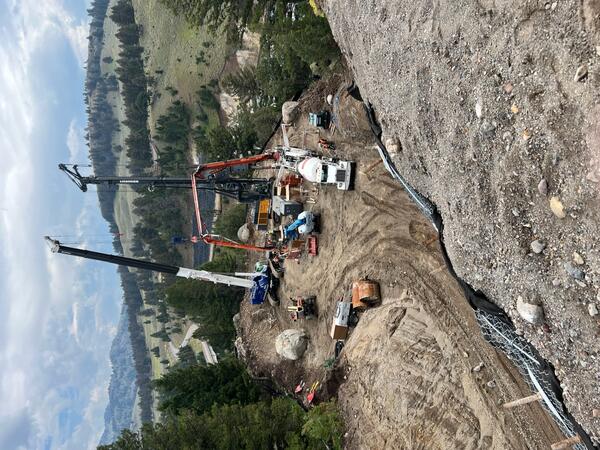
Pouring sulfate-resistant cement for one of the bridge footers after a drill hole has been completed. The existing bridge can be seen through the trees on the left side of the picture.
Pouring sulfate-resistant cement for one of the bridge footers after a drill hole has been completed. The existing bridge can be seen through the trees on the left side of the picture.

Drilling for the new Yellowstone River Bridge near Tower Junction. A small, yellow, personal 4-gas safety monitor can be seen on the upper left breast pocket on the person in the far right of the picture. Photo by Ken Sims (University of Wyoming), August 3, 2023.
Drilling for the new Yellowstone River Bridge near Tower Junction. A small, yellow, personal 4-gas safety monitor can be seen on the upper left breast pocket on the person in the far right of the picture. Photo by Ken Sims (University of Wyoming), August 3, 2023.

Photo of Devil’s Slide, Montana, looking across the Yellowstone River. The red streak is a Triassic shale layer. Rocks to the right of the streak are older and to the left are younger. USGS photo by Mike Poland, August 2, 2023.
Photo of Devil’s Slide, Montana, looking across the Yellowstone River. The red streak is a Triassic shale layer. Rocks to the right of the streak are older and to the left are younger. USGS photo by Mike Poland, August 2, 2023.

Streamgage site and profiling tool on the Yellowstone River at Corwin Springs, Montana. The gage house narrowly avoided damage during the June 2022 flood, which eroded the downstream bank. The river profiling instrument helps to map the river bottom to assess streamflow rates and conditions. USGS photo by Mike Poland, July 31, 2023.
Streamgage site and profiling tool on the Yellowstone River at Corwin Springs, Montana. The gage house narrowly avoided damage during the June 2022 flood, which eroded the downstream bank. The river profiling instrument helps to map the river bottom to assess streamflow rates and conditions. USGS photo by Mike Poland, July 31, 2023.

Map of Norris Geyser Basin showing the locations of major subbasins, roads and trails, and Nuphar Lake.
Map of Norris Geyser Basin showing the locations of major subbasins, roads and trails, and Nuphar Lake.

High-resolution satellite images of the Porcelain Basin and Nuphar Lake areas of Norris Geyser Basin acquired by Quickbird-2 on September 11, 2006 (left), WorldView-3 on July 7, 2016 (middle), and WorldView-3 on March 30, 2022 (right). Note the change in color of Nuphar lake, from deep green to light blue, over time, as well as the increased evidence of flow f
High-resolution satellite images of the Porcelain Basin and Nuphar Lake areas of Norris Geyser Basin acquired by Quickbird-2 on September 11, 2006 (left), WorldView-3 on July 7, 2016 (middle), and WorldView-3 on March 30, 2022 (right). Note the change in color of Nuphar lake, from deep green to light blue, over time, as well as the increased evidence of flow f

Schematic model of Yellowstone’s subsurface magmatic sill complex based on seismic data collected in 2020.
Schematic model of Yellowstone’s subsurface magmatic sill complex based on seismic data collected in 2020.

High-resolution satellite images of the Porcelain Basin and Nuphar Lake areas of Norris Geyser Basin acquired by Quickbird-2 on September 11, 2006 and WorldView-3 on March 30, 2022. Note the change in color of Nuphar lake, from deep green to light blue, over time, as well as the increased evidence of flow from thermal features on the east side of Porcelain Bas
High-resolution satellite images of the Porcelain Basin and Nuphar Lake areas of Norris Geyser Basin acquired by Quickbird-2 on September 11, 2006 and WorldView-3 on March 30, 2022. Note the change in color of Nuphar lake, from deep green to light blue, over time, as well as the increased evidence of flow from thermal features on the east side of Porcelain Bas