



Land Use, Change, and Forecasting
Land Use, Change, and Forecasting
Human activities and their associated impact on the landscape have significantly affected the condition of the Chesapeake Bay and its watershed. The USGS monitors land-cover change and simulates potential future development to help partners reduce the effects on water quality and habitats and to protect critical lands.
Filter Total Items: 24

The “sediment shadow” in Chesapeake Bay’s tidal freshwater rivers has important implications for restoration
Chesapeake Bay restoration efforts are focused on reducing nitrogen, phosphorus, and sediment loads to the estuary. A new synthesis of existing long-term records of suspended-sediment concentrations suggests that only a limited amount of watershed sediment is currently transported by rivers past the tidal freshwater zone and into saltier waters of the Chesapeake Bay.
USGS Chesapeake Bay Science Accomplishments for 2025
The Chesapeake Bay watershed is home to 18 million people and some of America’s most treasured natural resources – lands, waters, and wildlife that support a strong economy and cherished outdoor traditions, such as hunting and fishing. From local organizations to federal agencies, partners throughout the watershed are working to protect these resources. These partners rely on our unbiased, gold...
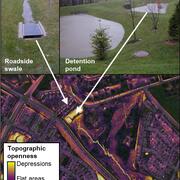
Remotely mapping stormwater facility footprints and storage volumes
Stormwater management practices are being used throughout the Chesapeake Bay watershed to reduce flood risks and pollutant loads, but consistent and comprehensive maps of these practices are often lacking. Stormwater managers often have incomplete information about the location and storage volume of stormwater facilities within their jurisdiction. Therefore, the USGS is working to develop...
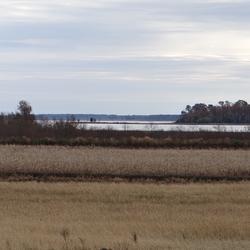
Prioritizing marsh restoration needs throughout Chesapeake Bay
A new USGS study estimates potential losses of Chesapeake Bay salt marshes that could occur in the next 80 years if no marsh restoration is undertaken. Using a suite of models, USGS researchers identified how future potential marsh changes can be used to prioritize present-day site-specific planning and restoration needs.

Key considerations to accurately predict tidal marsh longevity
A recent study provides key considerations about modeling the timeline of tidal marsh longevity. These timelines can help resource managers envision what future marsh conditions may look like, informing current and long-term adaptive management strategies.

Coastal Wetland Vulnerability to Climate Change and Sea-Level Rise: Understanding Ecological Thresholds and Ecosystem Transformations
Eighteen USGS coastal scientists from all four coasts of the conterminous United States are working together to advance the understanding of climate change and sea-level rise impacts to coastal wetlands.
By
California Water Science Center, Chesapeake Bay Activities, Eastern Ecological Science Center, Florence Bascom Geoscience Center, Great Lakes Science Center, Pacific Coastal and Marine Science Center, St. Petersburg Coastal and Marine Science Center, Western Ecological Research Center (WERC), Western Geographic Science Center, Wetland and Aquatic Research Center , Woods Hole Coastal and Marine Science Center

Discovering Connections Across America's Lands and Waters
Through collaboration and coordination, USGS research helps preserve and restore America’s most iconic landscapes. We apply insights across ecosystems to understand how these systems function and change, helping natural resource managers protect our Nation’s natural heritage for generations to come.
USGS Chesapeake Accomplishments and Highlights for 2024
As a home to 18 million people and a destination for countless visitors seeking recreational opportunities, the health of the Chesapeake Bay watershed is of critical importance. The U.S. Geological Survey (USGS) is a leading provider of data-driven insights about the condition of the watershed’s lands, waters, fish, and wildlife. These insights and our collaborative work with partners throughout...

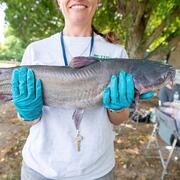
New study highlights linkages among land use, water chemistry, and the health of Smallmouth Bass in the Susquehanna River watershed
Contaminants associated with agricultural and developed land uses may negatively affect SMB health and disease resistance in the Susquehanna River watershed.

Using Multiple Indicators to Assess Stream Condition in the Chesapeake Bay
USGS is working with federal, state and local partners to develop multiple assessments of stream and river conditions in non-tidal areas of the Chesapeake Bay watershed. These assessments will help managers preserve stream health and improve biological conditions in impaired streams as the human population and climate continue to change in this region.

New study highlights impact of current and historic land use on stream incision in Maryland Piedmont headwaters
A new method was developed to remotely identify small, eroding streams and measure change over time.

Chesapeake Bay Land Use and Land Cover data is now published in additional formats
The Chesapeake Bay Land Use and Land Cover (LULC) database was developed by the University of Vermont’s Spatial Analysis Laboratory in cooperation with Chesapeake Conservancy (CC) and U.S. Geological Survey (USGS). The high-resolution land data were developed as part of a 6-year Cooperative Agreement between Chesapeake Conservancy and the U.S. Environmental Protection Agency (EPA), and a separate...