



Rising mist and fall colors at Snowden Pond, Patuxent Research Refuge, Laurel, MD. Patuxent Research Refuge is the only National Wildlife Refuge established explicitly for research purposes, and is home to both USFWS and USGS programs, including the Bird Banding Lab.
Images
Eastern Ecological Science Center images.
Filter Total Items: 5122

Mist over Patuxent Research Refuge's Snowden pond
Rising mist and fall colors at Snowden Pond, Patuxent Research Refuge, Laurel, MD. Patuxent Research Refuge is the only National Wildlife Refuge established explicitly for research purposes, and is home to both USFWS and USGS programs, including the Bird Banding Lab.

Bird in mist net at Patuxent Research Refuge
Gotcha! A ruby-crowned kinglet waits to be extracted from a mist net at the Bird Banding Lab's fall migration banding station. Powerlines that run through the Patuxent Wildlife Research Refuge, near Laurel, MD are managed as shrub habitat instead of mowed, which provides stopover habitat for migratory birds.
Gotcha! A ruby-crowned kinglet waits to be extracted from a mist net at the Bird Banding Lab's fall migration banding station. Powerlines that run through the Patuxent Wildlife Research Refuge, near Laurel, MD are managed as shrub habitat instead of mowed, which provides stopover habitat for migratory birds.

Whooping Cranes from Wash. Post
Recently a long-time resident of Patuxent Wildlife Research Center (now part of the Eastern Ecological Science Center) made the Washington Post. A color photograph of "Zinc" and "Mrs. Zinc" was featured in a story about naming animals. Zinc received his unique name when he was less than one-year-old.
Recently a long-time resident of Patuxent Wildlife Research Center (now part of the Eastern Ecological Science Center) made the Washington Post. A color photograph of "Zinc" and "Mrs. Zinc" was featured in a story about naming animals. Zinc received his unique name when he was less than one-year-old.

Fall Cape May Warbler
A Cape May Warbler pauses during fall migration on its journey south in Owings, MD
A Cape May Warbler pauses during fall migration on its journey south in Owings, MD

USGS and USFWS biologists survey terns at Poplar Island, MD
USGS and USFWS biologists survey terns at Poplar Island, MDAt Poplar Island in the Chesapeake Bay, MD, Peter McGowan (USFWS, left) and Diann Prosser (USGS, right) capture fledgling common terns to read plastic colored leg bands that identify individual birds. Here interagency collaboration leads to benefits for wildlife and people.
USGS and USFWS biologists survey terns at Poplar Island, MD
USGS and USFWS biologists survey terns at Poplar Island, MDAt Poplar Island in the Chesapeake Bay, MD, Peter McGowan (USFWS, left) and Diann Prosser (USGS, right) capture fledgling common terns to read plastic colored leg bands that identify individual birds. Here interagency collaboration leads to benefits for wildlife and people.

Cave Salamander sampling crew
Northeast Region Photo Contest Winner | October 2018 | People
Salamander sampling crew
Northeast Region Photo Contest Winner | October 2018 | People
Salamander sampling crew

BBL banding at Patuxent Research Refuge
Think habitat: not grass. Powerlines that run through the Patuxent Wildlife Research Refuge, near Laurel, MD are managed as shrub habitat instead of mowed, which provides stopover habitat for migratory birds.
Think habitat: not grass. Powerlines that run through the Patuxent Wildlife Research Refuge, near Laurel, MD are managed as shrub habitat instead of mowed, which provides stopover habitat for migratory birds.

Great blue heron at Snowden pond
Great Blue Heron at Snowden Pond, Patuxent Research Refuge, Laurel, MD. Patuxent Research Refuge is the only National Wildlife Refuge established explicitly for research purposes, and is home to both USFWS and USGS programs, including the Bird Banding Lab.
Great Blue Heron at Snowden Pond, Patuxent Research Refuge, Laurel, MD. Patuxent Research Refuge is the only National Wildlife Refuge established explicitly for research purposes, and is home to both USFWS and USGS programs, including the Bird Banding Lab.

Zebra Swallowtail
A not so common Zebra Swallowtail nectaring on the the Patuxent Research Refuge in Laurel, MD
A not so common Zebra Swallowtail nectaring on the the Patuxent Research Refuge in Laurel, MD

Gulf Coast South of Lafayette, LA
View of the barrier islands off Lafayette, LA while conducting low-level aerial seabird surveys in the Gulf of Mexico, as part of the GoMMAPPS project.
View of the barrier islands off Lafayette, LA while conducting low-level aerial seabird surveys in the Gulf of Mexico, as part of the GoMMAPPS project.

Oil Platform
Oil platform in the Gulf of Mexico viewed as part of GoMMAPPS aerial surveys for seabirds.
Oil platform in the Gulf of Mexico viewed as part of GoMMAPPS aerial surveys for seabirds.

Eelgrass: A Habitat At Risk
Eelgrass (Zostera marina) forms extensive meadows in low intertidal and shallow subtidal areas of estuaries and embayments along the Northwest Atlantic coast. Eelgrass meadows are noted as critical habitat for many recreational and commercial fish species as well as small forage fish.
Eelgrass (Zostera marina) forms extensive meadows in low intertidal and shallow subtidal areas of estuaries and embayments along the Northwest Atlantic coast. Eelgrass meadows are noted as critical habitat for many recreational and commercial fish species as well as small forage fish.
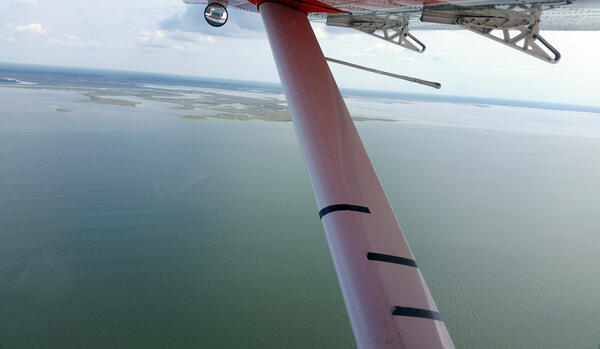
Aerial Survey Wing Markings
Standard wing markings on a US Fish and Wildlife Service Kodiak amphibious aircraft used to denote strip-transect distance bands to aid observers in data collection for the GoMMAPPS aerial seabird surveys from 2017-2020 and 2022-2023.
Standard wing markings on a US Fish and Wildlife Service Kodiak amphibious aircraft used to denote strip-transect distance bands to aid observers in data collection for the GoMMAPPS aerial seabird surveys from 2017-2020 and 2022-2023.

American Bullfrog Tadpole
This is a larval American Bullfrog, a large species of frog found throughout the eastern US. The larvae of this species can be identified by their large size and small black spots on the tail fin.
This is a larval American Bullfrog, a large species of frog found throughout the eastern US. The larvae of this species can be identified by their large size and small black spots on the tail fin.

Red-tailed Hawk
A Red-tailed Hawk pursued by Common Grackles and an Eastern Kingbird along the Williamsport Breeding Bird Survey route
A Red-tailed Hawk pursued by Common Grackles and an Eastern Kingbird along the Williamsport Breeding Bird Survey route

USGS National Fish Health Research Laboratory
USGS Eastern Ecological Science Center (formerly Leetown Science Center) National Fish Health Laboratory, Kearneysville, WV
USGS Eastern Ecological Science Center (formerly Leetown Science Center) National Fish Health Laboratory, Kearneysville, WV

Cerulean Warbler in shrub
A cerulean warbler (Setophaga cerulea) in a shrub, partially obscured by branches.
A cerulean warbler (Setophaga cerulea) in a shrub, partially obscured by branches.

Blue-winged Teal
A flock of Blue-winged teal at Uhler Marsh at the Eastern Ecological Science Center on the Patuxent Research Refuge in Laurel, MD.
A flock of Blue-winged teal at Uhler Marsh at the Eastern Ecological Science Center on the Patuxent Research Refuge in Laurel, MD.

Spotted Salamander
A photo of an adult spotted salamander (Ambystoma maculatum). Spotted salamanders are found throughout the northeast US, where they spend most of their lives underground. They emerge in the late winter and early spring to breed and lay eggs in vernal pools.
A photo of an adult spotted salamander (Ambystoma maculatum). Spotted salamanders are found throughout the northeast US, where they spend most of their lives underground. They emerge in the late winter and early spring to breed and lay eggs in vernal pools.

Myobacterial culture
Mycobacteriosis is a bacterial disease that can affect many species of fish around the world. We are studying the impacts of mycobacteriosis among northern snakehead from the Potomac River to better understand this disease in the species and the potential impacts to other aquatic animals.
Mycobacteriosis is a bacterial disease that can affect many species of fish around the world. We are studying the impacts of mycobacteriosis among northern snakehead from the Potomac River to better understand this disease in the species and the potential impacts to other aquatic animals.

Aerial Survey Aircraft
US Fish and Wildlife Service Kodiak amphibious aircraft used in the GoMMAPPS aerial seabird surveys from 2017-2020 and 2022-2023.
US Fish and Wildlife Service Kodiak amphibious aircraft used in the GoMMAPPS aerial seabird surveys from 2017-2020 and 2022-2023.