



Fiscal Year 2025 Highlights from EESC’s Disease Decision Analysis and Research Group
The Disease Decision Analysis and Research (DDAR) group is a multi-disciplinary team based out of the Eastern Ecological Science Center whose strengths are in ecology, decision sciences, quantitative modeling, social sciences, and natural resource management. Learn more about the recent activities of this team below.
In the past year, the USGS scientists of the Disease Decision Analysis and Research (DDAR) group and their collaborators continued to support the management of wildlife diseases by working closely with state, federal, and tribal partners on several key initiatives. Recent highlights include:
- Producing decision-relevant science to inform elk and bison feedground management decisions in the state of Wyoming;
- Supporting the response to highly pathogenic avian influenza by (1) analyzing outbreaks in commercial poultry and assessing relative importance of different on-the-farm practices and (2) exploring exposure of non-traditional host species to assess continued mortality risk and inform state management efforts;
- Supporting the state of Vermont in estimating the time-to-arrival and future impacts of chronic wasting disease on white-tailed deer and moose and how management can help delay impacts and reduce agency costs;
- Working to estimate the risk of chronic wasting disease introduction to western U.S. states and Canadian provinces that are currently disease-free;
- Supporting state, federal, and tribal land managers in quantitatively assessing options to reduce the risk of an emerging infectious salamander fungal disease (Bsal) to native amphibians;
- Leading an international effort to coordinate information sharing and scientific information to address the risk of the introduction of Bsal to North American amphibians;
- Advancing the science and practice of wildlife disease decision analysis with perspectives and guidance for informing management responses in leading journals; and
- Growing our network to over 20 members and 40 collaborating partners across the country.
As a team with wide-ranging scientific capabilities, DDAR continues to work directly with decision makers for rapid response to both persistent and emerging infectious disease issues.

News and Notes
Chronic Wasting Disease
In the past two decades, the range of chronic wasting disease in wild and farmed cervids has expanded into the northeastern and western US states (see map). State, federal, and tribal partners in regions that are not yet affected are working to better understand the time-to-arrival of chronic wasting disease as well as the appropriate response, including how to delay arrival, how to design efficient surveillance programs, and finally, how to respond to a detection once chronic wasting disease does arrive. The potential proactive actions may include limiting carcass movement and improper disposal, limiting captive cervid transport and cross-fence interactions with wild deer, and partnering with neighboring states to understand rates of natural spread. The reactive measures may include changes to harvest rates and targeted removals. To analyze effects of proactive and reactive management alternatives, DDAR scientists including quantitative ecologists, decision analysts, and social scientists are developing decision-support tools that help estimate a range of natural resource, economic, and public health related objectives.
Highly Pathogenic Avian Influenza
In response to the ongoing loss of domestic poultry to highly pathogenic avian influenza (HPAI), Dr. Diann Prosser and Jeffery Sullivan and DDAR affiliate Dr. Matthew Gonnerman worked with the University of Maryland and the U.S. Department of Agriculture to assess how landscape features and on-the-farm practices such as carcass and bird waste handling affects the risk of spillover of HPAI from wild birds. These data can be used by poultry producers to guide decision making regarding biosecurity implementation. In addition, the team is working to modify risk models to explore spillover from wild waterfowl to non-traditional avian host species such as waterbirds and raptors.
Dr. Diann Prosser and Jeffery Sullivan and DDAR affiliate Dr. Johanna Harvey have been working with the University of Maryland and numerous institutions throughout the Chesapeake Bay region to assess the exposure of non-traditional avian host species to HPAI. These data are being used by state biologists to assess continued risk of population level impacts in species of interest such as Common Terns.

White-nose Syndrome
USGS has been working collaboratively with state, federal, and tribal agencies across Montana to evaluate management strategies for bat populations susceptible to white-nose syndrome (WNS). Dr. Evan Grant and his research group led a team using structured decision-making to identify agency and statewide management objectives. The team also developed a multistate occupancy model, which they fit to acoustic monitoring data from 2020-2022, to estimate and forecast abundance dynamics for susceptible bat populations. Using a formal process of eliciting expert judgment, they obtained estimates for disease and management effects across different scenarios. The analysis provides a structured and transparent framework for decision-making under uncertainty, which can be adapted as new data become available from the USGS-led North American Bat Monitoring (NABat) Program and statewide monitoring efforts. This work establishes a template for proactive disease management and demonstrates how decision analysis can guide collaborative conservation efforts across fragmented jurisdictions.
Batrachochytrium salamandrivorans
Following a quantitative evaluation of the benefits of proactive management for mitigating the threat of an emerging infectious disease of amphibians, USGS worked with five U.S. national wildlife refuge managers to evaluate management options for responding to the threat of Batrachochytrium salamandrivorans to amphibian populations, considering the multiple dimensions of real management decisions. DDAR principal investigators worked with managers across the northeastern U.S. to characterize the full complexity of their multi-criteria decision contexts for addressing B. salamandrivorans disease risk. The analysis will provide quantitative evidence for the optimal timing to mitigate disease risk, considering the full range of objectives that are considered by each refuge manager, where the local context for a disease management decision may affect the optimal management action. This approach to framing and evaluating B. salamandrivorans disease management decisions will provide transparent and quantitative support for identifying response timing to safeguard disease-threatened populations.
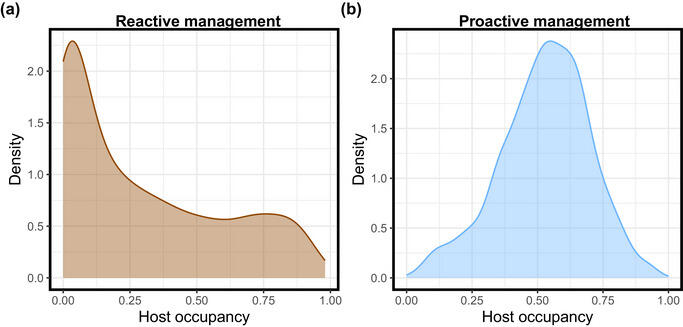
Although scientific research can help reduce uncertainty, decision analysis and quantitative modeling can help resolve the efficacy of different management actions across full suite of agency objectives. DDAR affiliate Dr. Molly Bletz and USGS’s Dr. Evan Grant helped agencies evaluate the efficacy of proactive versus reactive management strategies in combatting the potential invasion of chytrid fungus in North America (see figure below).
Workshops and Trainings
In addition to projects, DDAR also offers training to both internal and external audiences. Here are a few recent offerings:
Advanced Structured Decision Making Practicum. (Training). National Conservation Training Center, Shepherdstown, West Virginia. October 28-November 1, 2024. (Instructor: MC Runge)
Fundamentals of Structured Decision Making. (Training). National Conservation Training Center. Virtual offering. March 17-20, 2025. (Instructor: JD Cook)
Introduction to Structured Decision Making. (Training). Bureau of Reclamation Bay-Delta Office, Sacramento, California. June 23-27, 2025. (Instructors: MC Runge, JD Cook)
Our Team
Principal Investigators at USGS Eastern Ecological Science Center
Jonathan D. Cook, Research Wildlife Biologist
Evan H. Campbell Grant, Research Wildlife Biologist
Howard Ginsberg (Retired), Emeritus Scientist
Michael C. Runge, Research Ecologist
Diann J. Prosser, Research Wildlife Biologist
Collaborators
Larissa Bailey, Associate Professor, Department of Fish, Wildlife, and Conservation, Colorado State University
Richard E.W. Berl, Research Social Scientist, National Wildlife Health Center, USGS
Riley Bernard, Assistant Professor, Department of Zoology and Physiology, University of Wyoming
Molly Bletz, Assistant Professor, Department of Ecosystem Science and Management, Penn State University
Janelle Couret, Assistant Professor, Department of Biological Sciences, University of Rhode Island
Graziella V. DiRenzo, Assistant Unit Leader, USGS, Massachusetts Cooperative Fish and Wildlife Research Unit
Johanna Harvey, Assistant Professor, Department of Natural Resources Science, University of Rhode Island
Brittany Mosher, Assistant Professor, Rubenstein School of Environment and Natural Resources, University of Vermont
Jennifer Mullinax, Associate Professor, Department of Environmental Science and Technology, University of Maryland
Jeffery Sullivan, Biologist, USGS, Eastern Ecological Science Center
Noelle Thompson, Western Interagency Wildlife Health Specialist, Western Association of Fish and Wildlife Agencies
Claire Teitelbaum, Assistant Unit Leader, USGS, Georgia Cooperative Fish and Wildlife Research Unit
Postdoctoral and Student Researchers
Matthew Gonnerman, USGS Visiting Scientist and Postdoctoral Researcher at University of Maryland
Riley Mummah, Mendenhall Postdoctoral Researcher, USGS, Eastern Ecological Science Center
Elias Rosenblatt, Postdoctoral Researcher, University of Minnesota
Annabelle Stanley, PhD Student, University of Vermont