U.S. flag

An official website of the United States government

Fish and Wildlife

Learn more about FORT research on fish and wildlife.

Filter Total Items: 117

Assessing the Effectiveness of Fuel Breaks for Preserving Greater Sage-Grouse in the Great Basin

Fuel breaks have the potential to minimize catastrophic losses of sagebrush habitat and sage-grouse populations by altering fire behavior and facilitating fire suppression. However, they may carry risks to sage-grouse populations—of habitat loss, fragmentation, cheatgrass (Bromus tectorum) invasion, and alteration of sage-grouse movements—that have not been quantified.
Assessing the Effectiveness of Fuel Breaks for Preserving Greater Sage-Grouse in the Great Basin

Assessing the Effectiveness of Fuel Breaks for Preserving Greater Sage-Grouse in the Great Basin

Fuel breaks have the potential to minimize catastrophic losses of sagebrush habitat and sage-grouse populations by altering fire behavior and facilitating fire suppression. However, they may carry risks to sage-grouse populations—of habitat loss, fragmentation, cheatgrass (Bromus tectorum) invasion, and alteration of sage-grouse movements—that have not been quantified.
Learn More

Conservation Introductions: Enhancing Decision Support for the Pacific Northwest and Pacific Islands

This research effort is an interagency partnership between U.S. Geological Survey and U.S. Fish and Wildlife Service to explore the issues, viewpoints, and concerns within the Service in relation to conservation introductions. Conservation introduction is the planned, intentional moving of species, populations or genotypes to a location outside a target’s native range.
Conservation Introductions: Enhancing Decision Support for the Pacific Northwest and Pacific Islands

Conservation Introductions: Enhancing Decision Support for the Pacific Northwest and Pacific Islands

This research effort is an interagency partnership between U.S. Geological Survey and U.S. Fish and Wildlife Service to explore the issues, viewpoints, and concerns within the Service in relation to conservation introductions. Conservation introduction is the planned, intentional moving of species, populations or genotypes to a location outside a target’s native range.
Learn More

Using the Past and the Present To Understand Fire Ecology in the Range of the Gunnison Sage-Grouse

Little is known about the role of fire in the sagebrush ecosystem within the range of the Gunnison sage-grouse ( Centrocercus minimus), and fire has been mostly absent from these systems in the 20th century, partially owing to active fire suppression.
Using the Past and the Present To Understand Fire Ecology in the Range of the Gunnison Sage-Grouse

Using the Past and the Present To Understand Fire Ecology in the Range of the Gunnison Sage-Grouse

Little is known about the role of fire in the sagebrush ecosystem within the range of the Gunnison sage-grouse ( Centrocercus minimus), and fire has been mostly absent from these systems in the 20th century, partially owing to active fire suppression.
Learn More

Evaluating Trends in Greater Sage-Grouse Populations With Quantile Regression

USGS scientists are evaluating the use of quantile regression to develop models of sage-grouse population changes across the United States.
Evaluating Trends in Greater Sage-Grouse Populations With Quantile Regression

Evaluating Trends in Greater Sage-Grouse Populations With Quantile Regression

USGS scientists are evaluating the use of quantile regression to develop models of sage-grouse population changes across the United States.
Learn More

Greater Sage-Grouse Science (2015–17): Synthesis and Potential Management Implications

USGS led an interagency team of Federal and State agency biologists to develop a report that synthesizes greater sage-grouse scientific literature.
Greater Sage-Grouse Science (2015–17): Synthesis and Potential Management Implications

Greater Sage-Grouse Science (2015–17): Synthesis and Potential Management Implications

USGS led an interagency team of Federal and State agency biologists to develop a report that synthesizes greater sage-grouse scientific literature.
Learn More

Smart Energy Development: Tools for Informed Development & Successful Reclamation

The USGS is developing science and decision support tools to inform policy and management decisions about various aspects of the energy development life cycle.
Smart Energy Development: Tools for Informed Development & Successful Reclamation

Smart Energy Development: Tools for Informed Development & Successful Reclamation

The USGS is developing science and decision support tools to inform policy and management decisions about various aspects of the energy development life cycle.
Learn More

Assessing Threats to Conservation Priority Areas in State Wildlife Action Plans

States across the U.S. have developed Wildlife Action Plans, with the purpose of preventing future listings under the federal Endangered Species Act. Habitat loss and fragmentation are key threats to wildlife in the U.S., and housing development is a major driver of both. USGS is working to quantify the vulnerability of and threat to priority areas in State Wildlife Action Plans from future...
Assessing Threats to Conservation Priority Areas in State Wildlife Action Plans

Assessing Threats to Conservation Priority Areas in State Wildlife Action Plans

States across the U.S. have developed Wildlife Action Plans, with the purpose of preventing future listings under the federal Endangered Species Act. Habitat loss and fragmentation are key threats to wildlife in the U.S., and housing development is a major driver of both. USGS is working to quantify the vulnerability of and threat to priority areas in State Wildlife Action Plans from future...
Learn More

Informing Habitat Management for Desert Tortoise

There is increasing support for adopting landscape approaches to resource management, including monitoring threats that affect multiple resources across broad extents. However, there remains a need to assess potential threats to individual species of conservation concern. USGS is evaluating the extent to which a generalized indicator of terrestrial development can be used to inform and evaluate...
Informing Habitat Management for Desert Tortoise

Informing Habitat Management for Desert Tortoise

There is increasing support for adopting landscape approaches to resource management, including monitoring threats that affect multiple resources across broad extents. However, there remains a need to assess potential threats to individual species of conservation concern. USGS is evaluating the extent to which a generalized indicator of terrestrial development can be used to inform and evaluate...
Learn More

Ecology of Wildlife Disease

Some of the biggest challenges facing wildlife today are changes to their environment from both natural and anthropogenic causes. Natural resource managers, planners, policy makers, industry and private landowners must make informed decisions and policies regarding management, conservation, and restoration of species, habitats, and ecosystem function in response to these changes.
Ecology of Wildlife Disease

Ecology of Wildlife Disease

Some of the biggest challenges facing wildlife today are changes to their environment from both natural and anthropogenic causes. Natural resource managers, planners, policy makers, industry and private landowners must make informed decisions and policies regarding management, conservation, and restoration of species, habitats, and ecosystem function in response to these changes.
Learn More

Herbivore-Ecosystem Interactions

Data from these studies help inform management decisions regarding ungulates on public lands, typically in large, jurisdictionally complex landscapes. Recent work involves investigations on the effects of herd size and movements of elk, bison, and wild horses on various ecosystem components. Specifically, scientific efforts include quantifying interactions among herbivores, plants, and soils...
Herbivore-Ecosystem Interactions

Herbivore-Ecosystem Interactions

Data from these studies help inform management decisions regarding ungulates on public lands, typically in large, jurisdictionally complex landscapes. Recent work involves investigations on the effects of herd size and movements of elk, bison, and wild horses on various ecosystem components. Specifically, scientific efforts include quantifying interactions among herbivores, plants, and soils...
Learn More

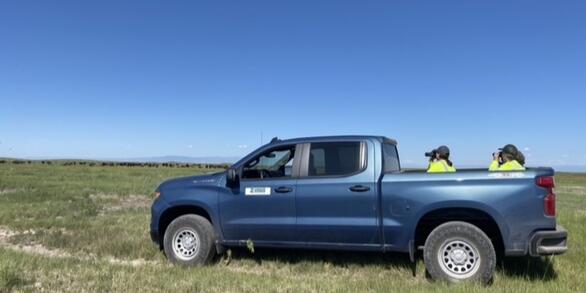
Where the Bison Roam: Public-Private Partnership Supports Potential Restoration

A little over one hundred years ago, plains bison were prolific in the Great American West. Reports describe herds containing thousands of animals migrating through the central and western states, totaling 20–30 million across their entire range. With commercial, unregulated hunting in the late 1800s came the rapid demise of bison to barely more than 1,000 by 18891. Recently, renewed interest in...
Where the Bison Roam: Public-Private Partnership Supports Potential Restoration

Where the Bison Roam: Public-Private Partnership Supports Potential Restoration

A little over one hundred years ago, plains bison were prolific in the Great American West. Reports describe herds containing thousands of animals migrating through the central and western states, totaling 20–30 million across their entire range. With commercial, unregulated hunting in the late 1800s came the rapid demise of bison to barely more than 1,000 by 18891. Recently, renewed interest in...
Learn More

Species Conservation

Large-scale changes are occurring to our natural landscapes, often resulting in changes to the distribution and abundance of species living within these landscapes. Populations of many species affected by these natural or anthropogenic changes require focused management to ensure their conservation and sometimes recovery from the brink of extinction.
Species Conservation

Species Conservation

Large-scale changes are occurring to our natural landscapes, often resulting in changes to the distribution and abundance of species living within these landscapes. Populations of many species affected by these natural or anthropogenic changes require focused management to ensure their conservation and sometimes recovery from the brink of extinction.
Learn More
Was this page helpful?