



Application Development
Application Development
Filter Total Items: 27

Prioritizing Restoration of Sagebrush Ecosystems Tool (PReSET): A USGS-facilitated Decision-support Tool for Sagebrush Ecosystem Conservation and Restoration Actions
Sagebrush ecosystems represent one of the most imperiled systems in North America and face continued and widespread degradation due to multiple factors including invasive species and increased human development. Effective sagebrush management must consider how to best conserve and restore habitats to stem the decline of species that rely on them, especially given limited conservation resources. To...
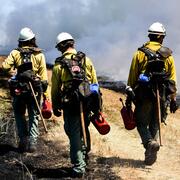
Land management research in support of streamlined energy development, economic growth, and wildfire management
FORT researchers provide sound science to support the Department of the Interior in its efforts to streamline reliable energy development, enhance cost efficiency in public lands management, and manage fire-prone habitats for public safety. This research is developed in partnership with resource managers from local, State, Federal and Tribal governments, industry, and nongovernmental organizations...

Research to support conservation of America’s national mammal, the bison
Once numbering in the tens of millions, plains bison ( Bison bison bison) were nearly driven to extinction with only a few hundred individuals remaining by the late 19th century. Plains bison have since recovered to approximately 20,000 animals managed in conservation herds throughout North America, yet substantial challenges to their recovery remain. The Department of the Interior (DOI) stewards...

Values Mapping for Planning in Regional Ecosystems (VaMPIRE)
As part of the Values Mapping for Planning in Regional Ecosystems project, also known as VaMPIRE, USGS scientists are developing a public participatory GIS application that aids in gathering information about visitors’ values for public lands and waters.

Prioritizing restoration and conservation of sagebrush ecosystems in northwestern Colorado
We are working with Colorado Parks and Wildlife (CPW) to pilot an expansion of the Prioritizing Restoration of Sagebrush Ecosystems Tool (PReSET; Duchardt et al. 2021) across northwestern Colorado. We recently completed Phase I of this project where we leveraged existing data resources to provide customized scenarios that are now directly guiding landscape-scale conservation delivery by CPW...

INHABIT: A web tool for invasive plant management across the contiguous United States
INHABIT is a desktop-optimized web application and decision support tool with mapped and tabular summaries of habitat suitability models for over two hundred fifty terrestrial invasive plant species of management concern across the contiguous United States. It is the product of a scientist-practitioner partnership and is designed to facilitate enhanced invasive species management actions...

Siren: The National Early Detection and Rapid Response Information System
Siren: the National Early Detection and Rapid Response (EDRR) Information System is an online resource for invasive species information sharing and collaboration that serves as the information hub of the National EDRR Framework.

Spatiotemporal conditions of vegetation and invasive plant species on mine lands.
To support the Department of Interior's bureaus, states, and local communities, we are developing 1) a document highlighting remote sensing approaches that can be leveraged for site prioritization, recovery design, and long-term assessments of recovery trends, and 2) data products of vegetation conditions, change, recovery potential, and risk of exotic plant invasion on mine lands. We will...

SageDAT: Data and Tools To Support Collaborative Sagebrush Ecosystem Conservation and Management
The USGS, the BLM, the FWS, and the Western Association of Fish and Wildlife Agencies have developed of a new DOI-funded effort, known as SageDAT.

Smart Energy Development: Tools for Informed Development & Successful Reclamation
The USGS is developing science and decision support tools to inform policy and management decisions about various aspects of the energy development life cycle.

Data and Tools for Landscape Assessment
The Information Science Branch develops and applies approaches that integrate natural science, computer technology, and information management to address key natural resource issues. Branch staff work with USGS scientists and data managers to convert field observations into GIS-oriented data and metadata products. The Branch also supports ecological and landscape modeling, including the...

Surface Disturbance and Reclamation Tracking Tool (SDARTT)
The Bureau of Land Management (BLM) and the United States Geological Survey (USGS) have partnered to create the Surface Disturbance Analysis and Reclamation Tracking Tool (SDARTT). SDARTT is to be the national repository for and analysis tool of disturbance data pertaining to public land operations for the BLM. Users will upload disturbance and reclamation data to SDARTT to map, analyze, and...