



Characterization and Reuse of Oil and Gas Waters
Quantities of Water Associated with Oil and Gas Development
Geophysical Mapping of Produced Water in Near-Surface Environments
Brine Research Instrumentation and Experimental (BRInE) Laboratory
The Oil and Gas Waters (OGW) project, funded by the Energy Resources Program, aims to provide information on the volume, quality, impacts, and potentially commodity recovery from water co-produced during the generation and development of domestic petroleum resources. The primary goals of this project are to meet the needs of Congress and other stakeholders in the quantification of lithium and oilfield brine-derived commodity resources and in the evaluation of the impacts of water production and use during energy development.
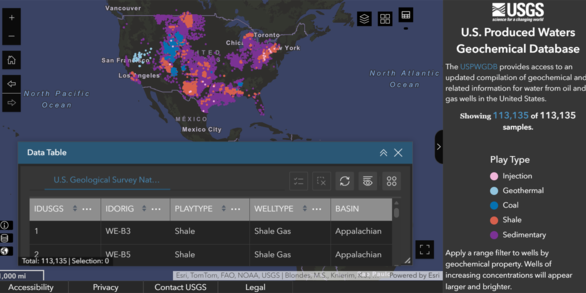

Lithium and other commodities in subsurface oilfield brines
The Smackover Formation
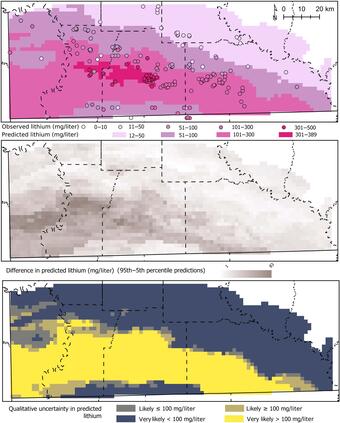
Andrew Masterson and Katherine Knierim are leading studies to characterize lithium in brines in the Smackover Formation, a regionally extensive petroleum producing reservoir within the Gulf Coast. This research is collaborative between the USGS Energy Resources Program funded Oil and Gas Waters Project (Geology, Energy & Minerals Science Center), the USGS Water Mission Area funded Lower Mississippi-Gulf Water Science Center, and the Arkansas Department of Energy and Environment Office of the State Geologist. Katherine Knierim used the USGS National Produced Waters Geochemical Database version 3.0 and newly acquired lithium concentration data from brines to generate spatially continuous prediction maps of sedimentary basin brine lithium concentrations from regional geology, geochemistry, and temperature data. This model was used to quantify the Smackover brine lithium resource of southern Arkansas. Andrew Masterson is using newly collected brine geochemical and isotopic data to interpret the origin of high lithium within Smackover Formation brines and detailed subsurface archived rock core work to better characterize the mechanism of enrichment. Further work includes expanding the regional scope of Smackover lithium brine assessment with sampling campaigns in northern Louisiana and the eastern trend in Alabama and Mississippi, as well as other target formations throughout the United States.
Appalachian Basin
Bonnie McDevitt and collaborators are using isotopic tracers (7Li/6Li, 11B/10B, 138Ba/134Ba) to better understand the mechanisms for lithium enrichment in the Utica/Point Pleasant Formation brines from Pennsylvania and Ohio and generally characterize lithium in brines of the Appalachian Basin. Isotopic tracers indicate thermal maturation (i.e., oil to dry gas) in unconventional petroleum reservoirs may be an important consideration to more efficiently target brines with elevated lithium concentrations for commercial production.
Quantities of Waters Associated with Oil and Gas Production
The Oil and Gas Waters Project conducts studies relating the interactions between resources, such as quantities of water used and produced as part of oil and gas development, and their associated benefits. Seth Haines is leading efforts to develop a generalized assessment methodology for quantifying lithium resources in formation brines, building from earlier methods for quantifying water production from oil and gas wells. Hannah Shook creates maps, charts, and web-based tools that transform complex data into graphics that illustrate geographic patterns in resources. Brian Varela leads efforts to analyze well production and related data, developing algorithms to help us understand trends in oil, gas, and water production, and related topics.
National Produced Waters Geochemical Database
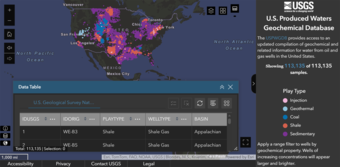
The USGS National Produced Waters Geochemical Database is a compilation of publicly available data on the inorganic and organic composition of waters associated with petroleum production. These historical, data are derived from approximately 18,000 individual oil, gas, and brine production wells. Oil and Gas Waters project members Phil Freeman, Colin Doolan, and Eli Moore provide new insights and periodic updates to the National Produced Waters Geochemical Database, and these publicly available data and online viewer are extensively used by federal and state agencies, academia, and private industry to understand the geochemistry and critical mineral potential of the U.S. domestic inventory of oil and gas waters.
The BRInE Lab: Analysis of high salinity brines

The Brine Research Instrumentation and Experimental (BRInE) Laboratory addresses the challenges of analyzing high salinity oil and gas wastewaters, “produced waters,” by adapting and modifying traditional methods of water analysis to this challenging matrix. Jessica Chenault (Laboratory Manager) and Amanda Herzberg (Laboratory Analyst) perform inorganic analysis of produced waters for geochemical fingerprinting and interpretation, and understanding sources of potential mineral commodities (e.g., lithium). Andrew Masterson leads the research arm of the BRInE Laboratory including examining the mineralogical controls, thermal behavior, and isotope geochemistry of lithium at the geological conditions typical of oil and gas reservoirs and Aaron Jubb leads exploratory studies on the fundamental properties of brines. The BRInE laboratory leads collaborative studies with state and federal governmental agencies and industry stakeholders interested in developing field and laboratory studies on synthetic brines and oil and gas waters.
Beneficial Re-use and Geologic Parameters of Produced Waters
Treatment and re-use of produced waters
The Oil and Gas Waters Project evaluated the major ion geochemistry, radium concentrations, and stable water isotope composition of 120 produced water samples from 17 unconventional petroleum wells in Weld County, Colorado, actively producing from the Late Cretaceous Niobrara Formation. These results highlight the origin of salinity in produced waters, the spatiotemporal variability in boron and bromide concentrations, and the variability in barium and radium concentrations in producing benches from the Niobrara Formation, with implications for hazard mitigation, when re-using these waters beneficially in the arid west.
Beneficial Reuse of Industrial Waste Streams
The Oil and Gas Waters Project studies the beneficial reuse of oil and gas produced water as part of a pilot plant demonstration to mineralize CO2 into stable carbonate minerals for use in cement production. Reducing two industrial waste streams, mitigating hazards associated with naturally occurring radioactive materials (NORM) and generating a saleable, tested product represents a successful circular economy. This work was performed by USGS Principal Investigator Bonnie McDevitt, with academic collaborators at UCLA and Cornell University.
The Oil and Gas Waters (OGW) project, funded by the Energy Resources Program, aims to provide information on the volume, quality, impacts, and potentially commodity recovery from water co-produced during the generation and development of domestic petroleum resources. The primary goals of this project are to meet the needs of Congress and other stakeholders in the quantification of lithium and oilfield brine-derived commodity resources and in the evaluation of the impacts of water production and use during energy development.
Lithium and other commodities in subsurface oilfield brines
The Smackover Formation
Andrew Masterson and Katherine Knierim are leading studies to characterize lithium in brines in the Smackover Formation, a regionally extensive petroleum producing reservoir within the Gulf Coast. This research is collaborative between the USGS Energy Resources Program funded Oil and Gas Waters Project (Geology, Energy & Minerals Science Center), the USGS Water Mission Area funded Lower Mississippi-Gulf Water Science Center, and the Arkansas Department of Energy and Environment Office of the State Geologist. Katherine Knierim used the USGS National Produced Waters Geochemical Database version 3.0 and newly acquired lithium concentration data from brines to generate spatially continuous prediction maps of sedimentary basin brine lithium concentrations from regional geology, geochemistry, and temperature data. This model was used to quantify the Smackover brine lithium resource of southern Arkansas. Andrew Masterson is using newly collected brine geochemical and isotopic data to interpret the origin of high lithium within Smackover Formation brines and detailed subsurface archived rock core work to better characterize the mechanism of enrichment. Further work includes expanding the regional scope of Smackover lithium brine assessment with sampling campaigns in northern Louisiana and the eastern trend in Alabama and Mississippi, as well as other target formations throughout the United States.
Appalachian Basin
Bonnie McDevitt and collaborators are using isotopic tracers (7Li/6Li, 11B/10B, 138Ba/134Ba) to better understand the mechanisms for lithium enrichment in the Utica/Point Pleasant Formation brines from Pennsylvania and Ohio and generally characterize lithium in brines of the Appalachian Basin. Isotopic tracers indicate thermal maturation (i.e., oil to dry gas) in unconventional petroleum reservoirs may be an important consideration to more efficiently target brines with elevated lithium concentrations for commercial production.
Quantities of Waters Associated with Oil and Gas Production
The Oil and Gas Waters Project conducts studies relating the interactions between resources, such as quantities of water used and produced as part of oil and gas development, and their associated benefits. Seth Haines is leading efforts to develop a generalized assessment methodology for quantifying lithium resources in formation brines, building from earlier methods for quantifying water production from oil and gas wells. Hannah Shook creates maps, charts, and web-based tools that transform complex data into graphics that illustrate geographic patterns in resources. Brian Varela leads efforts to analyze well production and related data, developing algorithms to help us understand trends in oil, gas, and water production, and related topics.
National Produced Waters Geochemical Database
The USGS National Produced Waters Geochemical Database is a compilation of publicly available data on the inorganic and organic composition of waters associated with petroleum production. These historical, data are derived from approximately 18,000 individual oil, gas, and brine production wells. Oil and Gas Waters project members Phil Freeman, Colin Doolan, and Eli Moore provide new insights and periodic updates to the National Produced Waters Geochemical Database, and these publicly available data and online viewer are extensively used by federal and state agencies, academia, and private industry to understand the geochemistry and critical mineral potential of the U.S. domestic inventory of oil and gas waters.
The BRInE Lab: Analysis of high salinity brines
The Brine Research Instrumentation and Experimental (BRInE) Laboratory addresses the challenges of analyzing high salinity oil and gas wastewaters, “produced waters,” by adapting and modifying traditional methods of water analysis to this challenging matrix. Jessica Chenault (Laboratory Manager) and Amanda Herzberg (Laboratory Analyst) perform inorganic analysis of produced waters for geochemical fingerprinting and interpretation, and understanding sources of potential mineral commodities (e.g., lithium). Andrew Masterson leads the research arm of the BRInE Laboratory including examining the mineralogical controls, thermal behavior, and isotope geochemistry of lithium at the geological conditions typical of oil and gas reservoirs and Aaron Jubb leads exploratory studies on the fundamental properties of brines. The BRInE laboratory leads collaborative studies with state and federal governmental agencies and industry stakeholders interested in developing field and laboratory studies on synthetic brines and oil and gas waters.
Beneficial Re-use and Geologic Parameters of Produced Waters
Treatment and re-use of produced waters
The Oil and Gas Waters Project evaluated the major ion geochemistry, radium concentrations, and stable water isotope composition of 120 produced water samples from 17 unconventional petroleum wells in Weld County, Colorado, actively producing from the Late Cretaceous Niobrara Formation. These results highlight the origin of salinity in produced waters, the spatiotemporal variability in boron and bromide concentrations, and the variability in barium and radium concentrations in producing benches from the Niobrara Formation, with implications for hazard mitigation, when re-using these waters beneficially in the arid west.
Beneficial Reuse of Industrial Waste Streams
The Oil and Gas Waters Project studies the beneficial reuse of oil and gas produced water as part of a pilot plant demonstration to mineralize CO2 into stable carbonate minerals for use in cement production. Reducing two industrial waste streams, mitigating hazards associated with naturally occurring radioactive materials (NORM) and generating a saleable, tested product represents a successful circular economy. This work was performed by USGS Principal Investigator Bonnie McDevitt, with academic collaborators at UCLA and Cornell University.