



This is our office.
These are our coworkers.
This is our rush hour.
This is our happy hour.
Dive in to learn more.
Northern Rocky Mountain Science Center
Welcome to the Northern Rocky Mountain Science Center (NOROCK), one of the nation’s key laboratories to study the ecosystems and species of the Northern Rockies. Since 2000, our scientists have tackled critical issues that matter to natural resource managers and the American people.
Featured Research
Featured Research

READI-Net—A network of robotic environmental DNA samplers to enhance the early detection of aquatic biological threats
Featured Research
Featured Research

NOROCK is developing drought early warning systems for fisheries and water management
NOROCK Quick Links
NOROCK Quick Links
Check out our most up-to-date data & science, and learn about any upcoming NOROCK opportunities .
News
IGBST Public Notifications and Resources
IGBST Public Notifications and Resources
USGS Research Informs Big Game Management—Mule Deer Sensitive to Temperature Extremes and Habitat Quality
USGS Research Informs Big Game Management—Mule Deer Sensitive to Temperature Extremes and Habitat Quality
Environmental DNA Monitoring Protects Fish Hatchery from Invasive Species
Environmental DNA Monitoring Protects Fish Hatchery from Invasive Species
Publications
Northern bobwhites select for native grasses on working grazing land Northern bobwhites select for native grasses on working grazing land
Northern bobwhite (Colinus virginianus; bobwhite) populations have experienced an 85% decline across most of its range since the 1960s. The most drastic decreases have been in the southeastern United States where biologists attribute the decline to widespread habitat loss, including conversion of native grasslands to tall fescue (Lolium arundinaceum) and other exotic cool-season grass...
Predicting disease spread from host movement data: Chronic wasting disease in North America as a case study Predicting disease spread from host movement data: Chronic wasting disease in North America as a case study
1. Rare long-distance movements can increase the spatial spread of invasive species and shifts in species ranges. However, in the context of wildlife disease spread, seasonal migrations only matter if they lead to transmission beyond an individual’s initial set of contacts, and the importance of juvenile dispersal depends on whether those juveniles become infected before they disperse. 2...
Detecting occurrence and timing of grizzly bear parturition based on anomalies in accelerometer data Detecting occurrence and timing of grizzly bear parturition based on anomalies in accelerometer data
Documenting natality of brown (grizzly) bears (Ursus arctos) is an important component of many population monitoring and research programs. Brown bears give birth during hibernation, so observation of litters is generally not feasible until females exit dens, and detection of litters can be compromised by poor observability. Using triaxial accelerometer activity data stored on...
Science
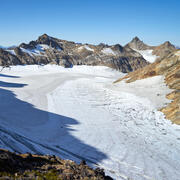
Glaciers and Landscape Change
Mountain glaciers are dynamic reservoirs of frozen water, deeply interconnected with their surrounding ecosystems. Glacier change in North America has major societal impacts, including to water resources, natural hazard risk, tourism disruption, fisheries, and global sea level change. Understanding and quantifying precise connections between changing glaciers, the surrounding landscape and climate...

Bighorn Sheep and Mountain Goat Research in Western National Park Units
Mountain goat and bighorn sheep are iconic symbols of many national lands in the West and are economically important as big game species on some public lands and as tourist attractions in and around national parks. Both species have limited distributions that can be difficult to observe and face multiple stressors including disease, increasing recreation in remote areas, and shifting weather...

Bighorn Sheep in and near Glacier National Park
Bighorn sheep in the American West are a valued big game species and enjoyed by tourists visiting national parks. The populations in Glacier National Park make up one of the largest metapopulations in the continental U.S., and USGS NOROCK scientists have been studying them to inform the management of this charismatic and economically valuable species.