



USGS and BLM publish a science synthesis on risks of spreading invasive annual grasses in MT, ND & SD through vegetation treatments
The USGS is working with federal land management agencies to develop a series of structured science syntheses (SSS) to support National Environmental Policy Act (NEPA) analyses. This new synthesis is the fifth publication in the SSS series and provides science to support NEPA analyses for agency decisions regarding invasive annual grasses.
Structured science syntheses for public lands management
Federal land management agencies conduct NEPA analyses to assess the potential environmental effects of proposed actions. Science is a core, required component of NEPA analysis. However, science about many land management issues can be complex or evolving. Staff from the Bureau of Land Management, U.S. Fish and Wildlife Service, and U.S. Geological Survey developed a new type of science delivery product, called a structured science synthesis (SSS), that provides content structured around priority management issues and organized according to steps in NEPA analysis.
Potential risks of vegetation treatments to introduce and increase invasive annual grasses in rangelands of Montana, North Dakota, and South Dakota—a science synthesis to inform National Environmental Policy Act analyses
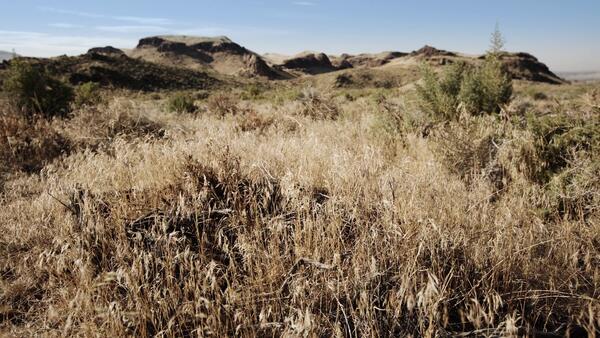
Scientists from the USGS Northern Rocky Mountain Science Center, USGS Fort Collins Science Center, and land managers with the Bureau of Land Management recently published an SSS that synthesizes science information on the risks of inadvertently increasing the abundance and distribution of invasive annual grasses (IAGs) following habitat treatments in the rangelands of Montana, North Dakota, South Dakota. The report includes four types of information critical to NEPA analyses: data, scientific studies, analysis methods, and mitigation measures. The authors conducted a literature review to compile relevant scientific studies on the responses of IAGs to vegetation treatments in the intermontane valleys of Montana and the northern Great Plains of Montana, North Dakota, and South Dakota (hereafter, “the focal region”).
The authors found that in sagebrush ecosystems within the focal region, prescribed fire often reduces or at least does not increase IAGs. However, high IAG cover found within firebreak constructions in both sagebrush and grasslands suggests that mechanical disturbances to soil from treatments may facilitate invasions. Herbicide and mechanical treatments applied to sagebrush showed increases in IAG biomass at sites with mechanical disturbances, but neither treatment type changed the percent composition of IAGs in the plant community. Temperature and precipitation have been strong factors in determining IAG responses to vegetation treatments in sagebrush ecosystems of the focal region, where more spring and summer precipitation likely provides a competitive edge to native, perennial grasses over winter annual grasses like cheatgrass.
In grasslands within the focal region, prescribed fire often reduces IAGs, but the effects are often short-lived and influenced by the abundance of native vegetation. Herbicides can increase control of IAGs following prescribed fire, while the effects of mowing are variable. Site conditions in grasslands, such as southeast-facing slopes, sandier or rockier sites, lower native plant species cover, or lower number of plant species, affect the likelihood of invasion by annual grasses.
Learn more about SSSs and other USGS science syntheses
The SSS series and other USGS science synthesis efforts continue to explore ways to enhance science delivery for public land management in the United States. See a list of past and upcoming synthesis products at:
USGS SCIENCE SYNTHESES FOR PUBLIC LANDS MANAGEMENT
DEVELOPING STRUCTURED SCIENCE SYNTHESES FOR USE IN NEPA ANALYSES AND DECISION MAKING IN THE BUREAU OF LAND MANAGEMENT
CLIMATE-INFORMED STRUCTURED SCIENCE SYNTHESES
“Potential risks of vegetation treatments to introduce and increase invasive annual grasses in rangelands of Montana, North Dakota, and South Dakota—a science synthesis to inform National Environmental Policy Act analyses” was authored by Aaron Johnston and Kyle Ebenhoch from the USGS Northern Rocky Mountain Science Center; Tait Rutherford and Sarah Carter from the USGS Fort Collins Science Center; Logan Maxwell, contractor to the USGS; and David Wood from the Bureau of Land Management. The SSS was published as a U.S. Geological Survey Scientific Investigations Report and is available online.
Related

Developing structured science syntheses for use in NEPA analyses and decision making in the Bureau of Land Management

USGS Science Syntheses for Public Lands Management

Developing science syntheses to facilitate climate-informed land management decisions and NEPA analyses on rangelands in the sagebrush biome
Related
Developing structured science syntheses for use in NEPA analyses and decision making in the Bureau of Land Management
USGS Science Syntheses for Public Lands Management