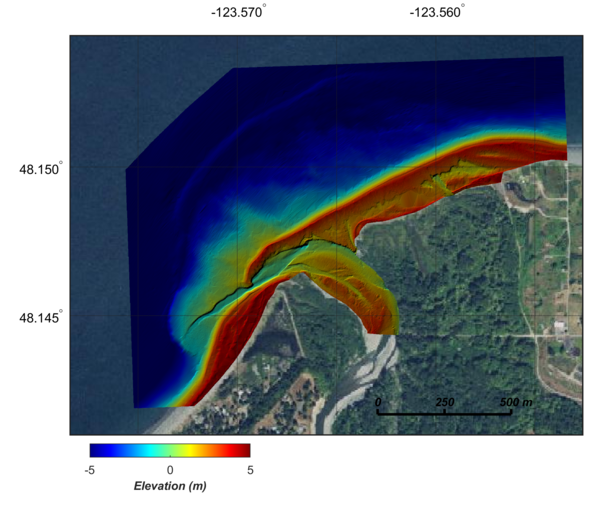
Map showing 1-m resolution digital elevation model (DEM) of Elwha River mouth
Map showing 1-m resolution digital elevation model (DEM) of Elwha River mouthMap showing 1-m resolution digital elevation model (DEM) of Elwha River mouth in Washington.
An official website of the United States government
Here's how you know
Official websites use .gov
A .gov website belongs to an official government organization in the United States.
Secure .gov websites use HTTPS
A lock () or https:// means you’ve safely connected to the .gov website. Share sensitive information only on official, secure websites.
Pacific Coastal and Marine Science Center images.
Map showing 1-m resolution digital elevation model (DEM) of Elwha River mouth in Washington.
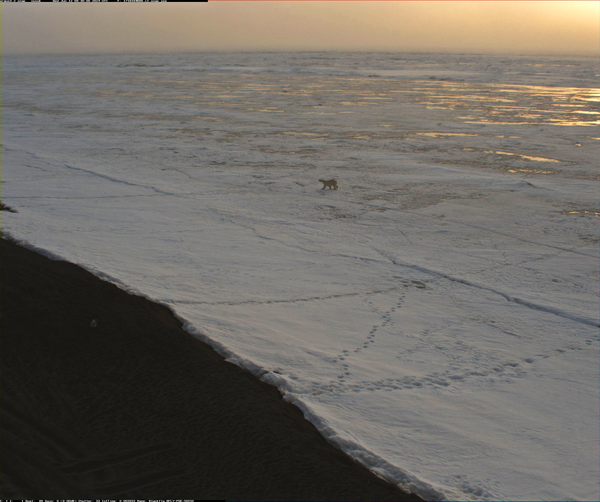
A composite of 10 minutes of 2Hz images taken by a coastal camera at Nuvuk, Alaska, showing a polar bear walking toward the camera.
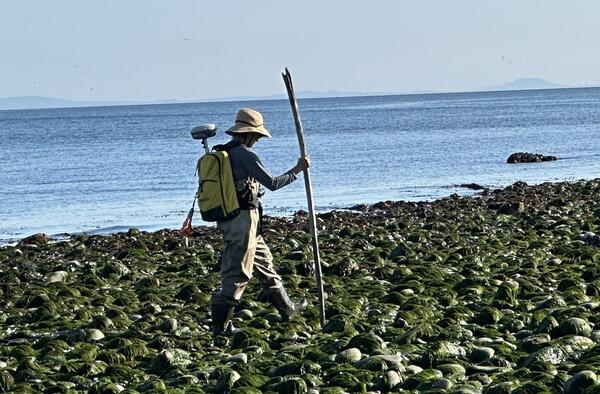
Picture of surveyor equipped with survey equipment during mapping mission of the Elwha River mouth.
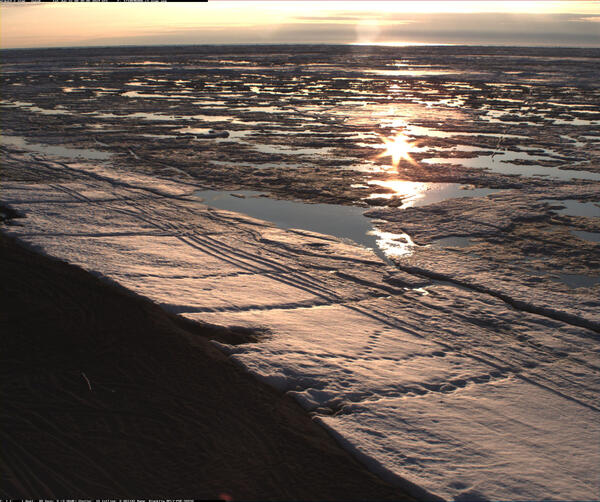
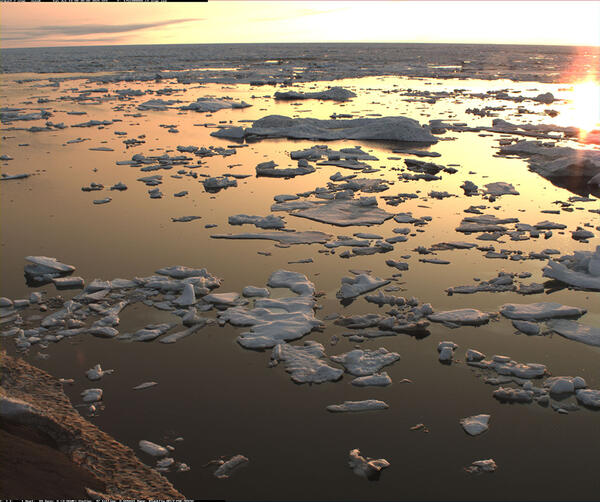
Sea ice at Nuvuk, Alaska on July 13 2025, captured by a coastal observing video camera.
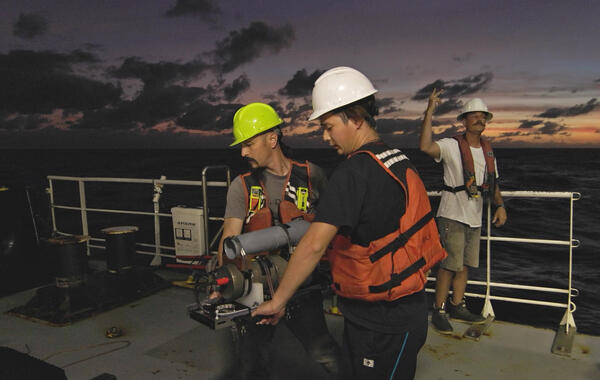
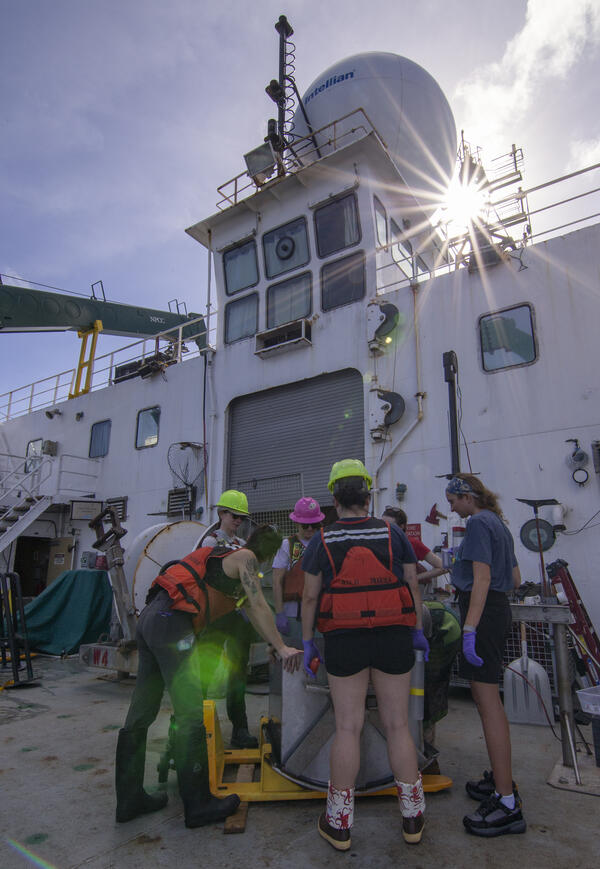
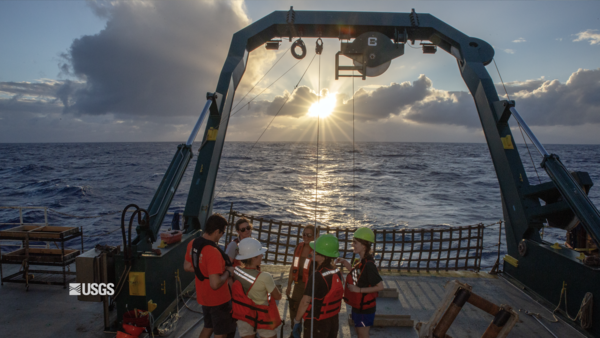
Scientists recovering the shadowgraph camera during the Hawaii Abyssal Nodules Expedition. Learn more about the expedition here.
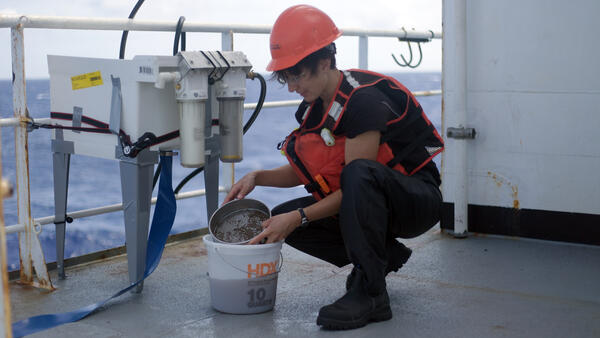
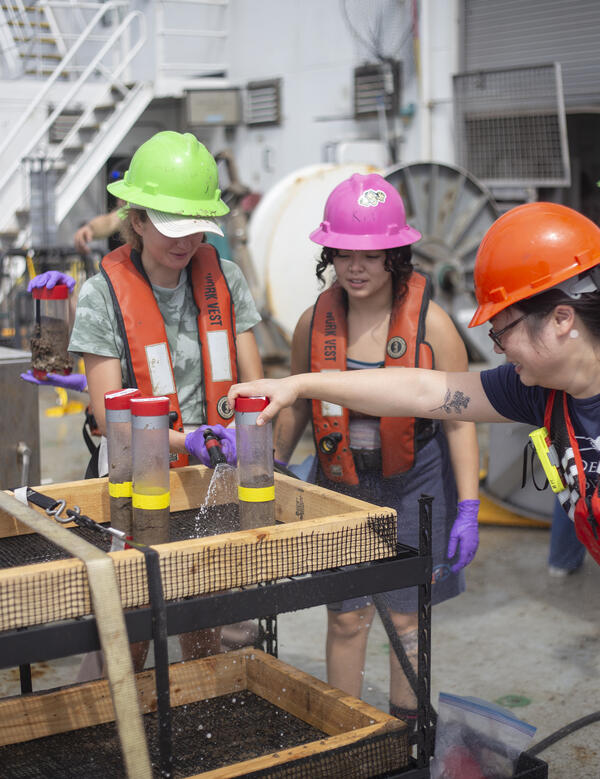
Scientist sifting through deep-sea mud for infauna during the Hawaii Abyssal Nodules Expedition. Learn more about the expedition here.
Scientists with a box core sample during the Hawaii Abyssal Nodules Expedition. Learn more about the expedition here.
Scientists preparing push core samples during the Hawaii Abyssal Nodules Expedition. Learn more about the expedition here.
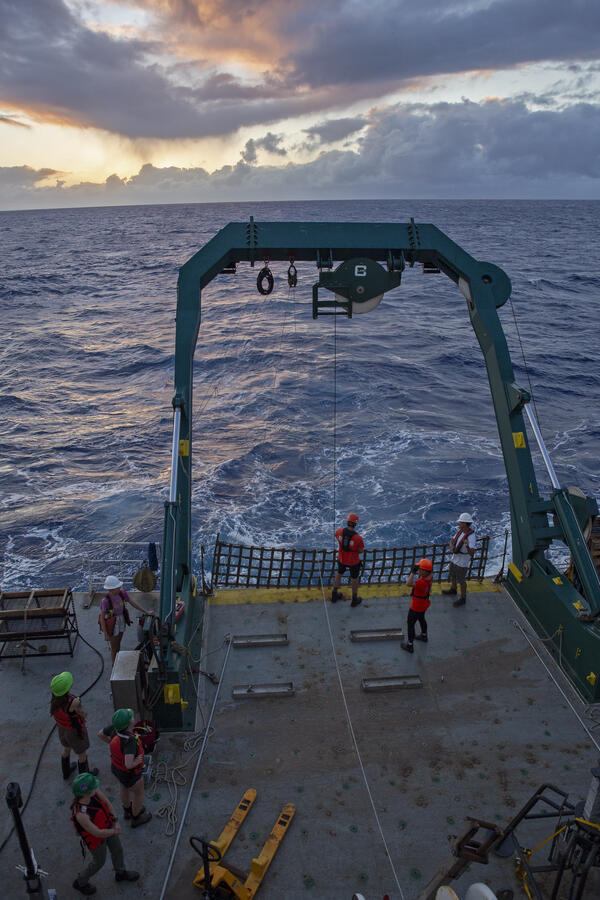
Back deck of the Kilo Moana during the Hawaii Abyssal Nodules Expedition. Learn more about the expedition here.
Scientists preparing to process a box core sample during the Hawaii Abyssal Nodules Expedition. Learn more about the expedition here.
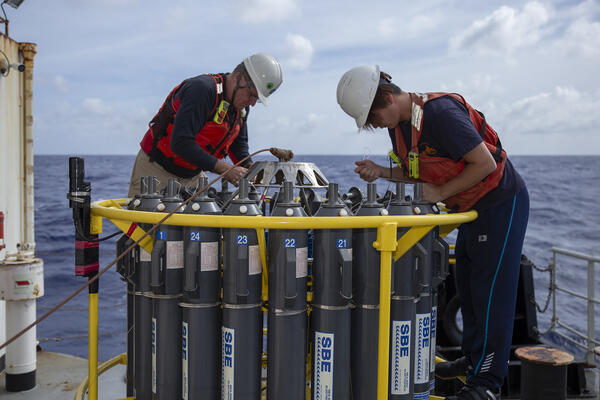
Preparing the CTD rosette during the Hawaii Abyssal Nodules Expedition. Learn more about the expedition here.
Scientists removing top water from a box core sample during the Hawaii Abyssal Nodules Expedition. Learn more about the expedition here.
In Fall 2025 the Hawaiʻi Abyssal Nodules and Associated Ecosystems Expedition, led by USGS scientists, will investigate the geology, minerals, and environmental setting of the deep seabed offshore Moku o Keawe (Hawaiʻi Island) in the U.S. Exclusive Economic Zone. This work is part of ongoing collaborative efforts with BOEM and NOAA.
Map showing locations of mapped groundwater seeps (white triangles), estimated fluxes of submarine groundwater discharge (blue triangles), groundwater temperature (orange arrow), and study sites (white squares) from the study Submarine groundwater discharge creates
Extreme 2-year water levels in SF Bay under baseline; restoration; urban; and combined scenarios at current versus 1.5 m SLR. From the study Mitigating Flood Risks in Urban Estuaries: Tidal Dynamics, Shoreline Hardening, Nature-Based Solutions, and Floodgates in San Francisco Bay.
The Autonomous MAPping CATaraft, or “Autonomous MAPCAT”, is a remotely controlled, 14 foot long by 7 foot wide boat, built from an inflatable pontoon, aluminum frame, whitewater cataraft.
Scanning electron micrographs of Trochammina hadai specimens collected worldwide. From the study Analysis of a human-mediated microbioinvasion: the global spread of the benthic foraminifer Trochammina hadai Uchio, 1962.
Map of Bellingham Bay contaminant study area. From the study Refining PAH and PCB bioavailability predictions in industrial sediments using source-fingerprinting, particle size, and bulk carbon, Puget Sound, Washington.
Graphical abstract for Bellingham Bay contaminant study. From the study Refining PAH and PCB bioavailability predictions in industrial sediments using source-fingerprinting, particle size, and bulk carbon, Puget Sound, Washington.
Collage of images showing natural offshore oil seepage on the California Coastline. From the study Natural Offshore Oil Seepage and Related Tarball Accumulation on the California Coastline—Santa Barbara Channel and the Southern Santa Maria Basin; Source Identification and Inventory.
Locations of the Whales Tail marsh complex (orange) and nearby tide gauge (light blue) within south San Francisco Bay. From the study Comparison of creek and bay influences on salt marsh sediment budget and deposition patterns.