



Volcano Digital Twin Working Group
A digital twin to accelerate volcano science and unify geodetic and seismic observations
A digital twin to accelerate volcano science and unify geodetic and seismic observations
Drylands of Western U.S. Working Group
Towards an integrated multi-scale understanding of dryland plant traits with application to land management
Towards an integrated multi-scale understanding of dryland plant traits with application to land management
Groundwater Impact on Lakes Working Group
Assessing the susceptibility of lakes to groundwater withdrawals in the Upper Midwest
Assessing the susceptibility of lakes to groundwater withdrawals in the Upper Midwest
Arctic Permafrost Synthesis Working Group
Synthesizing methane fluxes, isotopes, and microbiomes to better understand the dynamics and consequences of permafrost thaw in a sensitive and strategic Arctic
Synthesizing methane fluxes, isotopes, and microbiomes to better understand the dynamics and consequences of permafrost thaw in a sensitive and strategic Arctic
Contaminant Food Webs Working Group
A spatially explicit framework to assess the risk of aquatic contaminants to insectivorous birds
A spatially explicit framework to assess the risk of aquatic contaminants to insectivorous birds
New Data for Hazard Models Working Group
Operationalizing the use of millennial-scale geologic constraints for testing and improving modern seismic hazard models
Operationalizing the use of millennial-scale geologic constraints for testing and improving modern seismic hazard models
Flood Impacts Working Group
A global synthesis of flood impacts: Understanding the country-level vulnerability and causes
A global synthesis of flood impacts: Understanding the country-level vulnerability and causes
River Silicon Stoichiometry Working Group
Are we experiencing a riverine silicon surge? Implications for the global carbon cycle
Are we experiencing a riverine silicon surge? Implications for the global carbon cycle
John Wesley Powell Center for Analysis and Synthesis
Offering the opportunity for emergent knowledge in Earth system science through collaborative analysis and synthesis.
Working Group Resources
Working Group Resources

Information for working group leaders, visitors to the Powell Center, travel information, data resources, and the Powell Center Acknowledgement.
Proposal Process
Proposal Process

Instructions and resources for submitting proposals and accepted working groups.
News
Powell Center Seminar: FresH2O Zoops
Powell Center Seminar: FresH2O Zoops
Call for Proposals and How-To Seminar
Call for Proposals and How-To Seminar
Powell Center Working Groups - Class of 2027
Powell Center Working Groups - Class of 2027
Publications
Emergent headwater types for watershed monitoring, research, and planning Emergent headwater types for watershed monitoring, research, and planning
Headwaters—that is headwater streams and the watersheds they drain—strongly influence water quality, ecosystem services, and hydrologic connectivity, yet remain poorly mapped, monitored, and understood at large spatial scales. Using available spatial data to classify headwater “types” could therefore enhance the utility of sparse monitoring data to advance research and watershed planning...
A hybrid approach for revealing headwater hydrology A hybrid approach for revealing headwater hydrology
Coordinated work to compile existing data and apply models pairing physical understanding with machine learning could substantially improve streamflow predictions for little-known headwater basins.
Creating 3D point clouds, digital elevation models, and orthomosaics from historical aerial imagery through structure from motion aided photogrammetry Creating 3D point clouds, digital elevation models, and orthomosaics from historical aerial imagery through structure from motion aided photogrammetry
Detailed and accurate historical data are crucial to characterizing landscape change, whether it is caused by natural phenomena or of anthropogenic origin. Aerial imagery has been periodically collected by government and nongovernment agencies, for a broad range of purposes, since the early 20th century. The acquisition of aerial images involves using standardized equipment with large...
Science
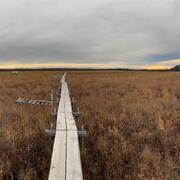
Synthesizing methane fluxes, isotopes, and microbiomes to better understand the dynamics and consequences of permafrost thaw in a sensitive and strategic Arctic
This interdisciplinary working group will bring together leading experts in microbial ecology, biogeochemistry, isotope science, remote sensing, and ecosystem modeling to synthesize how Arctic ecosystems are responding to changes in microbial and landscape processes.
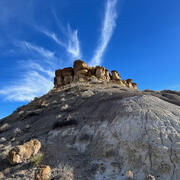
Towards an integrated multi-scale understanding of dryland plant traits with application to land management
This proposed project brings together scientists, federal agencies, and land managers to improve the monitoring and management of dryland ecosystems in the western United States.
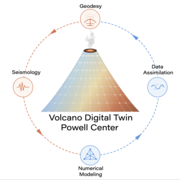
A digital twin to accelerate volcano science and unify geodetic and seismic observations
Emerging computational and data assimilation approaches and increasing data volumes imply an opportunity to greatly accelerate both fundamental volcano science and hazard assessment and forecasting.