



Art of Inquiry: Celebrating a semester of Art & Science at the Flagstaff Stemmy Awards
USGS celebrates the designation of Jessina Clasen and John Compton from Flagstaff Arts and Leadership Academy (FALA) as finalists for "Teacher of the Year" at the 2026 Flagstaff STEMMY Awards for their collaboration with the Flagstaff Science Campus.
Educators Jessina Clasen and John Compton from Flagstaff Arts and Leadership Academy (FALA) were honored during a ceremony at Lowell Observatory on March 19th, 2026 for their involvement in piloting a new art-meets-science program with the USGS Flagstaff Science Campus.
The semester-long collaboration in Fall 2025 paired FALA students directly with researchers from across all five USGS research centers in Flagstaff. The program established a maximum 1-to-3 ratio of scientists to students, providing a direct line of communication and mentorship. Students translated complex data sets, ranging from desert ecology to planetary mapping, into collaborative art pieces.
The impact of the collaboration was showcased through two community events, beginning with an art show hosted at the USGS campus on September 22, 2025, as part of the Flagstaff Festival of Science. This was followed by a capstone exhibit at the FALA campus on December 17, 2025, which highlighted the illustrations and sculptures that the FALA students developed through their direct interactions with USGS experts.
Scroll to learn about the art that resulted from this semester of USGS science in the classroom — and the research that inspired it.
Izaiah, Grade 11
Artist Statement
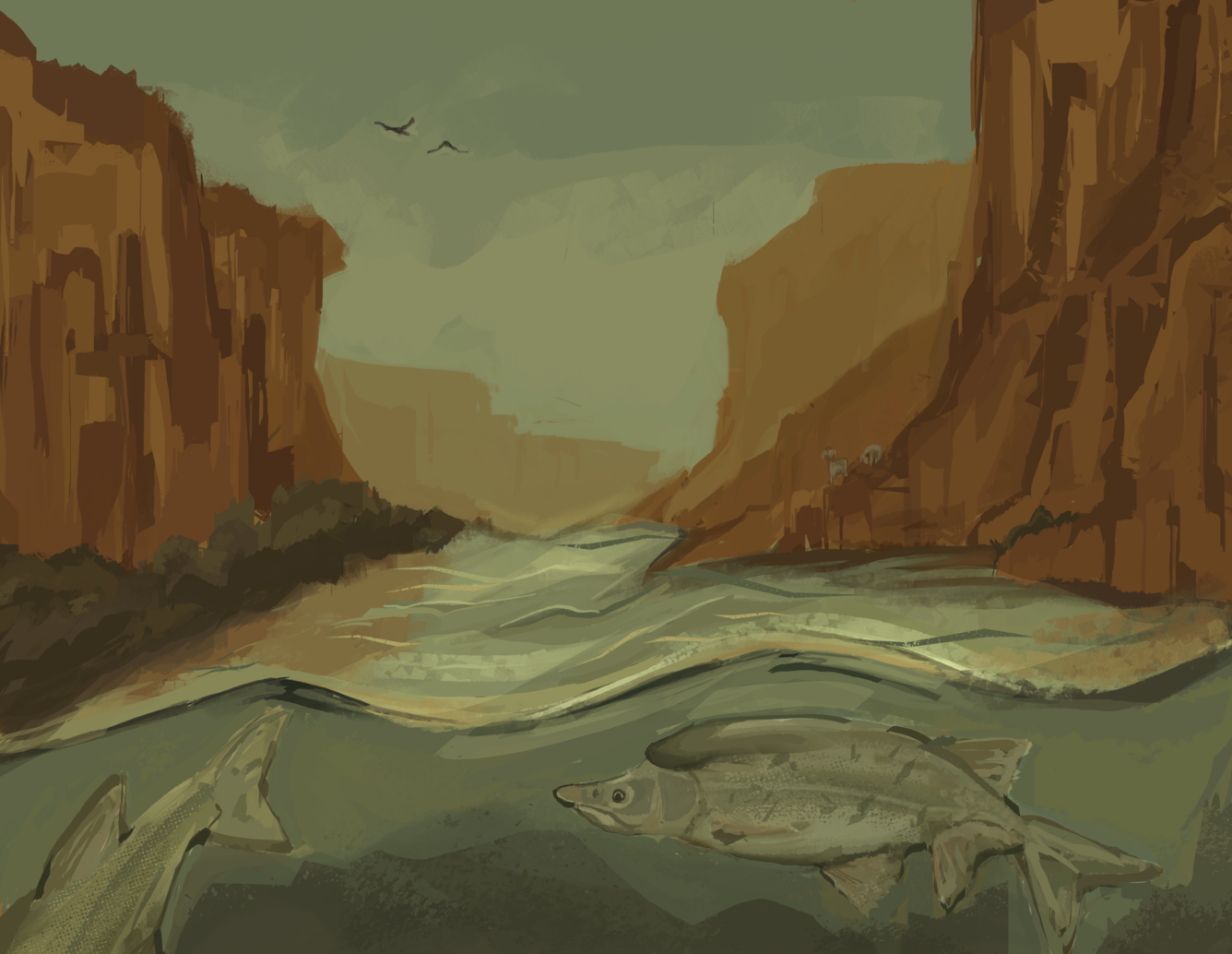
"I made a digital art piece using the app procreate on my ipad! I portrayed a wide shot view of the colorado river starring the humpback chub which are a native fish species that live in the raging waters that flow through the Grand Canyon. Along with the fish, I added a few other critters in the background such as bighorn sheep and ravens which are commonly spotted in the surrounding area by the scientist I’m partnered with and her colleagues! I thought the addition of these animals would showcase the diversity of the canyon.
It took quite a while to create this piece as I’m not too well versed in making landscapes. I tried to include my knowledge of traditional draw and painting techniques while taking my stylus to my screen. I started off by blocking my colors and trying not to add minute details too quickly. I utilized a lot of image references, especially when building up the sides of the grand canyon and the water surrounding the humpback chubs. I also played with saturation, hue, and value to create the depth and perspective. I wanted my piece to look as if the viewer were staring through a wide-angle camera placed halfway beneath the water.
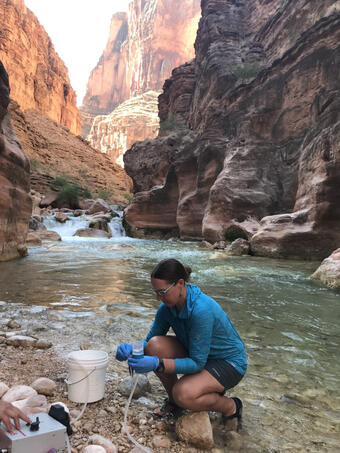
My collaborative biologist, Kimberly Dibble—who specializes in fish physiology, told my classmate and I all about these native fish species and the studies they do on their multi-week long trips on the colorado river. I felt like showing this in my piece would be very representative of USGS’ work! I hope my art piece will encourage viewers to learn more about the fish species featured, about the ones who are invasive and affecting our waters, and about what the scientists here at USGS are actively doing to improve the populations of native animal species that belong to the southwest! "
|
Media
Sources/Usage: Public Domain. View Media Details
| Scientist Statement
Kimberly Lellis Dibble, Ph.D., is a Supervisory Research Fish Biologist who studies aquatic invasive species in rivers and reservoirs across the Southwest region. She is primarily interested in using molecular tools such as environmental DNA to detect changes in invasive species distribution and relative abundance in waterways inhabited by threatened and endangered species. She is also working on a project that uses genetic information to understand source populations of invasive smallmouth bass and relatedness among populations in Lake Powell and in the downstream Colorado River. |
Leighanne, Grade 10
Artist Statement
What did you make?
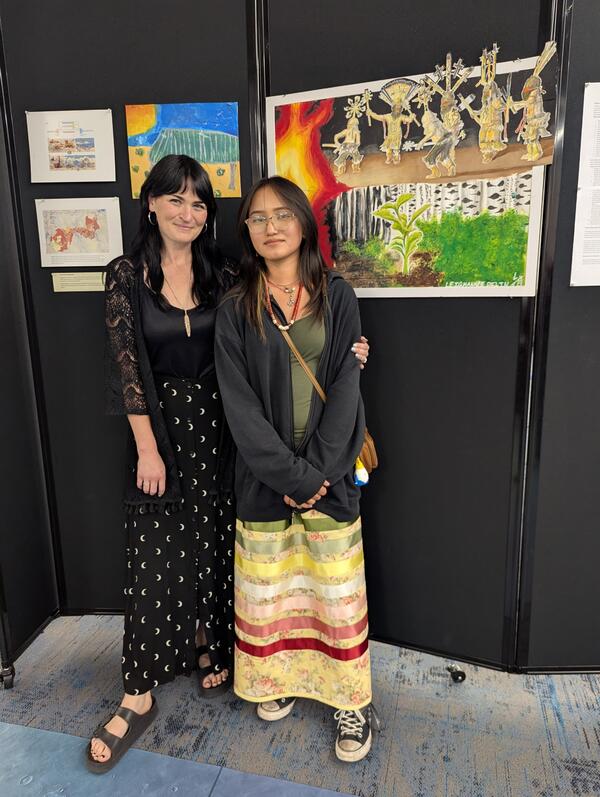
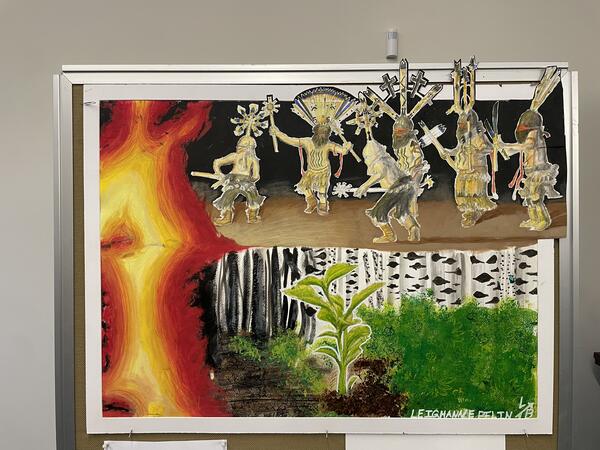
"What I make is a drawing of the Crown dancers or Ga’an which translate to Mountain Gods. And on the bottom of it is a plant, a quaking aspen which is native to the White Mountain. The plant itself is sprouting out of the burnt forest ground from a controlled fire. On the right of the drawing is the fire but on the top is being used for a ceremonial dance, for the bottom the fire represents a controlled fire passing through the forest of White Mountain."
What did you use to make?
- Watercolor paper
- Mechanical pencils (0.5 and 0.7 mm)
- Eraser
- Netted eraser
- Ruler
- Dusting brush
- Glue stick
- Foil tape
- Scissors
- Watercolor paint
- Watercolor pens
- Acrylic paint
- Paint brushes
- My fingertips
- Stamps
- Brayer
- Gelli print
- Color pencil
How did you make this?
"How I made this is starting with a reference, rough sketch. Then the actual sketch but add details with it, colored it, shading, lighting and any final touches."
What were the steps?
- Doing a rough sketch, basically knowing how much space is between each other and having to adjust a person or object if needed. And I try to not spend time adding details yet but spending time on how the anatomy of each dancer is to help me when I’m actually adding details.
- After the rough sketch I use my netted eraser to make my rough sketch transparent so it's easier to draw in the details. And drawing the clothing, crowns, and the muscles.
- I started to clean my pallet, watercolor pens, and paint brushes that I picked out. then started to add colors to the drawing. I take my time on the coloring part so that the paint doesn't overlap the pencil drawing.
- The background was a little tricky and I had to clean and switch different types of brushes to be able to get mostly all the background paper painting with black.
- I painted the small plants first then worked my way to the right, the burnt side I was sort of hesitant to paint the sand but it worked fine.
- Same thing with the fire but when I started painting it I noticed how thin the paint was. Like the paint is sort of transparent so I added cornstarch to thicken it., which came out like playdoh and just decided to smug it on there, then normally painting it with the yellows.
- When adding the highlights and shading I was scared to do. So I use my transparent sticky notes to see/ practice my shading and highlighting, basically experimenting with the colors such as yellow, orange and black.
- After that I cut closely around the crowns.
- I used the color pencil on the fire to make it more sharp and detailed, including the sprouting plant by enhancing the lighting of it with yellow. Then using watercolor again to make the shading more seen.
- I tried different types of stamps and gelli print which didn't come out great. So I just went any how with the stamp, adding texture to the other bushes of leaves.
- I even do the same thing on the burnt side of the forest but just only the floor.
Why is this piece of art special?
"The reason why this piece of art is special is because it brings awareness to the White Mountain and the tribe that lives there which are the Apache tribe and wildfires here in Flagstaff are happening often to the point I’m not surprised if I hear there’s one going on. And also shows how the importance of fire to the Apache tribe is.
The reason why my drawing is special to me is because I have never drawn a human, like a full body human before till now. Most of my drawings in the past and now I’ve always drawn animals/ mythical animals, sometimes I'll try to tempt drawing a human body without really studying the anatomy. A couple days ago I did study the anatomy of the human body by looking and observing the muscles which really help. And the other reason is the coloring, I rarely color my drawings. Most of my drawings are in pencil and sometimes pen. When adding colors I get sort of nervous and doing shading and lighting is hard for me but I’m still learning to this day."
What does it tell your viewers?
"What my drawing tells my viewers is the awareness of how wildfires aren't not that but can benefit a forest by cleaning the waste off from the ground and stimulate growth to small plants and seeds. And also how many tribes such as the Apache tribe values fire."
|
Media
Sources/Usage: Some content may have restrictions. View Media Details
| Scientist Statement
Aaron Russell. Ph.D., is a social scientist specializing in community focused wildfire risk assessment. His research focuses on the sharing and co-production of knowledge with Tribal communities in Arizona to make decision tools like risk assessments for wildfire more effective and helpful. |
Reggie, Grade 12
Artist Statement
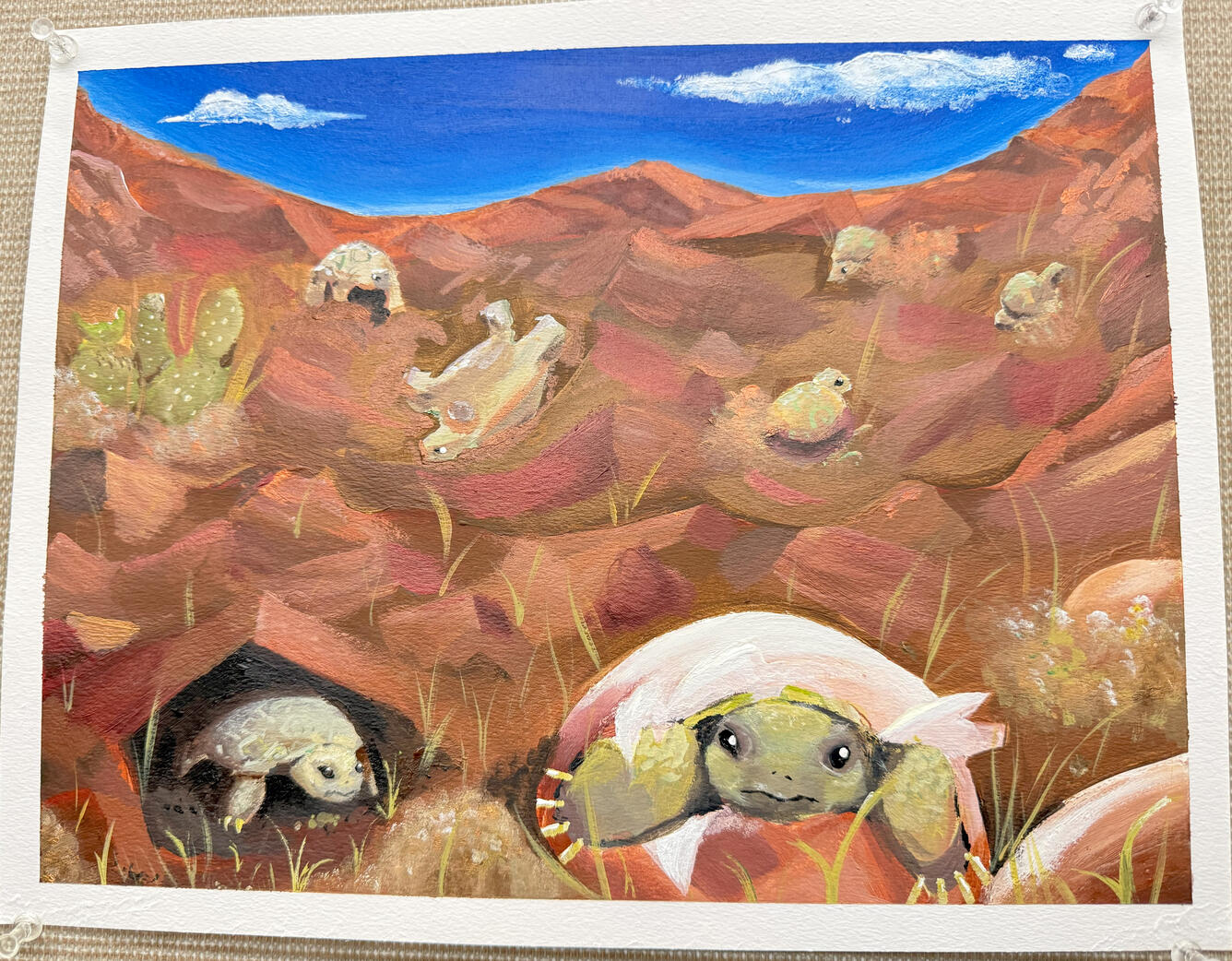
"In my piece, I worked with Sarah Birchard to learn a lot about the desert Mojave tortoise. Through my painting, I wanted to incorporate a lot of the interesting aspects of this species's life that I had learned. To paint, I used a variety of acrylic paints. I wanted to tell a story about the Mojave desert tortoises, including their fights, their eggs, and their foods."
Media
Sources/Usage: Public Domain. View Media Details
| Scientist Statement
Sarah Birchard moved to Flagstaff, AZ from Anchorage, Alaska to work with turtles for U.S. Geological Survey. Sarah has been working on several projects involving turtles since the summer of 2024, and plans to continue working with the wonderful world of shelled animals. |
A. Jardine, Grade 12
Artist Statement
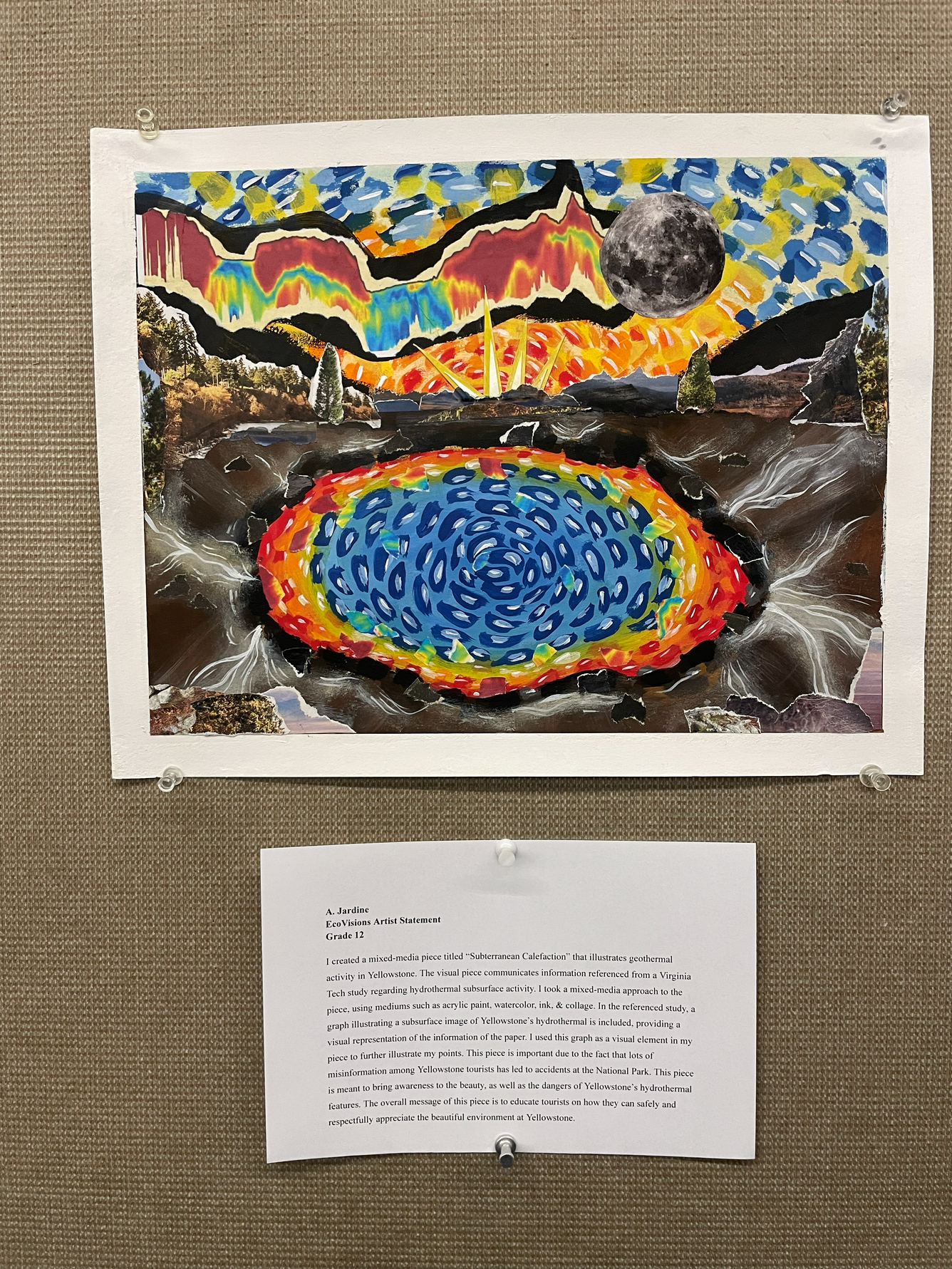
"I created a mixed-media piece titled “Subterranean Calefaction” that illustrates geothermal activity in Yellowstone. The visual piece communicates information referenced from a Virginia Tech study regarding hydrothermal subsurface activity. I took a mixed-media approach to the piece, using mediums such as acrylic paint, watercolor, ink, & collage. In the referenced study, a graph illustrating a subsurface image of Yellowstone’s hydrothermal is included, providing a visual representation of the information of the paper. I used this graph as a visual element in my piece to further illustrate my points. This piece is important due to the fact that lots of misinformation among Yellowstone tourists has led to accidents at the National Park. This piece is meant to bring awareness to the beauty, as well as the dangers of Yellowstone’s hydrothermal features. The overall message of this piece is to educate tourists on how they can safely and respectfully appreciate the beautiful environment at Yellowstone."
|
Media
Sources/Usage: Public Domain. View Media Details
| Scientist Statement
Greg Vaughan, Ph.D., is a geologist who studies active volcanoes and geothermal areas. He uses aerospace remote sensing data combined with field observations to map, measure, and monitor active thermal areas in Yellowstone. |
Sophia, Grade 9
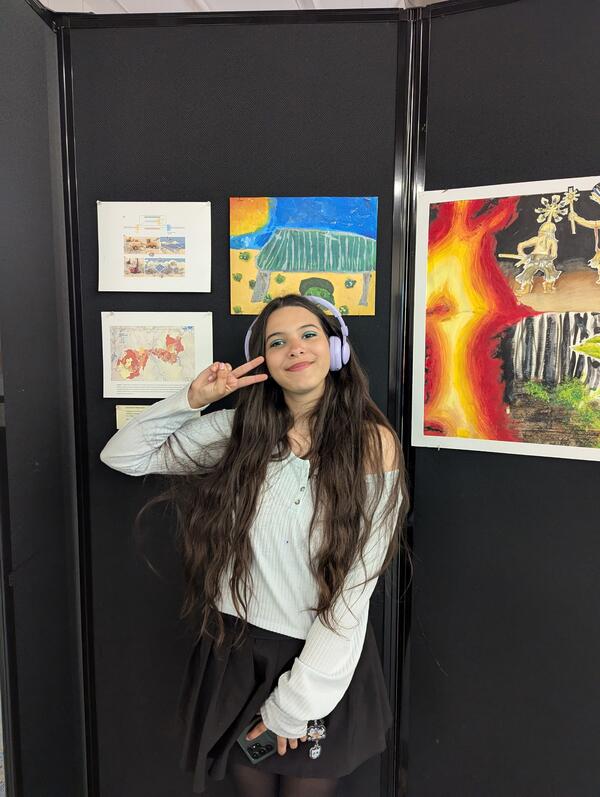
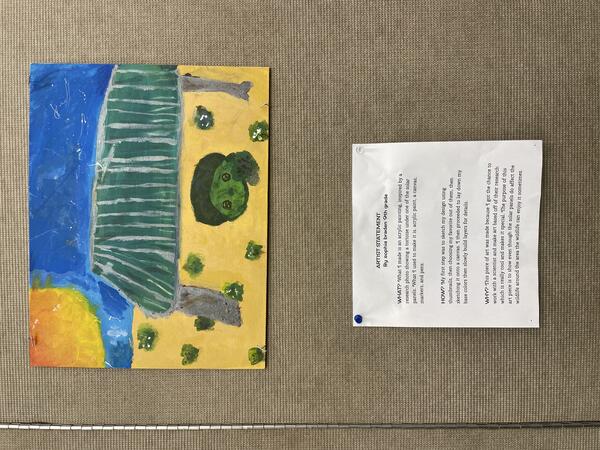
Artist Statement
WHAT? "What I made is an acrylic painting, inspired by a research photo showing a tortoise under one of the solar panels. What I used to make it is, acrylic paint, a canvas, markers, and pens."
HOW? "My first step was to sketch my design using thumbnails, then choosing my favorite out of them, then sketching it onto a canvas. I then proceeded to lay down my base colors then slowly build layers for details."
WHY? "This piece of art was made because I got the chance to work with a scientist and make art based off of their research which is really cool and makes it special. The purpose of this art piece is to show even though the solar panels do affect the wildlife around the area the wildlife can enjoy it sometimes."
Media
Sources/Usage: Public Domain. View Media Details
| Scientist Statement
Claire Karban, Ph.D., is a dryland ecologist studying the effects of climate and land uses, like grazing and energy development, on ecosystems in the Colorado Plateau and Mojave Desert. |
Wally, Grade 9
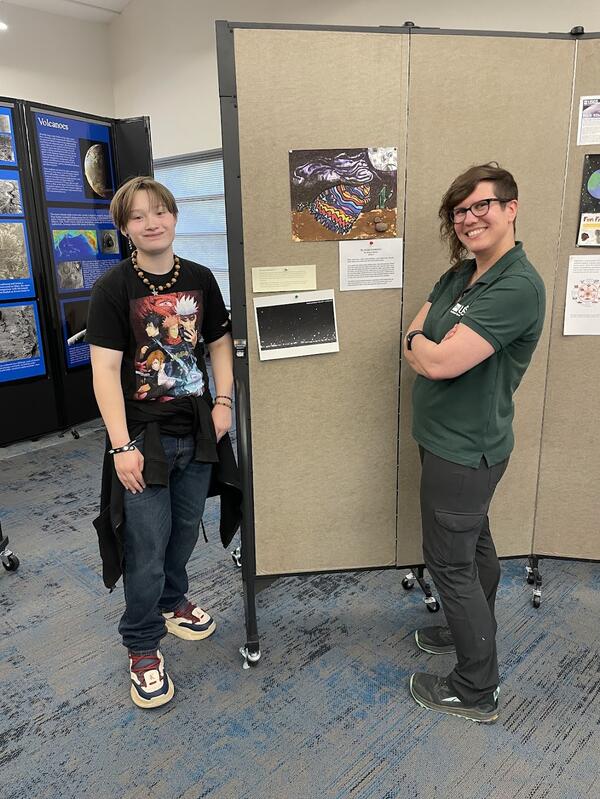
Artist Statement
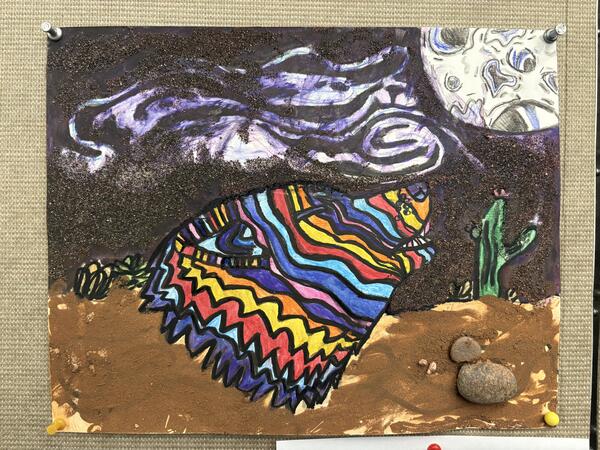
"What I made was a mixed media painting. I used water color pencils, water color paints, sand, glue and mixed media paper.
How I made this mixed media painting was I first sketched the picture out. Then I went over the sketch with water color pencils. Next I got a brush wet with water and used it to blend the water color pencil. After the water colored pencils dried I added glue to the background of the sky and blew black colored sand at it. Once that dried I added glue to the bottom half of my background and blew reddish/orangish sand at it. Then I let it dry and my mixed media painting was complete.
This piece of art is special because it expresses wind interpreted as spirit that resembles that of a wolf. In the Arizona high desert on a windy moonlight night. It tells the views the magic of wind."
Media

Sources/Usage: Public Domain. View Media Details
| Scientist Statement
Madeline Kelly, Ph.D., is a research scientist who studies how sand and sediment move in nature—from tiny grains to entire landscapes. Her work connects what happens at the smallest scale to big changes in rivers, deserts, and coastlines. |
Related
September 22nd: Art and Science Converge at USGS for a Flagstaff Festival of Science Exhibition September 22nd: Art and Science Converge at USGS for a Flagstaff Festival of Science Exhibition
Related