



Sampling terrace deposits above the Cheyenne River in South Dakota. Terrace deposits are serving as background readings for a sediment contamination study (Huron/Rapid City, SD, Water Science Centers). Kevin Baker is collecting samples in the trench. John Stamm is taking notes.
Images
Images
Filter Total Items: 9448

Another Day at the Office
Sampling terrace deposits above the Cheyenne River in South Dakota. Terrace deposits are serving as background readings for a sediment contamination study (Huron/Rapid City, SD, Water Science Centers). Kevin Baker is collecting samples in the trench. John Stamm is taking notes.

Flat Tree Oyster (Isognomon alatus)
At high tide, the red bark of the Red Mangrove Trees is submerged, creating a brilliant reflection at the water's surface. Flat Tree Oysters (Isognomon alatus) grow on the upper portions of the roots.
At high tide, the red bark of the Red Mangrove Trees is submerged, creating a brilliant reflection at the water's surface. Flat Tree Oysters (Isognomon alatus) grow on the upper portions of the roots.

Using Airboats For Marsh Studies
National Wetlands Research Center scientists use air boats for the marsh studies along the Gulf of Mexico.
National Wetlands Research Center scientists use air boats for the marsh studies along the Gulf of Mexico.

Sponges in the Hurricane Hole mangroves
Sponges, such as the blue, green and orange ones growing on these prop roots, provide much of the color in the Hurricane Hole mangroves.
Sponges, such as the blue, green and orange ones growing on these prop roots, provide much of the color in the Hurricane Hole mangroves.
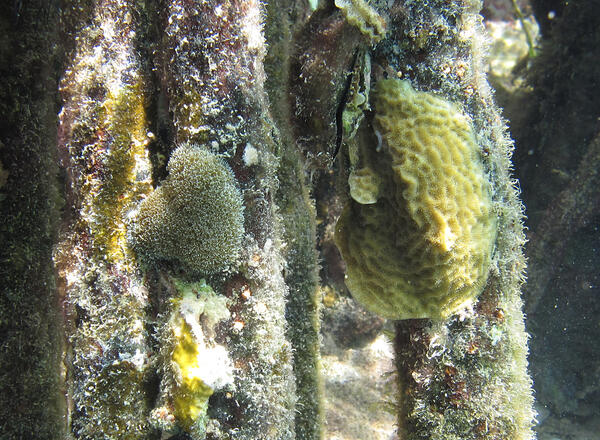
Finger Coral (Porites sp), Lettuce Coral (Agaricia sp)
Finger Coral (Porites sp), Lettuce Coral (Agaricia sp)Small corals have settled and begun to grow on the prop roots (Finger Coral, Porites sp. on the left; Lettuce Coral, Agaricia sp. on the right).
Finger Coral (Porites sp), Lettuce Coral (Agaricia sp)
Finger Coral (Porites sp), Lettuce Coral (Agaricia sp)Small corals have settled and begun to grow on the prop roots (Finger Coral, Porites sp. on the left; Lettuce Coral, Agaricia sp. on the right).

Ghost Crab
Ghost crab on the beach.

Giant Caribbean Anemone (Condylactis gigantea)
Giant Caribbean Anemones (Condylactis gigantea) display a wide range of colors but often have bright pink or purple tips.
Giant Caribbean Anemones (Condylactis gigantea) display a wide range of colors but often have bright pink or purple tips.

Boulder Geomagnetic Observatory
Zeiss Jena 010B Theodolite for making absolute measurements at Boulder magnetic observatory.
Zeiss Jena 010B Theodolite for making absolute measurements at Boulder magnetic observatory.

Rock Beauty Angelfish (Holacanthus tricolor)
The beautiful yellow and black Rock Beauty (Holacanthus tricolor) is much less abundant than the other members of the Angelfish Family.
The beautiful yellow and black Rock Beauty (Holacanthus tricolor) is much less abundant than the other members of the Angelfish Family.

Great Barracuda (Sphyraena barracuda)
An adult Great Barracuda (Sphyraena barracuda) bares his teeth.
An adult Great Barracuda (Sphyraena barracuda) bares his teeth.

Fire Sponge (Tedania ignis)
Bright red Fire Sponges (Tedania ignis) can cause severe reactions if touched.
Bright red Fire Sponges (Tedania ignis) can cause severe reactions if touched.

Spotted Trunkfish (Lactophrys bicaudalis)
Spotted Trunkfishes (Lactophrys bicaudalis) feed mostly on Sea Squirts (Tunicates).
Spotted Trunkfishes (Lactophrys bicaudalis) feed mostly on Sea Squirts (Tunicates).

ADCP at Sunset
ADCP work for a Waste Water Treatment Plant Study. Photo taken south of St. Paul, MN on the Mississippi River (Mounds View, MN, Water Science Center).
ADCP work for a Waste Water Treatment Plant Study. Photo taken south of St. Paul, MN on the Mississippi River (Mounds View, MN, Water Science Center).

Mountainous Star Coral (Montastraea faveolata)
This colony of Mountainous Star Coral (Montastraea faveolata) is so large (about 3 feet across) that it must have been growing before the severe bleaching and disease episode in 2005/2006 that caused so much coral mortality on St. John's reefs.
This colony of Mountainous Star Coral (Montastraea faveolata) is so large (about 3 feet across) that it must have been growing before the severe bleaching and disease episode in 2005/2006 that caused so much coral mortality on St. John's reefs.

Queen Angelfish Hides in Mangrove Prop Roots
A Queen Angelfish peers through the safety of the mangrove roots across the rich colors and textures of corals, sponges, urchins, and algae. Queen Angelfish feed almost exclusively on sponges, which are abundant in these mangroves.
A Queen Angelfish peers through the safety of the mangrove roots across the rich colors and textures of corals, sponges, urchins, and algae. Queen Angelfish feed almost exclusively on sponges, which are abundant in these mangroves.

Deepsea Brittle Star
Collected from more than 1000 feet below the surface of the Gulf of Mexico, this fragile brittle star clings to a soft coral. These deep-sea coral ecosystems ar biodiversity hot-spots in the deep ocean, but they are also vulnerable to climate change issues such as increased temperature and ocean acidification.
Collected from more than 1000 feet below the surface of the Gulf of Mexico, this fragile brittle star clings to a soft coral. These deep-sea coral ecosystems ar biodiversity hot-spots in the deep ocean, but they are also vulnerable to climate change issues such as increased temperature and ocean acidification.

Juvenile Barracuda
Barracudas of all sizes, from the juveniles shown here, to adults over 3 feet long, are common inhabitants of the mangroves.
Barracudas of all sizes, from the juveniles shown here, to adults over 3 feet long, are common inhabitants of the mangroves.

Gray Snapper (Lutjanus griseus)
Gray Snappers (Lutjanus griseus) are among the largest fish found in schools in the mangroves.
Gray Snappers (Lutjanus griseus) are among the largest fish found in schools in the mangroves.

Invasive Lionfish Removal
In September 2009, divers carefully capture an invasive red lionfish (Pterois volitans) found near the coast of North Carolina. Invasive lionfish are now established in the hard bottom habitats of North Carolina's coast, where they are abundant.
In September 2009, divers carefully capture an invasive red lionfish (Pterois volitans) found near the coast of North Carolina. Invasive lionfish are now established in the hard bottom habitats of North Carolina's coast, where they are abundant.

Invasive Lionfish Removal
Research divers rest at 20 feet as they ascend with a dive bag containing invasive red lionfish (Pterois volitans). The bag is clipped to a line to prevent them being stung by the lionfish as its bladder fills with air during the ascent. These lionfish were removed from hard bottom habitat, about 100 foot deep, near the coast of North Carolina.
Research divers rest at 20 feet as they ascend with a dive bag containing invasive red lionfish (Pterois volitans). The bag is clipped to a line to prevent them being stung by the lionfish as its bladder fills with air during the ascent. These lionfish were removed from hard bottom habitat, about 100 foot deep, near the coast of North Carolina.

Unidentified Hawk
Unidentified hawk perched upon a dead tree.
Unidentified hawk perched upon a dead tree.