What was the largest landslide in the United States? In the world?
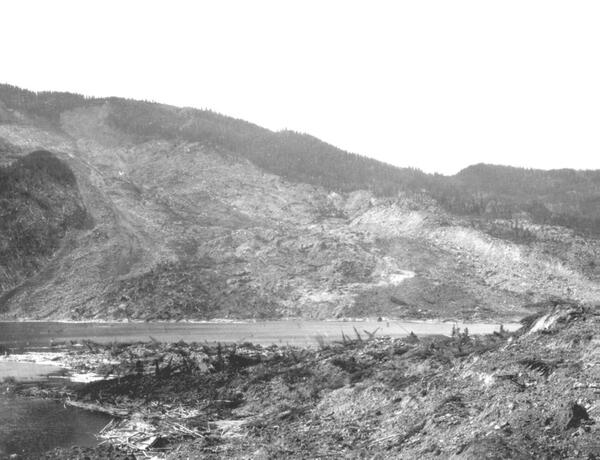
The largest subaerial (on land) landslide in Earth's recorded history was connected with the 1980 eruption of Mount St. Helens volcano in Washington state, USA. That landslide had a volume of 2.8 cubic kilometers (0.67 cubic miles) of material and the landslide traveled about 22.5 kilometers (14 miles) down the North Fork Toutle River. Average landside depth was 46 meters (150 feet) with a maximum depth of 182 meters (600 feet). The landslide velocity was 112-240 kilometers per hour (70-150 miles per hour). Landslides are common on tall, steep, and weak volcanic cones.
Learn more:
Related Content
What should I know about wildfires and debris flows?
How do landslides cause tsunamis?
Under what circumstances do U.S. Geological Survey landslide personnel conduct field work in landslide-prone areas?
Can major landslides and debris flows happen in all areas of the U.S.?
What is the difference between a landslide advisory, a landslide watch, and a landslide warning?
How many deaths result from landslides each year?
Do human activities cause landslides?
Why study landslides?
What is a landslide and what causes one?
New Landslide Guidebook for Puerto Rico Residents
A new landslide guidebook released February 5 is now available for Puerto Rico residents to learn more about the landslide hazards that can impact the island.
Landslide Risks Highlighted in New Online Tool
The U.S. Geological Survey today unveiled a new web-based interactive map that marks an important step toward mapping areas that could be at higher risk for future landslides. In collaboration with state geological surveys and other federal agencies, USGS has compiled much of the existing landslide data into a searchable, web-based interactive map called the U.S. Landslide Inventory Map.
Landslide Assistance from the Air
The USGS uses cutting edge technologies to investigate and forecast landslides and other natural hazards.
Huge landslide on California’s Big Sur coast continues to change
The Mud Creek landslide on California’s Big Sur coast keeps eroding.
USGS maps, measures huge landslide on California's Big Sur coast
USGS scientists analyzing before-and-after air photos have calculated the size of the May 20 landslide on California’s Big Sur coast, about 140 miles south of San Francisco.
EarthView–Landslide Spreads 6 Miles Across Glacier Bay National Park
Two snapshots from Landsat show the extent of a landslide in an Alaska National Park.
New Time-lapse Animation of Mount St. Helens 1980 Ash Cloud as Seen from Space
Scientists at the U.S. Geological Survey’s Cascades Volcano Observatory rediscovered an old cache of satellite images captured on May 18-19, 1980, and linked them together to create a time-lapse movie of Mount St. Helens' eruptive ash cloud movement across the western United States.
Protecting Communities from Landslides
New report identifies best practices for protecting communities
New USGS Fact Sheet About Landslides Delivering Slope Material to Nearshore Waters on California's Big Sur Coast
Landslides are common along the rugged Big Sur coast in central California
Documenting landslides in Puerto Rico caused by Hurricane Maria.
Bill Schulz, USGS Research Geologist, takes photographs of Puerto Rican hillsides from a U.S. Army helicopter to document landslides caused by Hurricane Maria. This work will help identify areas around Puerto Rico with the highest risk of more landslides, which is information the Federal Emergency Management Agency will use to determine the best way to mitigate and prepare
...Big Sur landslide on May 20, 2017
USGS air photo of the Mud Creek landslide, taken on May 27, 2017.
Digital Elevation Map of Mount St. Helens pre and post 1980
The shaded relief image was produced from LIDAR data. LIDAR is an acronym for Light Detection and Ranging, a modern remote sensing technique used to map topography very accurately—more so than is possible with older techniques. The crater is 1.2 miles (1.9km) wide east-west. Elsewhere the scale varies owing to the oblique viewing angle. The landslide deposit includes the
...Volcano Web Shorts 2: Debris Flows
Debris flows are hazardous flows of rock, sediment and water that surge down mountain slopes and into adjacent valleys. Hydrologist Richard Iverson describes the nature of debris-flow research and explains how debris flow experiments are conducted at the USGS Debris Flow Flume, west of Eugene, Oregon. Spectacular debris flow footage, recorded by Franck Lavigne of the
Mud Creek landslide near Big Sur
A view of the Mud Creek landslide near Big Sur, California, from the research vessel Snavely
2005 Landslide in La Conchita, CA
On January 10, 2005, a landslide struck the community of La Conchita in Ventura County, California, destroying or seriously damaging 36 houses and killing 10 people. For a USGS rerpot on this event, please see USGS Open-file report, "Landslide Hazards at La Conchita, California."
North Flank of Mount St. Helens
This view from near the Forest Learning Center along Highway 504 shows the north flank of Mount St. Helens, from which much of the debris from the massive 1980 avalanche/eruption spilled into the Toutle River valley. The eruption produced about 3 cubic kilometers of ash and sediment that was distributed across the landscape around the volcano. This material is being
...Mount St. Helens Simplified Volcano Hazards Map
Mount St. Helens, Washington simplified hazards map showing potential impact area for ground-based hazards during a volcanic event. More simplified volcano hazard maps for the other Cascades Volcanoes can be found here.
Mount Saint Helens eruption
On Sunday, May 18, 1980 at 8:32 a.m., the bulging north flank of Mount St. Helens slid away in a massive landslide -- the largest in recorded history. Seconds later, the uncorked volcano exploded and blasted rocks northward across forest ridges and valleys, destroying everything in its path within minutes.
2008 Landslide Near Hongyan Resort, China
The May 12, 2008, Great Sichuan Earthquake, also called the Wenchuan Earthquake, occurred at 14:28 local time, in Sichuan Province, China. The earthquake magnitudes were Mw = 7.9 (USGS), Ms = 8.0 (Chinese Earthquake Administration). The epicenter was 80 km west-northwest of Chengdu, the capital city of Sichuan province. Damage by earthquake-induced landslides was
...