



This is our office.
These are our coworkers.
This is our rush hour.
This is our happy hour.
Dive in to learn more.
Northern Rocky Mountain Science Center
Northern Rocky Mountain Science Center scientists work throughout the U.S. and the world on a diverse set of issues to support the safeguarding, understanding, and management of our public lands.
Featured Research
Featured Research

READI-Net—A network of robotic environmental DNA samplers to enhance the early detection of aquatic biological threats
Featured Research
Featured Research

NOROCK is developing drought early warning systems for fisheries and water management
NOROCK Quick Links
NOROCK Quick Links
Check out our most up-to-date data & science, and learn about any upcoming NOROCK opportunities .
News
USGS READI-Net Tests Next Generation Environmental DNA Sampling Robot for Early Detection of Biological Threats
USGS READI-Net Tests Next Generation Environmental DNA Sampling Robot for Early Detection of Biological Threats
Earth Science Matters - Vol. 21 | Issue 1
Earth Science Matters - Vol. 21 | Issue 1
USGS and BLM publish a science synthesis on risks of spreading invasive annual grasses in MT, ND & SD through vegetation treatments
USGS and BLM publish a science synthesis on risks of spreading invasive annual grasses in MT, ND & SD through vegetation treatments
Publications
Estimating GPS-based social aggregation metrics using collar data Estimating GPS-based social aggregation metrics using collar data
Understanding social aggregation patterns in ungulate herds is essential for gaining behavioral insights, optimizing resource use, reducing human-wildlife conflict, and managing disease risk. As chronic wasting disease is the preeminent disease-related threat to cervid populations in North America, knowledge of contact between individuals and spatiotemporal patterns of aggregation...
Distribution and threats to the Arizona toad in Clark County Distribution and threats to the Arizona toad in Clark County
The Arizona Toad (Anaxyrus microscaphus) has been petitioned for protection under the U.S. Endangered Species Act (ESA) and is under evaluation for inclusion as a Covered Species under the Clark County Multi Species Habitat Conservation Plan Amendment (Clark County Department of Comprehensive Planning and USFWS, 2001; USFWS, 2015b). Although the species is locally abundant in some parts...
Adaptive capacity of freshwater organisms in North America: Current understanding and future applications Adaptive capacity of freshwater organisms in North America: Current understanding and future applications
Freshwater species are increasingly threatened by climate change, yet our ability to assess their vulnerability remains incomplete. Typically, climate change vulnerability assessments (CCVAs) evaluate three components: exposure, sensitivity, and adaptive capacity. Adaptive capacity, defined as the ability of a species to adjust to changing conditions, provides critical insight into how...
Science
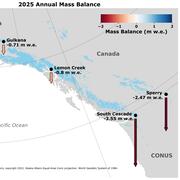
2025 USGS Benchmark Glaciers Executive Summary
2025 Data Now Available: Explore how the USGS Benchmark Glaciers have changed in 2025
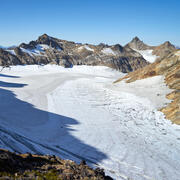
Glaciers and Landscape Change
Mountain glaciers are dynamic reservoirs of frozen water, deeply interconnected with their surrounding ecosystems. Glacier change in North America has major societal impacts, including to water resources, natural hazard risk, tourism disruption, fisheries, and global sea level change. Understanding and quantifying precise connections between changing glaciers, the surrounding landscape and climate...

Mass Balance Methods: Measuring Glacier Change
Nearly all of Earth's alpine glaciers are losing mass, with consequences for freshwater resources, landscape stability, regional ecosystems, and global sea level. Rates of glacier mass loss in Western North America and Alaska are among the highest on Earth (The GlaMBIE Team, 2025).