
U.S. flag

An official website of the United States government

Invasive Animals

Filter Total Items: 18
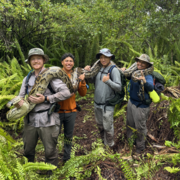
Invasive Burmese python research in the Greater Everglades

USGS leads federal research to control the highly invasive Burmese python ( Python bivittatus), which has become firmly established across the Greater Everglades Ecosystem and poses a serious threat to native wildlife. Capable of reaching over 17 feet long, this massive constrictor is believed to be a key factor in the sharp decline of mammal populations in the region. For over a decade...
Invasive Burmese python research in the Greater Everglades

Invasive Burmese python research in the Greater Everglades

USGS leads federal research to control the highly invasive Burmese python ( Python bivittatus), which has become firmly established across the Greater Everglades Ecosystem and poses a serious threat to native wildlife. Capable of reaching over 17 feet long, this massive constrictor is believed to be a key factor in the sharp decline of mammal populations in the region. For over a decade...
Learn More

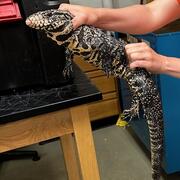
Early detection and rapid response tools for invasive tegu lizards

Scientists at USGS have shown that much of the US is suitable for invasion by tegu lizards, and suitability will likely increase in the future. While tegus can be removed via trapping, it is difficult to monitor every geographic area where tegus could invade. Thus, methods for quickly detecting and removing tegus in new areas are the best way to prevent spread and minimize damage from these...
Early detection and rapid response tools for invasive tegu lizards

Early detection and rapid response tools for invasive tegu lizards

Scientists at USGS have shown that much of the US is suitable for invasion by tegu lizards, and suitability will likely increase in the future. While tegus can be removed via trapping, it is difficult to monitor every geographic area where tegus could invade. Thus, methods for quickly detecting and removing tegus in new areas are the best way to prevent spread and minimize damage from these...
Learn More

Developing and evaluating a point-of-use environmental DNA test for rapid field detection of highly invasive brown treesnakes

New terrestrial environmental DNA (eDNA) sampling techniques are sensitive tools for early detection of the highly invasive brown treesnakes (BTS). In a new collaborative research effort involving four USGS science centers, scientists have initiated the development of an innovative point-of-use (POU) assay for BTS. POU assays are tests that can be run in the field with minimal equipment and no...
Developing and evaluating a point-of-use environmental DNA test for rapid field detection of highly invasive brown treesnakes

Developing and evaluating a point-of-use environmental DNA test for rapid field detection of highly invasive brown treesnakes

New terrestrial environmental DNA (eDNA) sampling techniques are sensitive tools for early detection of the highly invasive brown treesnakes (BTS). In a new collaborative research effort involving four USGS science centers, scientists have initiated the development of an innovative point-of-use (POU) assay for BTS. POU assays are tests that can be run in the field with minimal equipment and no...
Learn More

A citizen science program for brown treesnake removal and native species recovery at a National Historical Park in Guam

The National Park Service (NPS), U.S. Geological Survey (USGS), U.S. Fish and Wildlife Service (USFWS), and community Citizen Scientists are working together to remove brown treesnakes at War in the Pacific National Historical Park - Asan Beach Unit to aid restoration of native avian and reptile species.
A citizen science program for brown treesnake removal and native species recovery at a National Historical Park in Guam

A citizen science program for brown treesnake removal and native species recovery at a National Historical Park in Guam

The National Park Service (NPS), U.S. Geological Survey (USGS), U.S. Fish and Wildlife Service (USFWS), and community Citizen Scientists are working together to remove brown treesnakes at War in the Pacific National Historical Park - Asan Beach Unit to aid restoration of native avian and reptile species.
Learn More

Future Aquatic Invaders of the Northeast U.S.: How Climate Change, Human Vectors, and Natural History Could Bring Southern and Western Species North

Researchers will evaluate the potential of aquatic species to invade the Northeast U.S. Following the identification of appropriate target species by regional stakeholders, researchers will gather data from the NAS database and develop models to determine habitat suitability for each species.
Future Aquatic Invaders of the Northeast U.S.: How Climate Change, Human Vectors, and Natural History Could Bring Southern and Western Species North

Future Aquatic Invaders of the Northeast U.S.: How Climate Change, Human Vectors, and Natural History Could Bring Southern and Western Species North

Researchers will evaluate the potential of aquatic species to invade the Northeast U.S. Following the identification of appropriate target species by regional stakeholders, researchers will gather data from the NAS database and develop models to determine habitat suitability for each species.
Learn More

Multi-year Burmese Python Vital Rate Research Collaborative in the Greater Everglades

USGS researchers will track juvenile Burmese python within Big Cypress National Preserve (BICY) and collect data on snake growth, habitat use, and causes of mortality. Known-fate models will be used to estimate survival and better understand factors that influence survival.
Multi-year Burmese Python Vital Rate Research Collaborative in the Greater Everglades

Multi-year Burmese Python Vital Rate Research Collaborative in the Greater Everglades

USGS researchers will track juvenile Burmese python within Big Cypress National Preserve (BICY) and collect data on snake growth, habitat use, and causes of mortality. Known-fate models will be used to estimate survival and better understand factors that influence survival.
Learn More

Siren: The National Early Detection and Rapid Response Information System

Siren: the National Early Detection and Rapid Response (EDRR) Information System is an online resource for invasive species information sharing and collaboration that serves as the information hub of the National EDRR Framework.
Siren: The National Early Detection and Rapid Response Information System

Siren: The National Early Detection and Rapid Response Information System

Siren: the National Early Detection and Rapid Response (EDRR) Information System is an online resource for invasive species information sharing and collaboration that serves as the information hub of the National EDRR Framework.
Learn More

State Partnerships in South Florida

USGS-FORT in partnership with the University of Florida and two state agencies (South Florida Water Management District and Florida Fish and Wildlife Conservation Commission) have initiated a scout snake program to increase the ability to detect and remove Burmese pythons from the interior of the landscape.
State Partnerships in South Florida

State Partnerships in South Florida

USGS-FORT in partnership with the University of Florida and two state agencies (South Florida Water Management District and Florida Fish and Wildlife Conservation Commission) have initiated a scout snake program to increase the ability to detect and remove Burmese pythons from the interior of the landscape.
Learn More

Biology, Impacts and Control of Invasive Reptiles in the Everglades

Invasive species are considered to be second only to habitat degradation in terms of negative impacts on the Earth’s ecosystems, and our scientists make up a significant proportion of the global expertise in the rapidly-growing problem of invasive reptiles.
Biology, Impacts and Control of Invasive Reptiles in the Everglades

Biology, Impacts and Control of Invasive Reptiles in the Everglades

Invasive species are considered to be second only to habitat degradation in terms of negative impacts on the Earth’s ecosystems, and our scientists make up a significant proportion of the global expertise in the rapidly-growing problem of invasive reptiles.
Learn More

Ecology and Control of Invasive Reptiles in Florida

This project involves development of tools for the detection and control of invasive reptiles in Florida, with an emphasis on pythons and tegu lizards. The goals are to reduce the risk of reptile invasions, investigate early detection methods, maintain rapid response capacity, and understand invasive reptile population biology and ecology to inform management options.
Ecology and Control of Invasive Reptiles in Florida

Ecology and Control of Invasive Reptiles in Florida

This project involves development of tools for the detection and control of invasive reptiles in Florida, with an emphasis on pythons and tegu lizards. The goals are to reduce the risk of reptile invasions, investigate early detection methods, maintain rapid response capacity, and understand invasive reptile population biology and ecology to inform management options.
Learn More

Mentoring the next generation: USGS, NPS, and University of Florida Cooperative Research Unit Invasive Reptile Intern Program

Invasive reptiles like the Burmese python ( Python bivittatus) and black and white tegu lizard ( Tupinambis merianae) are exerting tremendous harm on Everglades ecosystems, but these problematic species present an excellent opportunity to engage the next generation in science. Since entering into an agreement with Everglades National Park in late 2013, the Invasive Species Science Branch of the U...
Mentoring the next generation: USGS, NPS, and University of Florida Cooperative Research Unit Invasive Reptile Intern Program

Mentoring the next generation: USGS, NPS, and University of Florida Cooperative Research Unit Invasive Reptile Intern Program

Invasive reptiles like the Burmese python ( Python bivittatus) and black and white tegu lizard ( Tupinambis merianae) are exerting tremendous harm on Everglades ecosystems, but these problematic species present an excellent opportunity to engage the next generation in science. Since entering into an agreement with Everglades National Park in late 2013, the Invasive Species Science Branch of the U...
Learn More

USGS Everglades Research Office - Florida

The Daniel Beard Center in Everglades National Park provides the base for most of the field work done on the control of invasive reptiles by USGS Fort Collins Science Center staff. The team works in Everglades National Park, Big Cypress National Preserve, Crocodile Lake National Wildlife Refuge, and other parts of the Greater Everglades Ecosystem focusing on, among other species of concern...
USGS Everglades Research Office - Florida

USGS Everglades Research Office - Florida

The Daniel Beard Center in Everglades National Park provides the base for most of the field work done on the control of invasive reptiles by USGS Fort Collins Science Center staff. The team works in Everglades National Park, Big Cypress National Preserve, Crocodile Lake National Wildlife Refuge, and other parts of the Greater Everglades Ecosystem focusing on, among other species of concern...
Learn More
Was this page helpful?