Wild turkeys run along a path in an eastern US forest
Wild turkeys run along a path in an eastern US forestWild turkeys run along a path in Massachusetts. Photo by Meredith Hartwell, USGS.
An official website of the United States government
Here's how you know
Official websites use .gov
A .gov website belongs to an official government organization in the United States.
Secure .gov websites use HTTPS
A lock () or https:// means you’ve safely connected to the .gov website. Share sensitive information only on official, secure websites.
Below are images, video and podcasts associated with SBSC's science and staff. Images appear according to the year they were taken. To search, click 'View All,' and type a keyword or select a year from the dropdown menu. Or, click through the pages using the arrows at the bottom of the page.
Wild turkeys run along a path in Massachusetts. Photo by Meredith Hartwell, USGS.
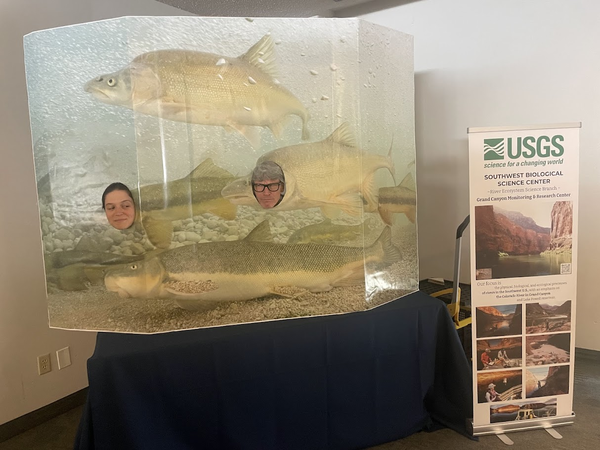
USGS scientists Shannon Sartain and Paul Grams smile through a playful humpback chub cutout display. The display was part of the SBSC information table at the Flagstaff Biennial conference on Science and Technology, Sept 2025. Photo by Anya Metcalfe, USGS.
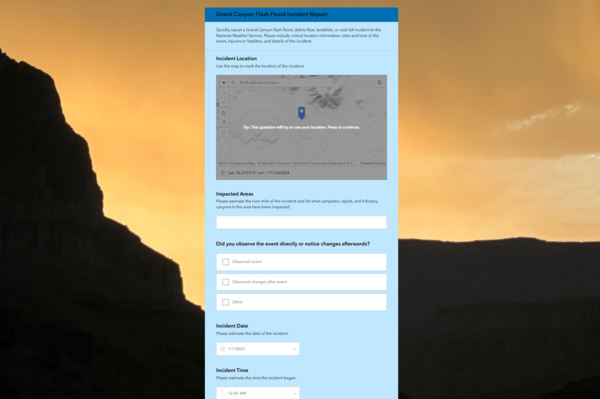
A screenshot of the Grand Canyon community science natural hazard event reporting app form fields.
Laura Shriver, RAMPS coordinator, gives a tour of a Northern Arizona RestoreNet site to Northern Arizona University students. Photo by Jessica Archibald (Diablo Trust).
A man with curly hair stands in a laboratory filled with large fish tanks and holds a jar with two small fish swimming
On a scorching day in June 2022, the summer Lake Powell reached its lowest water level in five decades, National Park Service staff caught baby smallmouth bass in the lower Colorado River.
A male desert bighorn sheep near a water catchment in the Sonoran Desert, Cabeza Prieta National Wildlife Refuge
A group of desert bighorn sheep (Ovis canadensis mexicana) interact near a water catchment, also known as a tinaja, in the Sonoran Desert, Cabeza Prieta National Wildlife Refuge, southern Arizona.
A collection of video for use in products related to the USGS's streamgage at Lees Ferry. The USGS installed the Lees Ferry gauge 100 years ago, and the data collected since have become critical to monitoring water availability in the West.
Shot List:
A collection of video for use in products related to the USGS's streamgage at Lees Ferry. The USGS installed the Lees Ferry gauge 100 years ago, and the data collected since have become critical to monitoring water availability in the West.
Shot List:
A river guide rows her raft through a big rapid in Grand Canyon
Meet Katie, one of the 40 million people who depend on the Colorado River. Pondering life after high school, Katie finds comfort in reflecting on her time in one of the Nation’s most iconic National Parks.
There were two documented gray fox visits at the burrows, making them the third most documented predator. Gray foxes are implicated predators of various life stages of desert tortoises, but it is difficult to catch them in the act. In this case, a gray fox approaches a burrow, and thoroughly investigates the burrow mouth.
There was one documented skunk event captured on camera - the least documented predator. Here, a western spotted skunk is thoroughly investigating the burrow of one of the marked female tortoises in the study population. Western spotted skunks are known predators of turtle eggs.
Welcome to another episode of Outstanding in the Field, the U.S. Geological Survey’s podcast series produced by the Ecosystems Mission Area. We highlight our fun and fascinating fieldwork studying ecosystems across the country. Today we’ll be discussing tiny communities that are found on the surface of the soil in the harsh environments of cold and hot deserts.
In this episode of Outstanding in the Field, we are talking about beaches in a place that most people probably would not think of—the Grand Canyon.
The USGS Ecosystems Mission Area brings you Outstanding in the Field, a series of stories about our science, our adventures, and our efforts to better understand our fish and wildlife and the ecosystems that support them. In this episode we describe some of the one-of-a-kind native fish species that call the Grand Canyon segment of the Colorado River home.
The USGS Ecosystems Mission Area brings you Outstanding in the Field, a series of stories about our science, our adventures, and our efforts to better understand our fish and wildlife and the ecosystems that support them.