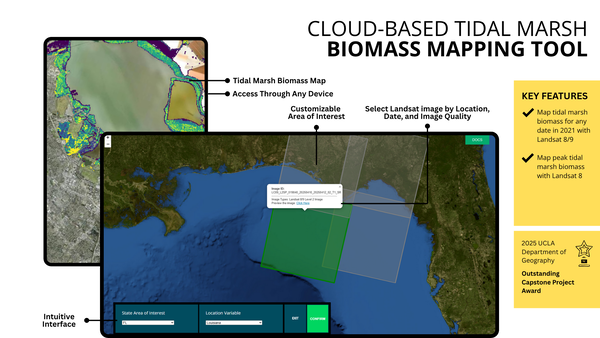
Cloud-based Tidal Marsh Biomass Mapping Tool Description
Cloud-based Tidal Marsh Biomass Mapping Tool DescriptionThe graphical user interface of the Cloud-based tidal marsh biomass mapping tool that highlights features and map outputs.
An official website of the United States government
Here's how you know
Official websites use .gov
A .gov website belongs to an official government organization in the United States.
Secure .gov websites use HTTPS
A lock () or https:// means you’ve safely connected to the .gov website. Share sensitive information only on official, secure websites.
The graphical user interface of the Cloud-based tidal marsh biomass mapping tool that highlights features and map outputs.
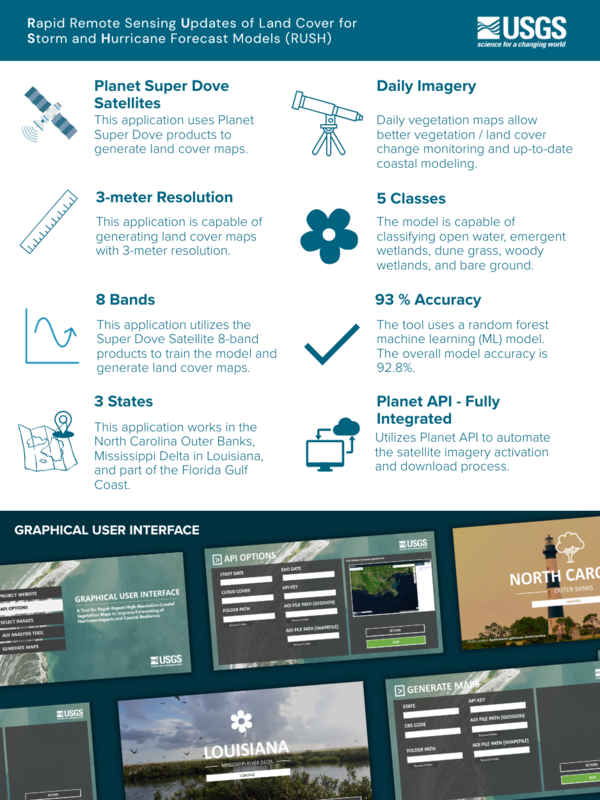
A fact sheet that shows the RUSH tool’s characteristics and graphical user interface.
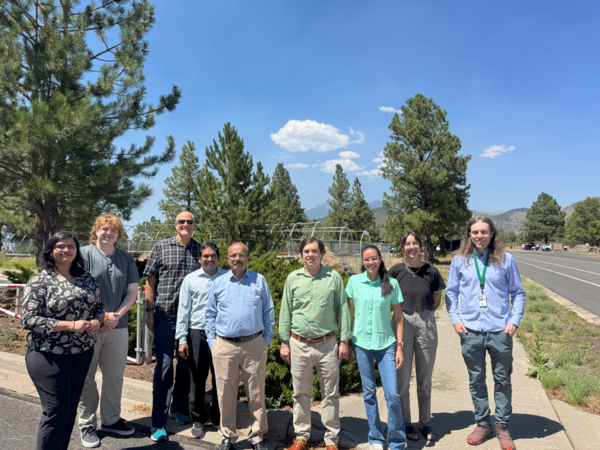
The GFSAD is a NASA funded project (2023-2028) to provide highest-resolution global cropland data and their water use that contributes towards global food-and-water security in the twenty-first century. This image is from the GFSAD project members' 4th workshop hosted in Flagstaff, Arizona where Dr.
The GFSAD is a NASA funded project (2023-2028) to provide highest-resolution global cropland data and their water use that contributes towards global food-and-water security in the twenty-first century. This image was taken after day one of the 4th GFSAD project workshop hosted in Flagstaff, Arizona.
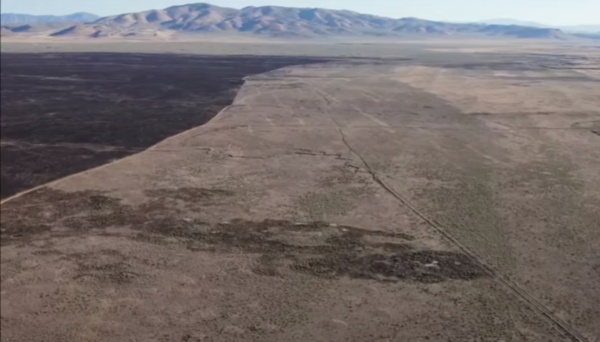
A fire stopped through active suppression activities at a fuel break in Idaho.
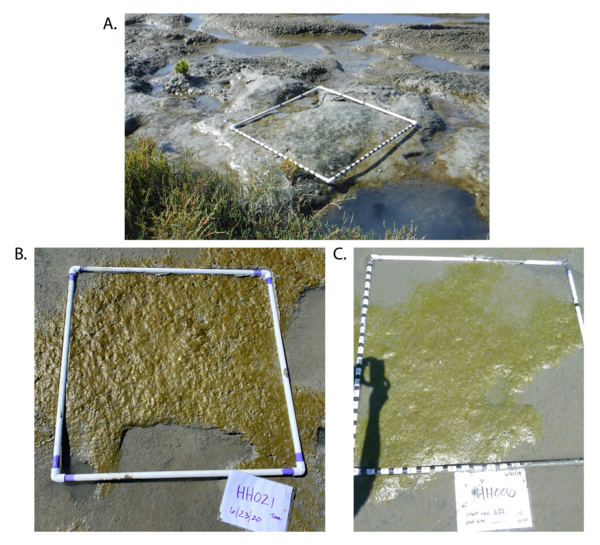
Maps of (a) chl-a concentration, (b) carbohydrates, (c) lipids, and (d) total organic carbon in southern San Francisco Bay, 15 April 2021, based on final partial least squares regression models and AVIRIS-NG 3.7 m imagery. Base map from Esri and its licensors, copyright 2022.
RUSH is a tool for rapid repeat high resolution coastal vegetation maps to improve forecasting of hurricane impacts and coastal resilience. Vegetation cover in coastal settings significantly controls flooding, erosion, and barrier island breaching during extreme storms by reducing wave energy.
It is only in recent years that the restoration profession has begun to recognize the trilogy that links hydrology, geomorphology and ecology. Understanding the fundamental nature of this trilogy is essential to the effective restoration of all streams and wetlands. All three factors must be respected if any project is to be successfully planned, impleme
After around 150 years of Powell’s watershed map, we are getting there….. Think like watershed with interdependence and connectivity of the uplands-middle lands and lowlands and act like a river being the connector of these interactions from the top to the bottom and vice versa.
This project is located in the Juniper Tank Pasture on the Ash Creek Livestock Association.
Lucinda Cole and I retired to the Pitchfork Ranch in southwest New Mexico two decades ago. We’ve overseen 17 government grants to install grade-control structures in 31 side-drainages and the ranches’ 9-mile reach of the 48-mile-long Burro Ciénaga riparian watercourse, 1.5-miles perennial ciénaga.
We have experienced the placement of rocks on hillsides in eroded areas. The rock dams capture silt and water. A great many dams placed close together in all drainages capture so much water that the hills become sponges.