
U.S. flag

An official website of the United States government

Ecosystems Mission Area

The USGS Ecosystems Mission Area provides science that directly benefits the health, safety, and prosperity of the American people by providing trusted and timely information to help address the Nation’s toughest management and conservation issues impacting public lands and the surrounding communities that benefit from them. 

News

Science in Service: USGS monitoring sustains a delisted species for the US Navy

Science in Service: USGS monitoring sustains a delisted species for the US Navy

As Lakes Warm and Ice Seasons Shorten, Anglers Are Catching Different Fish Across the Midwest

As Lakes Warm and Ice Seasons Shorten, Anglers Are Catching Different Fish Across the Midwest

Geospatial Applications to Visualize Science and Support Decision‑Making Across Scales

Geospatial Applications to Visualize Science and Support Decision‑Making Across Scales

Publications

RoadxStr user’s guide—For collection of road-stream crossing assessment field observations RoadxStr user’s guide—For collection of road-stream crossing assessment field observations

Intersections of drainage networks and road networks represent a critical nexus between natural waterways and human infrastructure. Managing these systems involves decisions related to management of infrastructure, hydrologic and geomorphic processes, and ecological connectivity. Interactions among these systems influence multiple values, including the intactness of transportation...
Authors
Emily Heaston, Sean Winter, Shelby Bauer, Tait Ronningen, Jason Dunham

Design and function of the Autonomous Benthic Imaging and Surveying System (ABISS) for remote sensing of lake and seabed environments Design and function of the Autonomous Benthic Imaging and Surveying System (ABISS) for remote sensing of lake and seabed environments

Lake and seabed environments are home to fisheries and other biota that are important to ecosystems and economies, yet these environments and the species that use them are difficult to accurately assess and monitor. Traditional benthic survey techniques, like bottom trawling used by the U.S. Geological Survey, are limited by substrate constraints, poor spatial resolution and precision...
Authors
Alden T. Tilley, Peter C. Esselman, Christopher Roussi, Ben Hart, Aaron Lyons, Anthony J. Arnold, Jeremy Childress, Charley Weller

Evaluating evidence of changing regional occupancy of four bat species in response to forest management practices Evaluating evidence of changing regional occupancy of four bat species in response to forest management practices

Coordinated, regional strategies to guide effective management and conservation of forests can be used to balance conservation with management for other objectives such as timber, scenic viewsheds, and fire. A key part of these regional strategies is incorporating knowledge of how management actions may affect certain species, especially those that are sensitive or are of concern...
Authors
Richard D. Inman, Bradley James Udell, Amy Kristine Wray, Bethany R. Straw, Andrea Nichole Schuhmann, Helen Trice Davis, Sarah C. Sawyer, Brian E. Reichert

Science

The Rusting of Arctic Rivers: Freshwater Ecosystems Respond to Rapidly Uptaking Metals

The water quality of streams and rivers in the Arctic is sensitive to rapid climate change and altered disturbance regimes.
The Rusting of Arctic Rivers: Freshwater Ecosystems Respond to Rapidly Uptaking Metals

The Rusting of Arctic Rivers: Freshwater Ecosystems Respond to Rapidly Uptaking Metals

The water quality of streams and rivers in the Arctic is sensitive to rapid climate change and altered disturbance regimes.
Learn More

Developing structured science syntheses for use in NEPA analyses and decision making in the Bureau of Land Management
Science information is fundamental to understanding how proposed actions on public lands may impact the environment. However, agencies often have limited time to compile and synthesize existing science. We are working with land management agencies to develop and explore the usability of a new type of science product— structured science syntheses—for facilitating the use of science information in...
Developing structured science syntheses for use in NEPA analyses and decision making in the Bureau of Land Management

Developing structured science syntheses for use in NEPA analyses and decision making in the Bureau of Land Management

Science information is fundamental to understanding how proposed actions on public lands may impact the environment. However, agencies often have limited time to compile and synthesize existing science. We are working with land management agencies to develop and explore the usability of a new type of science product— structured science syntheses—for facilitating the use of science information in...
Learn More

Early detection of aquatic threats: eDNA research in the Colorado River ecosystem & Lake Powell

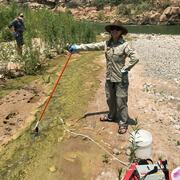
The USGS and partners are conducting environmental DNA (eDNA) research in the Colorado River downstream from Glen Canyon Dam and in Lake Powell to detect invasive fish species and other aquatic threats before they become established. eDNA is a cutting-edge technology that makes it possible to identify invasive species before they are visible, even in vast or hard-to-survey environments like rivers...
Early detection of aquatic threats: eDNA research in the Colorado River ecosystem & Lake Powell

Early detection of aquatic threats: eDNA research in the Colorado River ecosystem & Lake Powell

The USGS and partners are conducting environmental DNA (eDNA) research in the Colorado River downstream from Glen Canyon Dam and in Lake Powell to detect invasive fish species and other aquatic threats before they become established. eDNA is a cutting-edge technology that makes it possible to identify invasive species before they are visible, even in vast or hard-to-survey environments like rivers...
Learn More
Was this page helpful?