



Jason T. Magnuson, PhD (Former Employee)
Science and Products

Healthy Fish and Wildlife: Community Livelihoods, Fishing and Hunting Heritage, Recreation, and Economic Security
Healthy fish and wildlife underpin the economic vitality, food security, recreational enjoyment, and cultural heritage of fishing and hunting in communities across the United States. Fishing and hunting resources scale from the personal recreation of families to multi-billion-dollar industries. Recognizing these critical connections, the U.S. Geological Survey (USGS) works to understand, protect...
By
Ecosystems Mission Area, Contaminant Biology, Environmental Health Program, Toxic Substances Hydrology, California Water Science Center, Central Midwest Water Science Center, Columbia Environmental Research Center, Eastern Ecological Science Center, Forest and Rangeland Ecosystem Science Center, Upper Midwest Environmental Sciences Center, Upper Midwest Water Science Center

Perfluorohexanesulfonic Acid (PFHxS) Dysregulates Lipid Homeostasis in Early Life Stage Fish
A frequently detected perfluorinated compound in the environment, perfluorohexanesulfonic acid (PFHxS), can alter lipid metabolism in developing fish. This work identifies a novel mechanism in which PFHxS targets lipid metabolism pathways by using multiple omic techniques and modeling approaches.

Gut-Liver Axis: Review on How Microplastics Can Cause Toxicity Through an Interaction Between the Gut, Microbial Community, and Liver
Microplastics can cause liver damage when consumed by terrestrial and aquatic organisms. This review proposes a novel mechanism to help explain the toxic effects following ingestion, which involves the gut, microbial community, and liver through the gut-liver axis.

Study Finds PFOSA Can Suppress Immune Function in Developing Zebrafish (Danio rerio)
The Stockholm Convention has labeled PFOS a “persistent organic pollutant” due to its long-enduring prevalence, negative toxicological effects, and ability to bioaccumulate in living things. Concerns about PFOSA have been raised due to its similarity to PFOS, its ability to metabolize into PFOS, and its persistent use today

Comprehensive Research on PFAS Exposomics and Risk Assessment
The Columbia Environmental Research Center (CERC) conducts cutting-edge research on per- and polyfluoroalkyl substances (PFAS) through the lens of the One Health Paradigm, emphasizing the interconnectedness of human, animal, and environmental health.
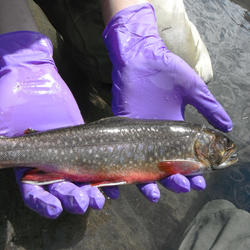
Fishing, Hunting and Subsistence Living Integrated Science Team
The Fishing, Hunting, and Subsistence Living Integrated Science Team focuses on contaminant and pathogen exposures in the environment that could impact the presence and vitality of fish and wildlife populations that drive commercial, recreational and subsistence activities such as hunting and fishing. If actual risks are identified this project will inform how to economically and effectively...
Science and Products
Healthy Fish and Wildlife: Community Livelihoods, Fishing and Hunting Heritage, Recreation, and Economic Security
Healthy fish and wildlife underpin the economic vitality, food security, recreational enjoyment, and cultural heritage of fishing and hunting in communities across the United States. Fishing and hunting resources scale from the personal recreation of families to multi-billion-dollar industries. Recognizing these critical connections, the U.S. Geological Survey (USGS) works to understand, protect...
By
Ecosystems Mission Area, Contaminant Biology, Environmental Health Program, Toxic Substances Hydrology, California Water Science Center, Central Midwest Water Science Center, Columbia Environmental Research Center, Eastern Ecological Science Center, Forest and Rangeland Ecosystem Science Center, Upper Midwest Environmental Sciences Center, Upper Midwest Water Science Center
Perfluorohexanesulfonic Acid (PFHxS) Dysregulates Lipid Homeostasis in Early Life Stage Fish
A frequently detected perfluorinated compound in the environment, perfluorohexanesulfonic acid (PFHxS), can alter lipid metabolism in developing fish. This work identifies a novel mechanism in which PFHxS targets lipid metabolism pathways by using multiple omic techniques and modeling approaches.
Gut-Liver Axis: Review on How Microplastics Can Cause Toxicity Through an Interaction Between the Gut, Microbial Community, and Liver
Microplastics can cause liver damage when consumed by terrestrial and aquatic organisms. This review proposes a novel mechanism to help explain the toxic effects following ingestion, which involves the gut, microbial community, and liver through the gut-liver axis.
Study Finds PFOSA Can Suppress Immune Function in Developing Zebrafish (Danio rerio)
The Stockholm Convention has labeled PFOS a “persistent organic pollutant” due to its long-enduring prevalence, negative toxicological effects, and ability to bioaccumulate in living things. Concerns about PFOSA have been raised due to its similarity to PFOS, its ability to metabolize into PFOS, and its persistent use today
Comprehensive Research on PFAS Exposomics and Risk Assessment
The Columbia Environmental Research Center (CERC) conducts cutting-edge research on per- and polyfluoroalkyl substances (PFAS) through the lens of the One Health Paradigm, emphasizing the interconnectedness of human, animal, and environmental health.
Fishing, Hunting and Subsistence Living Integrated Science Team
The Fishing, Hunting, and Subsistence Living Integrated Science Team focuses on contaminant and pathogen exposures in the environment that could impact the presence and vitality of fish and wildlife populations that drive commercial, recreational and subsistence activities such as hunting and fishing. If actual risks are identified this project will inform how to economically and effectively...