U.S. flag

An official website of the United States government

Images

Images of Yellowstone.

Filter Total Items: 687
Difference in mapped rock units for Mount Everts, Yellowstone National Park

Simplified geologic maps showing the difference in mapped rock units from the current, large-scale geologic maps dividing Mount Everts and that join along the boundary between Montana and Wyoming.

Map of the Uhl Hill fault in eastern Grand Teton National Park, Wyoming

Map of the Uhl Hill fault in eastern Grand Teton National Park. Base map is a 1-meter lidar hillshade. Black arrows mark the visible fault scarp, and red lines mark locations where scarp profiles were generated from lidar data or field surveying.

Map of the Uhl Hill fault in eastern Grand Teton National Park. Base map is a 1-meter lidar hillshade. Black arrows mark the visible fault scarp, and red lines mark locations where scarp profiles were generated from lidar data or field surveying.

Castle Geyser features and Scanning Electron Microscope image of algal filament in a silica sheath

On the left is Castle Geyser during an eruption with a pool from nearby Tortoise Shell Spring showing photosynthetic pigments at the bottom. The middle image is of a small pool in the Geyser Hill Group in the Upper Geyser Basin with an outflow channel full of yellow, green, orange, red, and brown pigmented phototrophic microbial mats.

On the left is Castle Geyser during an eruption with a pool from nearby Tortoise Shell Spring showing photosynthetic pigments at the bottom. The middle image is of a small pool in the Geyser Hill Group in the Upper Geyser Basin with an outflow channel full of yellow, green, orange, red, and brown pigmented phototrophic microbial mats.

Scarp of the Uhl Hill fault in eastern Grand Teton National Park, Wyoming

Scarp of the Uhl Hill fault. Photo (top) is looking west at the east-facing fault scarp, with a geologist at the top of the scarp for scale. Here, the fault cuts through Pinedale-1 glacial deposits just south of a Pinedale-2 end moraine. Plot (bottom) is a scarp profile generated from lidar elevation data.

Scarp of the Uhl Hill fault. Photo (top) is looking west at the east-facing fault scarp, with a geologist at the top of the scarp for scale. Here, the fault cuts through Pinedale-1 glacial deposits just south of a Pinedale-2 end moraine. Plot (bottom) is a scarp profile generated from lidar elevation data.

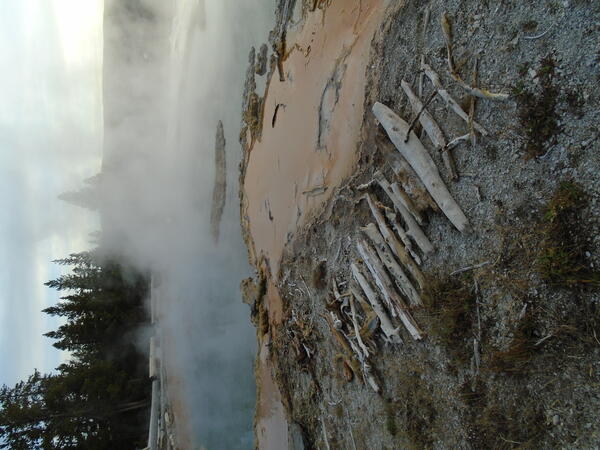
Steaming hot spring and forest in background.  About a dozen logs are arranged alongside one another in the foreground.
Logs removed from Solitary Geyser in 2021

Logs and debris removed from Solitary Geyser, near Old Faithful, during remediation work in 2021.  Photo by Jeff Cross.

Map of Porcelain Basin and images of colloidal pool over time.
Colloidal_Pool_maps_and_photos.png

Comparison of (a) 1904 Historical map with (b) 1988 USGS map. Colloidal Pool is a large, labeled pool roughly located on a straight line between Hurricane vent and Whirligig Geyser on the 1988 map (b); this same transect on the 1904 map (a) shows no feature at that location (white circle).

Comparison of (a) 1904 Historical map with (b) 1988 USGS map. Colloidal Pool is a large, labeled pool roughly located on a straight line between Hurricane vent and Whirligig Geyser on the 1988 map (b); this same transect on the 1904 map (a) shows no feature at that location (white circle).

High powered microscopic images showing clay particles and diatoms
SEM_Colloidal_poolpng.png

Scanning electron microscopy (SEM) images of the Colloidal Pool colloids (images are a combination of backscatter and secondary electrons). The colloids are a mixture of clay particles, hydrated silica, alunite, and diatoms.

Scanning electron microscopy (SEM) images of the Colloidal Pool colloids (images are a combination of backscatter and secondary electrons). The colloids are a mixture of clay particles, hydrated silica, alunite, and diatoms.

Thin section photo of Lava Creek Tuff “unit 2"

Microscope thin-section photo of Lava Creek Tuff “unit 2.” Photo by Ray Salazar (Montana State University) on October 28, 2021.

Different views of an eruption from two predictable geysers

Different views of an eruption from two predictable geysers. (a, c) Graphs showing water temperatures recorded by data loggers stationed near Beehive and Old Faithful Geysers, respectively. These data loggers were deployed by the Yellowstone Geology Program, configured to capture temperatures at one-minute intervals (indicated by blue dots).

Different views of an eruption from two predictable geysers. (a, c) Graphs showing water temperatures recorded by data loggers stationed near Beehive and Old Faithful Geysers, respectively. These data loggers were deployed by the Yellowstone Geology Program, configured to capture temperatures at one-minute intervals (indicated by blue dots).

Example initial analyses on the water temperature data

Example initial analyses on the water temperature data. (a, c) Graphs showing the calculated time between eruptions. (b, d) Histograms demonstrating the distribution of eruption intervals.

Example initial analyses on the water temperature data. (a, c) Graphs showing the calculated time between eruptions. (b, d) Histograms demonstrating the distribution of eruption intervals.

Yellowstone Lake bathymetry showing the location of the Deep Hole vent field
Yellowstone Lake map showing the location of the Deep Hole vent field

Yellowstone Lake bathymetry showing the location of the Deep Hole vent field.  Inset shows locations of heat-flux measurements (red dots) in the Deep Hole vent field.

Research Vessel Annie and Remotely Operated Vehicle Yogi

Research Vessel Annie and Remotely Operated Vehicle Yogi.  a) R/V Annie on Yellowstone Lake operated by the Global Foundation for Ocean Exploration.  Image Rob Harris, OSU.  b) ROV Yogi with GFOE President Dave Lovalvo.  Image Todd Gregory, GFOE.  C) ROV Yogi and 1-m heat flow probe.  This pr

Research Vessel Annie and Remotely Operated Vehicle Yogi.  a) R/V Annie on Yellowstone Lake operated by the Global Foundation for Ocean Exploration.  Image Rob Harris, OSU.  b) ROV Yogi with GFOE President Dave Lovalvo.  Image Todd Gregory, GFOE.  C) ROV Yogi and 1-m heat flow probe.  This pr

USGS Earth Explorer web tool showing an example of the geographic area and date range search criteria for Yellowstone
Earth Explorer web tool showing example of search criteria

Screen shot of the USGS Earth Explorer web tool showing an example of the geographic area and date range search criteria for Yellowstone.

Shaded relief map of Henrys Fork Caldera and vicinity

Shaded relief map of Henrys Fork Caldera and vicinity. The margin of Henrys Fork Caldera is shown in blue. Note the smooth, low-relief topography within the caldera compared to the steep and dynamic topography associated with Yellowstone Caldera (at the right side of the image).

Shaded relief map of Henrys Fork Caldera and vicinity. The margin of Henrys Fork Caldera is shown in blue. Note the smooth, low-relief topography within the caldera compared to the steep and dynamic topography associated with Yellowstone Caldera (at the right side of the image).

Site of the former Fountain Hotel in Yellowstone National Park

Site of the former Fountain Hotel in Yellowstone National Park.  Red arrows indicate the location of the pipe that ran through the meadow between Leather Pool and the site of the Fountain Hotel (yellow arrow). Yellowstone National Park photo by Annie Carlson, October 2021.

Site of the former Fountain Hotel in Yellowstone National Park.  Red arrows indicate the location of the pipe that ran through the meadow between Leather Pool and the site of the Fountain Hotel (yellow arrow). Yellowstone National Park photo by Annie Carlson, October 2021.

Interferogram created from data collected on September 22, 2020, and September 17, 2021, by the Sentinel-1 satellite system
Yellowstone interferogram from Sentinel-1 spanning September 22, 2020 to September 17, 2021

Interferogram created from data collected on September 22, 2020, and September 17, 2021, by the Sentinel-1 satellite system. Colored fringes indicate a change in distance (called range change) between the satellite and ground surface that is caused by surface deformation.

Interferogram created from data collected on September 22, 2020, and September 17, 2021, by the Sentinel-1 satellite system. Colored fringes indicate a change in distance (called range change) between the satellite and ground surface that is caused by surface deformation.

Extracting pore water from Yellowstone Lake sediment cores

Pore waters from Yellowstone Lake sediment cores collected in August 2021 are extracted through filtration devices into plastic syringes.  Note that the second core from the left appears light in color because the plastic core liner was etched by very hot 91°C (196°F) fluids.

Pore waters from Yellowstone Lake sediment cores collected in August 2021 are extracted through filtration devices into plastic syringes.  Note that the second core from the left appears light in color because the plastic core liner was etched by very hot 91°C (196°F) fluids.

Was this page helpful?