Eastern Iowa Ambystoma laterale - Blue-spotted Salamander. USGS ARMI photo by Evan S. Grimes
Images
See our science through the images below.
Eastern Iowa Ambystoma laterale - Blue-spotted Salamander. USGS ARMI photo by Evan S. Grimes
Male leafcutting bee (Megachile) approaching an Origanum
Male leafcutting bee (Megachile) approaching an OriganumThe alfalfa leafcutting bee (Megachile rotundata) is an introduced species common to Southwest Idaho. They originate from the old world, most likely from northeastern Africa or the Middle East. These bees are successful pollinators of various crops and have been imported to North America for use in agriculture and beekeeping.
Male leafcutting bee (Megachile) approaching an Origanum
Male leafcutting bee (Megachile) approaching an OriganumThe alfalfa leafcutting bee (Megachile rotundata) is an introduced species common to Southwest Idaho. They originate from the old world, most likely from northeastern Africa or the Middle East. These bees are successful pollinators of various crops and have been imported to North America for use in agriculture and beekeeping.
Image collage of USGS Ecosystems Mission Area scientists in the field.
Image collage of USGS Ecosystems Mission Area scientists in the field.Image collage of USGS Ecosystems Mission Area scientists in the field.
Image collage of USGS Ecosystems Mission Area scientists in the field.
Image collage of USGS Ecosystems Mission Area scientists in the field.Image collage of USGS Ecosystems Mission Area scientists in the field.
Miriam Jones holding a peat core that was extracted from a thawed permafrost bog at the Alaska Permafrost Experiment (APEX) site at Bonanza Creek LTER, Alaska. The boundary between the formerly frozen permafrost plateau and thawed bog is visible in the peat stratigraphy, with the light-colored peat indicated thawed bog.
Hexagon-based aerial survey design with transects overlaid. The EPA 40 km2 hexagons (White et al. 2018) were overlaid across the entirety of the northern Gulf of Mexico. Sampled hexagons were then selected using a Generalized Random Tesselation Stratified (GRTS) sampling scheme.
Map of AK showing probability of change occurrence
Map of AK showing probability of change occurrenceMap of Alaska showing probability (%) of change occurrence. Insets show fire boundaries from the Bureau of Land Management (BLM) Large Fire Database and Landsat 8 imagery (bottom right; 2016) north of Fairbanks, Alaska.
Map of AK showing probability of change occurrence
Map of AK showing probability of change occurrenceMap of Alaska showing probability (%) of change occurrence. Insets show fire boundaries from the Bureau of Land Management (BLM) Large Fire Database and Landsat 8 imagery (bottom right; 2016) north of Fairbanks, Alaska.
Photograph of the flowers of Dakota wild buckwheat (Eriogonum visheri).
It is native to the Great Plains in the United States, where it is known from North Dakota, South Dakota, and Montana.
Photograph of the flowers of Dakota wild buckwheat (Eriogonum visheri).
It is native to the Great Plains in the United States, where it is known from North Dakota, South Dakota, and Montana.
Juvenile Salt Marsh Harvest Mouse (Reithrodontomys raviventris)
Juvenile Salt Marsh Harvest Mouse (Reithrodontomys raviventris)USGS wildlife biologists holding a juvenile salt marsh harvest mouse (Reithrodontomys raviventris). The species is listed as "endangered" under the Endangered Species Act of 1973.
Juvenile Salt Marsh Harvest Mouse (Reithrodontomys raviventris)
Juvenile Salt Marsh Harvest Mouse (Reithrodontomys raviventris)USGS wildlife biologists holding a juvenile salt marsh harvest mouse (Reithrodontomys raviventris). The species is listed as "endangered" under the Endangered Species Act of 1973.
Flames from the Woodbury Fire rise above Tonto National Monument
Flames from the Woodbury Fire rise above Tonto National MonumentFlames from the Woodbury Fire rise above Tonto National Monument.
Flames from the Woodbury Fire rise above Tonto National Monument
Flames from the Woodbury Fire rise above Tonto National MonumentFlames from the Woodbury Fire rise above Tonto National Monument.
Cape San Blas Road, before and after a Category 5 hurricane
Cape San Blas Road, before and after a Category 5 hurricaneThese two NOAA satellite images show Cape San Blas Road in the Florida Panhandle town of Cape San Blas before Hurricane Michael, and after the Category 5 storm. The red circle shows where the USGS sea turtle researchers' field station and seasonal home once stood. The building was demolished down to the concrete slab.
Cape San Blas Road, before and after a Category 5 hurricane
Cape San Blas Road, before and after a Category 5 hurricaneThese two NOAA satellite images show Cape San Blas Road in the Florida Panhandle town of Cape San Blas before Hurricane Michael, and after the Category 5 storm. The red circle shows where the USGS sea turtle researchers' field station and seasonal home once stood. The building was demolished down to the concrete slab.
The USGS along with the Monterey Bay Aquarium Research Institute (MBARI) funded a pilot study to use a long-range AUV to study limnology of Lake Michigan. The AUV is pictured here being deployed in Lake Michigan to document variation in algae productivity at a whole-lake scale and compare 3-D spatial patterns in chlorophyll a to satellite estimates.
A sea otter mother feeds her pup in Glacier Bay, Alaska. USGS researchers study sea otter distribution and abundance in Alaska and other parts of the country.
Aquatic insect eggs just above the waterline along the Colorado River in Grand Canyon
Aquatic insect eggs just above the waterline along the Colorado River in Grand CanyonAquatic insect eggs are laid on rocks just at the waterline along the Colorado River in Grand Canyon and here they are exposed as the water levels fluctuate. Aquatic insects are an important part of the food base in the Colorado River, providing food for fish, bats, and birds. Aquatic insects need to stay damp to survive and hatch.
Aquatic insect eggs just above the waterline along the Colorado River in Grand Canyon
Aquatic insect eggs just above the waterline along the Colorado River in Grand CanyonAquatic insect eggs are laid on rocks just at the waterline along the Colorado River in Grand Canyon and here they are exposed as the water levels fluctuate. Aquatic insects are an important part of the food base in the Colorado River, providing food for fish, bats, and birds. Aquatic insects need to stay damp to survive and hatch.
Opening slide for the Intro to GenEst, A Generalized Estimator of Mortality, Workshop held at the National Wind Coordinating Collaborative's Wind Wildlife Research Meeting XII on November 26, 2018 in St. Paul Minnesota.
A burrowing owl, captured by a wildlife camera, standing next to the enterence of its den.
USGS conducts a health assessment on a mantee in Crystal River, Florida.
In August of 2018 this adult female golden eagle was captured and outfitted with a GPS transmitter. You can see the transmitter on the eagle’s back, below the head. This was the first golden eagle ever captured as part of a research project in Yellowstone National Park.
A view of a vegetated inland coastline overlooking the water on Dauphin Island, Alabama. The island protects mainland Alabama’s coastal communities and resources from storms, while also providing recreational opportunities (fishing, beach tourism, etc.) and other economic benefits to the local community and state.
Bat, bird, and insect activity can be monitored with pairs of thermal-imaging cameras mounted on the wind turbines, and automatically recorded to a computer inside the base of the turbine.
A panoramic view on Dauphin Island, Alabama. The island protects mainland Alabama’s coastal communities and resources from storms, while also providing recreational opportunities (fishing, beach tourism, etc.) and other economic benefits to the local community and state.
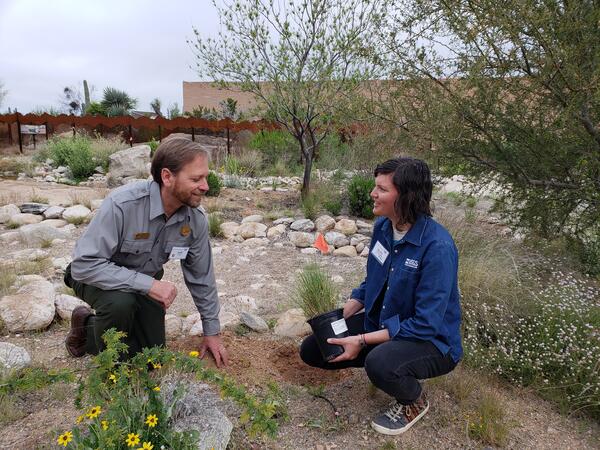
RestoreNet locations are testing commonly used restoration techniques, including pitting, mulching, and above-ground micro sites. Here, metal crosses create an above-ground microsite that can increase soil moisture by providing shade and collecting debris under some conditions.