The northern channel margin of the fissure 8 lava flow. Small hill in the distance is the site of our PGcam. Overflows from the channel can be seen producing shiny black to silver pahoehoeflows (incandescent red breakout visible in center of photo).
Images
Images related to natural hazards.
The northern channel margin of the fissure 8 lava flow. Small hill in the distance is the site of our PGcam. Overflows from the channel can be seen producing shiny black to silver pahoehoeflows (incandescent red breakout visible in center of photo).
Fissure 8 cone, lava fountain, and channelized lava flow on the morning overflight - June 19 at about 6:10am HST. The lava channel is very full with many small overflows visible on the channel margins. Overflows are sluggish and move slowly downslope as they build up the levees.
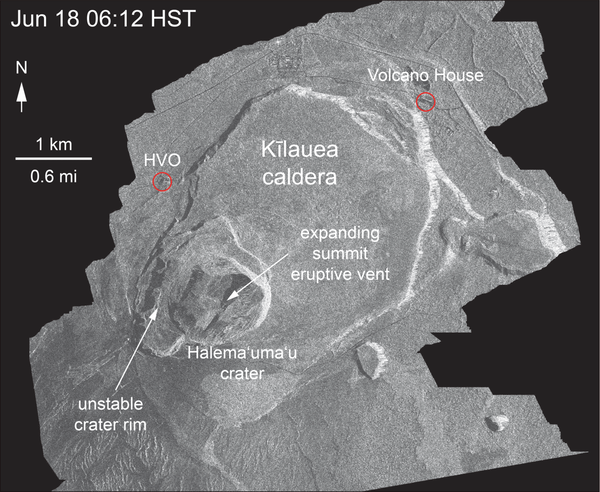
Satellite radar shows continued slumping of Halema‘uma‘u rim
Satellite radar shows continued slumping of Halema‘uma‘u rimThis animated GIF shows a sequence of radar amplitude images that were acquired by the Agenzia Spaziale Italiana CosmoSkyMed satellite system. The images illustrate changes to the caldera area of Kīlauea Volcano that occurred between May 5 and June 18 at about 6:00 a.m. HST.
Satellite radar shows continued slumping of Halema‘uma‘u rim
Satellite radar shows continued slumping of Halema‘uma‘u rimThis animated GIF shows a sequence of radar amplitude images that were acquired by the Agenzia Spaziale Italiana CosmoSkyMed satellite system. The images illustrate changes to the caldera area of Kīlauea Volcano that occurred between May 5 and June 18 at about 6:00 a.m. HST.
Fissure 8 cone, lava fountain, and channelized lava flow on the mor...
Fissure 8 cone, lava fountain, and channelized lava flow on the mor...Fissure 8 cone, lava fountain, and channelized lava flow on the morning overflight - June 19 at about 6:10am HST. The lava channel is very full with many small overflows visible on the channel margins. Overflows are sluggish and move slowly downslope as they build up the levees.
Fissure 8 cone, lava fountain, and channelized lava flow on the mor...
Fissure 8 cone, lava fountain, and channelized lava flow on the mor...Fissure 8 cone, lava fountain, and channelized lava flow on the morning overflight - June 19 at about 6:10am HST. The lava channel is very full with many small overflows visible on the channel margins. Overflows are sluggish and move slowly downslope as they build up the levees.
June 18 summit overflight shows Halema‘uma‘u with HVO for perspective
June 18 summit overflight shows Halema‘uma‘u with HVO for perspectiveDuring the helicopter overflight on June 18, crews captured this image of the growing Halema‘uma‘u crater viewed to the southeast. With HVO and Jagger Museum sitting on the caldera rim (right side, middle where the road bends to the left) it is easier to comprehend the scale of subsidence at the summit.
June 18 summit overflight shows Halema‘uma‘u with HVO for perspective
June 18 summit overflight shows Halema‘uma‘u with HVO for perspectiveDuring the helicopter overflight on June 18, crews captured this image of the growing Halema‘uma‘u crater viewed to the southeast. With HVO and Jagger Museum sitting on the caldera rim (right side, middle where the road bends to the left) it is easier to comprehend the scale of subsidence at the summit.
Kīlauea LERZ lava flows and fissures, June 19, 1:00 p.m.
Kīlauea LERZ lava flows and fissures, June 19, 1:00 p.m.Map as of 1:00 p.m. HST, June 19, 2018. Given the dynamic nature of Kīlauea's lower East Rift Zone eruption, with changing vent locations, fissures starting and stopping, and varying rates of lava effusion, map details shown here are accurate as of the date/time noted. Shaded purple areas indicate lava flows erupted in 1840, 1955, 1960, and 2014-2015.
Kīlauea LERZ lava flows and fissures, June 19, 1:00 p.m.
Kīlauea LERZ lava flows and fissures, June 19, 1:00 p.m.Map as of 1:00 p.m. HST, June 19, 2018. Given the dynamic nature of Kīlauea's lower East Rift Zone eruption, with changing vent locations, fissures starting and stopping, and varying rates of lava effusion, map details shown here are accurate as of the date/time noted. Shaded purple areas indicate lava flows erupted in 1840, 1955, 1960, and 2014-2015.
An overflight of Kīlauea's summit on June 18 showed the continued dramatic slumping and collapse of the Halema‘uma‘u crater area. This photo shows the area north-northwest of Halema‘uma‘u near a GPS station, North Pit. This station has subsided about 60 m (197 ft) in the past week.
Fissure 6 (photo center) showed signs of activity overnight, producing small amounts of spatter and feeding short lava flows. Fissure 6 is located about 2.2 km (1.4 mi) downrift from Fissure 8.
During the helicopter overflight on June 18, crews captured this image of the growing Halema‘uma‘u crater viewed to the southeast.
Fissure 8 lava flows in an open channel all the way to the ocean. Kapoho Crater is the vegetated hill on the right side of the photograph. Ocean entry plume seen in the distance.
An HVO geologist uses a thermal camera to measure the temperature (about 93 degrees C or 200 degrees F) of a ground crack near fissure 9.
An animated GIF showing lava bubbling out of fissure 8 at Kīlauea Volcano, Hawaii. Clip is taken from the full b-roll video listed as the source.
Fissure 8 cone and channelized lava flow.
Fissure 8 lava fountains obscured by a longer exposure photograph taken early morning on June 18. The incandescent spots along a horizontal line mark the edge of the lava channel.
North side of the growing Halema‘uma‘u, marked by large cracks and ...
North side of the growing Halema‘uma‘u, marked by large cracks and ...North side of the growing Halema‘uma‘u crater, marked by large cracks and large blocks that have slumped into the crater.
North side of the growing Halema‘uma‘u, marked by large cracks and ...
North side of the growing Halema‘uma‘u, marked by large cracks and ...North side of the growing Halema‘uma‘u crater, marked by large cracks and large blocks that have slumped into the crater.
An HVO geologist uses a thermal camera to measure the temperature (about 93 degrees C or 200 degrees F) of a ground crack near fissure 9.
North side of the growing Halema‘uma‘u crater, marked by large cracks and large blocks that have slumped into the crater.
Kīlauea LERZ lava flows and fissures, June 18, 9:00 a.m.
Kīlauea LERZ lava flows and fissures, June 18, 9:00 a.m.Map as of 9:00 a.m. HST, June 18, 2018. Given the dynamic nature of Kīlauea's lower East Rift Zone eruption, with changing vent locations, fissures starting and stopping, and varying rates of lava effusion, map details shown here are accurate as of the date/time noted. Shaded purple areas indicate lava flows erupted in 1840, 1955, 1960, and 2014-2015.
Kīlauea LERZ lava flows and fissures, June 18, 9:00 a.m.
Kīlauea LERZ lava flows and fissures, June 18, 9:00 a.m.Map as of 9:00 a.m. HST, June 18, 2018. Given the dynamic nature of Kīlauea's lower East Rift Zone eruption, with changing vent locations, fissures starting and stopping, and varying rates of lava effusion, map details shown here are accurate as of the date/time noted. Shaded purple areas indicate lava flows erupted in 1840, 1955, 1960, and 2014-2015.
Kīlauea Volcano — Satellite Radar (Continued Slumping)
Kīlauea Volcano — Satellite Radar (Continued Slumping)This animated GIF shows a sequence of radar amplitude images that were acquired by the Agenzia Spaziale Italiana CosmoSkyMed satellite system. The images illustrate changes to the caldera area of Kīlauea Volcano that occurred between May 5 and June 18 at about 6:00 a.m. HST.
Kīlauea Volcano — Satellite Radar (Continued Slumping)
Kīlauea Volcano — Satellite Radar (Continued Slumping)This animated GIF shows a sequence of radar amplitude images that were acquired by the Agenzia Spaziale Italiana CosmoSkyMed satellite system. The images illustrate changes to the caldera area of Kīlauea Volcano that occurred between May 5 and June 18 at about 6:00 a.m. HST.