



Stacked lava flows are visible in the wall of the down-dropped block, which was exposed during the Kīlauea summit collapse events in 2018. A small exposure of lighter-colored volcanic ash, likely the Keanakāko‘i tephra deposits erupted during Kīlauea's last explosive phase several hundred years ago, is visible beneath tens of meters (yards) of lava flows.
Images
Hawaiian Volcano Observatory images of eruptive activity, field work, and more.
Filter Total Items: 4185

Kīlauea caldera gas mapping—August 3, 2021
Stacked lava flows are visible in the wall of the down-dropped block, which was exposed during the Kīlauea summit collapse events in 2018. A small exposure of lighter-colored volcanic ash, likely the Keanakāko‘i tephra deposits erupted during Kīlauea's last explosive phase several hundred years ago, is visible beneath tens of meters (yards) of lava flows.

View of Halema‘uma‘u at Kīlauea summit - July 30, 2021
View of Halema‘uma‘u at Kīlauea summit - July 30, 2021A view looking north into Halema‘uma‘u on July 30, 2021. Although eruptive activity has paused at the summit of Kīlauea, HVO geologists still monitor the lava lake and summit area weekly. Lava lake surface depths remain the same since mid to late May when active lava was last observed at the surface. USGS photo by N. Deligne.
View of Halema‘uma‘u at Kīlauea summit - July 30, 2021
View of Halema‘uma‘u at Kīlauea summit - July 30, 2021A view looking north into Halema‘uma‘u on July 30, 2021. Although eruptive activity has paused at the summit of Kīlauea, HVO geologists still monitor the lava lake and summit area weekly. Lava lake surface depths remain the same since mid to late May when active lava was last observed at the surface. USGS photo by N. Deligne.

Close up view of inactive western fissure spatter cone in Halema‘uma‘u
Close up view of inactive western fissure spatter cone in Halema‘uma‘uEruptive activity paused within Halema‘uma‘u, at Kīlauea's summit, a bit more than 2 months ago. In that time, the spatter cone at the western fissure complex has slowly degraded due to numerous small scale collapses, leaving a debris apron (fresh looking rubble) and exposing the interior of the spatter cone. USGS photo by N. Deligne.
Close up view of inactive western fissure spatter cone in Halema‘uma‘u
Close up view of inactive western fissure spatter cone in Halema‘uma‘uEruptive activity paused within Halema‘uma‘u, at Kīlauea's summit, a bit more than 2 months ago. In that time, the spatter cone at the western fissure complex has slowly degraded due to numerous small scale collapses, leaving a debris apron (fresh looking rubble) and exposing the interior of the spatter cone. USGS photo by N. Deligne.

Kīlauea caldera gas mapping - July 28, 2021 — Kīlauea
Kīlauea caldera gas mapping - July 28, 2021 — KīlaueaWhile mapping volcanic gasses in Kīlauea caldera, HVO scientists got a view (looking west) of Halema‘uma‘u and the down-dropped block. The steep crater walls of Halema‘uma‘u are visible in the upper center and right portions of this photo, but the recently active lava lake is out of view below the eastern crater rim.
Kīlauea caldera gas mapping - July 28, 2021 — Kīlauea
Kīlauea caldera gas mapping - July 28, 2021 — KīlaueaWhile mapping volcanic gasses in Kīlauea caldera, HVO scientists got a view (looking west) of Halema‘uma‘u and the down-dropped block. The steep crater walls of Halema‘uma‘u are visible in the upper center and right portions of this photo, but the recently active lava lake is out of view below the eastern crater rim.

Kīlauea caldera gas mapping - July 28, 2021 — Kīlauea
Kīlauea caldera gas mapping - July 28, 2021 — KīlaueaA USGS scientist calibrates two MultiGas instruments to prepare for mapping volcanic gasses on the floor of Kīlauea caldera. With the MultiGas strapped to metal backpack frames, the scientists traverse across the caldera floor to collect gas data which will be compared to the last survey.
Kīlauea caldera gas mapping - July 28, 2021 — Kīlauea
Kīlauea caldera gas mapping - July 28, 2021 — KīlaueaA USGS scientist calibrates two MultiGas instruments to prepare for mapping volcanic gasses on the floor of Kīlauea caldera. With the MultiGas strapped to metal backpack frames, the scientists traverse across the caldera floor to collect gas data which will be compared to the last survey.

Field Work at Keller Well
HVO geologists measure the depth to the water table at the Keller Well, located south of Halema‘uma‘u crater. The Keller Well is a borehole drilled in 1973 to a depth of 4,140 ft (1,262 m) that has been used to monitor the hydrology of the summit region of Kīlauea volcano. Photo taken on July 27, 2021, at 9:30 a.m. HST. USGS photo by J.M. Chang.
HVO geologists measure the depth to the water table at the Keller Well, located south of Halema‘uma‘u crater. The Keller Well is a borehole drilled in 1973 to a depth of 4,140 ft (1,262 m) that has been used to monitor the hydrology of the summit region of Kīlauea volcano. Photo taken on July 27, 2021, at 9:30 a.m. HST. USGS photo by J.M. Chang.

Maintenance of volcano monitoring webcam—Kīlauea summit
Maintenance of volcano monitoring webcam—Kīlauea summitAn HVO geologist conducts maintenance on the S1cam web camera located along the southern rim of Halema‘uma‘u, at the summit of Kīlauea.
Maintenance of volcano monitoring webcam—Kīlauea summit
Maintenance of volcano monitoring webcam—Kīlauea summitAn HVO geologist conducts maintenance on the S1cam web camera located along the southern rim of Halema‘uma‘u, at the summit of Kīlauea.

HVO scientists measure volcanic gasses—Kīlauea caldera floor, July 22
HVO scientists measure volcanic gasses—Kīlauea caldera floor, July 22HVO scientists walk transects along the down-dropped portion of Kīlauea caldera floor as part of a gas survey conducted on July 22.
HVO scientists measure volcanic gasses—Kīlauea caldera floor, July 22
HVO scientists measure volcanic gasses—Kīlauea caldera floor, July 22HVO scientists walk transects along the down-dropped portion of Kīlauea caldera floor as part of a gas survey conducted on July 22.

Aerial photo of inactive lava lake—Halema‘uma‘u, Kīlauea summit
Aerial photo of inactive lava lake—Halema‘uma‘u, Kīlauea summitThis aerial photo of the inactive lava lake within Halema‘uma‘u at the summit of Kīlauea was captured during a routine helicopter overflight by HVO geologists on Thursday, July 22, 2021.
Aerial photo of inactive lava lake—Halema‘uma‘u, Kīlauea summit
Aerial photo of inactive lava lake—Halema‘uma‘u, Kīlauea summitThis aerial photo of the inactive lava lake within Halema‘uma‘u at the summit of Kīlauea was captured during a routine helicopter overflight by HVO geologists on Thursday, July 22, 2021.

Aerial view of Halema‘uma‘u and the Kīlauea summit caldera—July 22
Aerial view of Halema‘uma‘u and the Kīlauea summit caldera—July 22This wide-angle aerial view looks southeast over Kīlauea's summit caldera, with the recently active lava lake in Halema‘uma‘u visible in the lower right. On the left side of the photo, the large cliffs formed during the 2018 collapses are visible. Kīlauea Iki can be seen in the upper left. USGS photo by M. Patrick, taken on July 22, 2021.
Aerial view of Halema‘uma‘u and the Kīlauea summit caldera—July 22
Aerial view of Halema‘uma‘u and the Kīlauea summit caldera—July 22This wide-angle aerial view looks southeast over Kīlauea's summit caldera, with the recently active lava lake in Halema‘uma‘u visible in the lower right. On the left side of the photo, the large cliffs formed during the 2018 collapses are visible. Kīlauea Iki can be seen in the upper left. USGS photo by M. Patrick, taken on July 22, 2021.

HVO scientist samples volcanic gas from crack—Kīlauea summit, July 22
HVO scientist samples volcanic gas from crack—Kīlauea summit, July 22An HVO scientist samples the gas around a crack identified as emitting elevated levels of carbon dioxide (a volcanic gas) on the down-dropped block within Kīlauea caldera. The sample will later be analyzed to determine its complete chemical composition. This work was conducted within a closed area of Hawai‘i Volcanoes National Park, with park permission.
HVO scientist samples volcanic gas from crack—Kīlauea summit, July 22
HVO scientist samples volcanic gas from crack—Kīlauea summit, July 22An HVO scientist samples the gas around a crack identified as emitting elevated levels of carbon dioxide (a volcanic gas) on the down-dropped block within Kīlauea caldera. The sample will later be analyzed to determine its complete chemical composition. This work was conducted within a closed area of Hawai‘i Volcanoes National Park, with park permission.

HVO geologist conducts a routine high-precision survey—Kīlauea summit
HVO geologist conducts a routine high-precision survey—Kīlauea summitAn HVO geologist conducts a routine high-precision survey of the inactive lava lake in Halema‘uma‘u, at the summit of Kīlauea volcano. Mist moving across the caldera on the morning of July 22 produced a rainbow over the lake. No significant changes have occurred in Halema‘uma‘u in recent weeks. USGS photo by M. Patrick.
HVO geologist conducts a routine high-precision survey—Kīlauea summit
HVO geologist conducts a routine high-precision survey—Kīlauea summitAn HVO geologist conducts a routine high-precision survey of the inactive lava lake in Halema‘uma‘u, at the summit of Kīlauea volcano. Mist moving across the caldera on the morning of July 22 produced a rainbow over the lake. No significant changes have occurred in Halema‘uma‘u in recent weeks. USGS photo by M. Patrick.

Volcanic gas survey within Kīlauea caldera—July 22, 2021
Volcanic gas survey within Kīlauea caldera—July 22, 2021On July 22, HVO scientists surveyed the floor of the down-dropped block within Kīlauea caldera for diffuse volcanic gas emissions. This particular part of the caldera floor subsided during Kīlauea's collapse events in 2018.
Volcanic gas survey within Kīlauea caldera—July 22, 2021
Volcanic gas survey within Kīlauea caldera—July 22, 2021On July 22, HVO scientists surveyed the floor of the down-dropped block within Kīlauea caldera for diffuse volcanic gas emissions. This particular part of the caldera floor subsided during Kīlauea's collapse events in 2018.

Close-up of inactive western fissure in Halema‘uma‘u, July 16, 2021
Close-up of inactive western fissure in Halema‘uma‘u, July 16, 2021This close-up view of the western fissure within Halema‘uma‘u at the summit of Kīlauea was captured on Friday, July 16, 2021. HVO scientists were making a routine observational visit to the crater rim; no changes to the inactive lava lake were detected.
Close-up of inactive western fissure in Halema‘uma‘u, July 16, 2021
Close-up of inactive western fissure in Halema‘uma‘u, July 16, 2021This close-up view of the western fissure within Halema‘uma‘u at the summit of Kīlauea was captured on Friday, July 16, 2021. HVO scientists were making a routine observational visit to the crater rim; no changes to the inactive lava lake were detected.

Halema‘uma‘u observations — July 9, 2021
A Hawaiian Volcano Observatory geologist uses a laser rangefinder to survey points across the solidified lava lake surface in Halema‘uma‘u, at the summit of Kīlauea. No significant changes in lake surface elevation have been observed in recent weeks. USGS photo by M. Patrick taken on July 9, 2021.
A Hawaiian Volcano Observatory geologist uses a laser rangefinder to survey points across the solidified lava lake surface in Halema‘uma‘u, at the summit of Kīlauea. No significant changes in lake surface elevation have been observed in recent weeks. USGS photo by M. Patrick taken on July 9, 2021.

View of Halema‘uma‘u at Kīlauea summit - July 2 2021
View of Halema‘uma‘u at Kīlauea summit - July 2 2021A view looking north into Halema‘uma‘u on July 2, 2021. Although eruptive activity has paused at the summit of Kīlauea, HVO geologists still monitor the lava lake and summit area regularly. Lava lake surface depths remain the same over the past few weeks.
View of Halema‘uma‘u at Kīlauea summit - July 2 2021
View of Halema‘uma‘u at Kīlauea summit - July 2 2021A view looking north into Halema‘uma‘u on July 2, 2021. Although eruptive activity has paused at the summit of Kīlauea, HVO geologists still monitor the lava lake and summit area regularly. Lava lake surface depths remain the same over the past few weeks.

Volcanoes in Canada?
At left, a map of select recent volcanoes and volcanic areas in Canada (volcano location data from: Global GIS: volcanoes of the world; volcano basic data. [Shapefile]. American Geological Institute.
At left, a map of select recent volcanoes and volcanic areas in Canada (volcano location data from: Global GIS: volcanoes of the world; volcano basic data. [Shapefile]. American Geological Institute.

Kīlauea summit on June 25, 2021
Blue-tinged gases are seen above the lava lake in Halema‘uma‘u crater in this image taken from the southwest rim on June 25, 2021, at 12:37 p.m. HST.
Blue-tinged gases are seen above the lava lake in Halema‘uma‘u crater in this image taken from the southwest rim on June 25, 2021, at 12:37 p.m. HST.
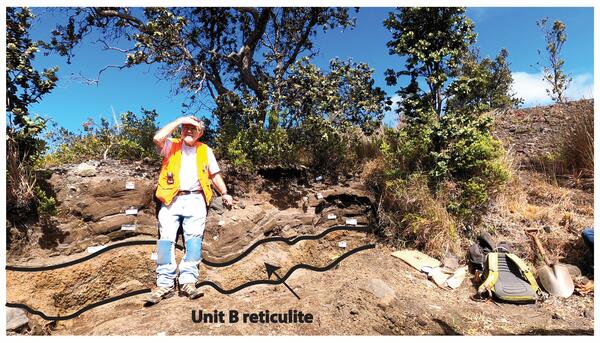
Keanakākoʻi tephra outcrop near Uēkahuna overlook
Retired USGS Hawaiian Volcano Observatory geologist Don Swanson stands in front of an outcrop near Uēkahuna at the summit of Kīlauea, where deposits of the Keanakākoʻi tephra are exposed. Unit B, the reticulite deposit that formed from a lava fountaining eruption at Kīlauea summit about 500 years ago, is outlined in black. USGS photo.
Retired USGS Hawaiian Volcano Observatory geologist Don Swanson stands in front of an outcrop near Uēkahuna at the summit of Kīlauea, where deposits of the Keanakākoʻi tephra are exposed. Unit B, the reticulite deposit that formed from a lava fountaining eruption at Kīlauea summit about 500 years ago, is outlined in black. USGS photo.

Kīlauea summit on June 11, 2021
A view of Halema‘uma‘u on June 11, 2021, at 12:20 p.m. HST. Although eruptive activity has paused at the Kīlauea summit, HVO geologists still monitor the lava lake and summit area regularly. They make observations to note any physical changes in the landscape or visual changes in gas emissions.
A view of Halema‘uma‘u on June 11, 2021, at 12:20 p.m. HST. Although eruptive activity has paused at the Kīlauea summit, HVO geologists still monitor the lava lake and summit area regularly. They make observations to note any physical changes in the landscape or visual changes in gas emissions.

Kīlauea summit on June 8, 2021
On June 8, 2021, the USGS Hawaiian Volcano Observatory conducted a routine helicopter overflight and fieldwork at the summit of Kīlauea. Here, a geophysicist returns to the helicopter after making Global Positioning Systems (GPS) measurements. These surveys measure small changes in the ground surface caused by subsurface magma movement.
On June 8, 2021, the USGS Hawaiian Volcano Observatory conducted a routine helicopter overflight and fieldwork at the summit of Kīlauea. Here, a geophysicist returns to the helicopter after making Global Positioning Systems (GPS) measurements. These surveys measure small changes in the ground surface caused by subsurface magma movement.