



This map of Halema‘uma‘u at the summit of Kīlauea shows 20 m (66 ft) contour lines (dark gray) that mark locations of equal elevation above sea level (asl). The map shows that the lava lake has filled 229 m (751 ft) of the crater, to an elevation of 746 m (2448 ft) asl since the eruption began on December 20, 2020.
Images
Hawaiian Volcano Observatory images of eruptive activity, field work, and more.
Filter Total Items: 4185

May 7, 2021—Kīlauea summit eruption contour map
This map of Halema‘uma‘u at the summit of Kīlauea shows 20 m (66 ft) contour lines (dark gray) that mark locations of equal elevation above sea level (asl). The map shows that the lava lake has filled 229 m (751 ft) of the crater, to an elevation of 746 m (2448 ft) asl since the eruption began on December 20, 2020.

Halema‘uma‘u lava lake, May 6, 2021
View of the active surface lava in the western portion of Halema‘uma‘u, at the summit of Kīlauea Volcano. The west vent (upper left) continues to erupt lava into the lava lake through an inlet near the base of the cone.
View of the active surface lava in the western portion of Halema‘uma‘u, at the summit of Kīlauea Volcano. The west vent (upper left) continues to erupt lava into the lava lake through an inlet near the base of the cone.

Close-up view of active western portion of Halema‘uma‘u lava lake
Close-up view of active western portion of Halema‘uma‘u lava lakeThis close-up view of the active western portion of the Halema‘uma‘u lava lake at the summit of Kīlauea was captured on Thursday, May 6 through the lens of a laser rangefinder used by HVO scientists to measure distances to features within the crater.
Close-up view of active western portion of Halema‘uma‘u lava lake
Close-up view of active western portion of Halema‘uma‘u lava lakeThis close-up view of the active western portion of the Halema‘uma‘u lava lake at the summit of Kīlauea was captured on Thursday, May 6 through the lens of a laser rangefinder used by HVO scientists to measure distances to features within the crater.

Halema‘uma‘u eruptive activity on 05 May 2021
Lava continues to flow from the western vent (bottom left) into the lava lake at Halema‘uma‘u Crater at the summit of Kīlauea Volcano, Island of Hawai‘i. A portion of the active surface of the lava lake can be seen here with orange, incandescent lava between the west vent and the main island. This photograph was taken on Wednesday, March 5, 2021, at 12:37 p.m.
Lava continues to flow from the western vent (bottom left) into the lava lake at Halema‘uma‘u Crater at the summit of Kīlauea Volcano, Island of Hawai‘i. A portion of the active surface of the lava lake can be seen here with orange, incandescent lava between the west vent and the main island. This photograph was taken on Wednesday, March 5, 2021, at 12:37 p.m.

Annual Mauna Loa GPS Survey—2021
GPS campaign survey stations high on the flanks of Mauna Loa offer expansive views of neighboring volcanoes. From this station located west of Mauna Loa summit, Hualālai volcano is visible. Most Mauna Loa GPS campaign survey sites have been occupied every year since 1996, whereas less active volcanoes Hualālai and Haleakalā are surveyed every 3–5 years.
GPS campaign survey stations high on the flanks of Mauna Loa offer expansive views of neighboring volcanoes. From this station located west of Mauna Loa summit, Hualālai volcano is visible. Most Mauna Loa GPS campaign survey sites have been occupied every year since 1996, whereas less active volcanoes Hualālai and Haleakalā are surveyed every 3–5 years.

View of Kīlauea's September 1982 lava flow lobe — April 30, 2021
View of Kīlauea's September 1982 lava flow lobe — April 30, 2021HVO scientists hiked along the closed Crater Rim Road on April 30th to retrieve acoustic (sound) sensors for a scientific study. This section of the road was damaged by earthquake activity during the 2018 Kīlauea summit caldera collapse. This stretch of road traverses part of the September 1982 lava flow, visible as a lobe of black rock on the right of the road.
View of Kīlauea's September 1982 lava flow lobe — April 30, 2021
View of Kīlauea's September 1982 lava flow lobe — April 30, 2021HVO scientists hiked along the closed Crater Rim Road on April 30th to retrieve acoustic (sound) sensors for a scientific study. This section of the road was damaged by earthquake activity during the 2018 Kīlauea summit caldera collapse. This stretch of road traverses part of the September 1982 lava flow, visible as a lobe of black rock on the right of the road.

Halema‘uma‘u lava lake, Kīlauea summit eruption—April 30, 2021
Halema‘uma‘u lava lake, Kīlauea summit eruption—April 30, 2021On Friday, April 30, lava continued to erupt from the west vent in Halema‘uma‘u at the summit of Kīlauea Volcano. Active surface lava (center of the photo) was limited to the center of the previously active lake surface, where the north (right) and south (left) sides have cooled and crusted over (appearing darker in the image). This photo was taken around 2 p.m.
Halema‘uma‘u lava lake, Kīlauea summit eruption—April 30, 2021
Halema‘uma‘u lava lake, Kīlauea summit eruption—April 30, 2021On Friday, April 30, lava continued to erupt from the west vent in Halema‘uma‘u at the summit of Kīlauea Volcano. Active surface lava (center of the photo) was limited to the center of the previously active lake surface, where the north (right) and south (left) sides have cooled and crusted over (appearing darker in the image). This photo was taken around 2 p.m.

View of Kīlauea summit eruption gas plume from southeast — April 30
View of Kīlauea summit eruption gas plume from southeast — April 30While hiking along the rim of the 2018 collapse area at the summit of Kīlauea, HVO scientists visited a site to the southeast of Halema‘uma‘u known as Akanikōlea—a culturally-significant place that is featured in Hawaiian legends.
View of Kīlauea summit eruption gas plume from southeast — April 30
View of Kīlauea summit eruption gas plume from southeast — April 30While hiking along the rim of the 2018 collapse area at the summit of Kīlauea, HVO scientists visited a site to the southeast of Halema‘uma‘u known as Akanikōlea—a culturally-significant place that is featured in Hawaiian legends.

View of lava lake in Halema‘uma‘u—Kīlauea, April 27, 2021
View of lava lake in Halema‘uma‘u—Kīlauea, April 27, 2021The lava lake in Halema‘uma‘u crater, at the summit of Kīlauea, remains active, as seen in this view looking north. Active surface lava is limited to the western (left) portion of the lake between the main island and the western fissure complex.
View of lava lake in Halema‘uma‘u—Kīlauea, April 27, 2021
View of lava lake in Halema‘uma‘u—Kīlauea, April 27, 2021The lava lake in Halema‘uma‘u crater, at the summit of Kīlauea, remains active, as seen in this view looking north. Active surface lava is limited to the western (left) portion of the lake between the main island and the western fissure complex.

View of Halema‘uma‘u lava lake from the west, April 26, 2021
View of Halema‘uma‘u lava lake from the west, April 26, 2021On Monday, April 26, 2021, lava continued to flow from the western vent (bottom left) into the active lava lake (center) in Halema‘uma‘u Crater at the summit of Kīlauea Volcano. The active lava lake surface continues to shrink as areas on the north (upper left) and south (center right) sides cool and solidify. This photograph was taken at 1:03 p.m.
View of Halema‘uma‘u lava lake from the west, April 26, 2021
View of Halema‘uma‘u lava lake from the west, April 26, 2021On Monday, April 26, 2021, lava continued to flow from the western vent (bottom left) into the active lava lake (center) in Halema‘uma‘u Crater at the summit of Kīlauea Volcano. The active lava lake surface continues to shrink as areas on the north (upper left) and south (center right) sides cool and solidify. This photograph was taken at 1:03 p.m.

Close-up view of the west vent and inlet at Halema‘uma‘u
Close-up view of the west vent and inlet at Halema‘uma‘uA close-up view of the west vent spatter cones (bottom left) and inlet where lava is entering the lava lake (center right) in Halema‘uma‘u Crater at the summit of Kīlauea Volcano. A piece of crust, that solidified near the inlet, broke off and was being transported away from the inlet. This photograph was taken on April 26, 2021, at 1:51 p.m.
Close-up view of the west vent and inlet at Halema‘uma‘u
Close-up view of the west vent and inlet at Halema‘uma‘uA close-up view of the west vent spatter cones (bottom left) and inlet where lava is entering the lava lake (center right) in Halema‘uma‘u Crater at the summit of Kīlauea Volcano. A piece of crust, that solidified near the inlet, broke off and was being transported away from the inlet. This photograph was taken on April 26, 2021, at 1:51 p.m.

April 23, 2021—Kīlauea summit eruption contour map
April 23, 2021—Kīlauea summit eruption contour mapThis map of Halema‘uma‘u at the summit of Kīlauea shows 20 m (66 ft) contour lines (dark gray) that mark locations of equal elevation above sea level (asl). The map shows that the lava lake has filled 228 m (748 ft) of the crater, to an elevation of 745 m (2444 ft) asl since the eruption began on December 20, 2020.
April 23, 2021—Kīlauea summit eruption contour map
April 23, 2021—Kīlauea summit eruption contour mapThis map of Halema‘uma‘u at the summit of Kīlauea shows 20 m (66 ft) contour lines (dark gray) that mark locations of equal elevation above sea level (asl). The map shows that the lava lake has filled 228 m (748 ft) of the crater, to an elevation of 745 m (2444 ft) asl since the eruption began on December 20, 2020.

April 22, 2021- Close-up view of Halema‘uma‘u lava lake crusting-over
April 22, 2021- Close-up view of Halema‘uma‘u lava lake crusting-overThis zoomed-in photo of the far southwest end of the active lava lake within Halema‘uma‘u at Kīlauea's summit was captured on Thursday, April 22, and it illustrates the process by which parts of the lava lake become inactive.
April 22, 2021- Close-up view of Halema‘uma‘u lava lake crusting-over
April 22, 2021- Close-up view of Halema‘uma‘u lava lake crusting-overThis zoomed-in photo of the far southwest end of the active lava lake within Halema‘uma‘u at Kīlauea's summit was captured on Thursday, April 22, and it illustrates the process by which parts of the lava lake become inactive.

April 22, 2021 — Kīlauea summit lava lake
On Thursday, April 22, HVO scientists observed the ongoing eruption at the Kīlauea summit from the south rim of Halema‘uma‘u. This photo shows the active western portion of the lava lake, which appears to be in the process of shrinking again, with its northeast (upper-right) and southwest (lower-left) ends crusting over substantially.
On Thursday, April 22, HVO scientists observed the ongoing eruption at the Kīlauea summit from the south rim of Halema‘uma‘u. This photo shows the active western portion of the lava lake, which appears to be in the process of shrinking again, with its northeast (upper-right) and southwest (lower-left) ends crusting over substantially.

April 20, 2021 — Kīlauea lava lake and rocks
A telephoto view of the southern lava lake crust and Halema‘uma‘u crater wall at the summit of Kīlauea. Many rockfalls from the steep and unstable crater walls of Halema‘uma‘u have deposited large boulders onto the stagnant lava surface over the past few months. This photo was taken from the west rim of Halema‘uma‘u looking southeast. USGS photo taken by L.
A telephoto view of the southern lava lake crust and Halema‘uma‘u crater wall at the summit of Kīlauea. Many rockfalls from the steep and unstable crater walls of Halema‘uma‘u have deposited large boulders onto the stagnant lava surface over the past few months. This photo was taken from the west rim of Halema‘uma‘u looking southeast. USGS photo taken by L.

April 21 - Halema‘uma‘u crater
A view of Halema‘uma‘u crater at the summit of Kīlauea Volcano, Island of Hawai‘i, showing the active western fissure with rising fumes, the active western portion of the lava lake (lighter colored area in the middle of the photo), and the big island within the lava lake (right).
A view of Halema‘uma‘u crater at the summit of Kīlauea Volcano, Island of Hawai‘i, showing the active western fissure with rising fumes, the active western portion of the lava lake (lighter colored area in the middle of the photo), and the big island within the lava lake (right).

April 20, 2021 — Kīlauea vent
A telephoto view of the west vent and lava lake inlet within Halema‘uma‘u crater at the summit of Kīlauea. Lava erupting from the west vent (upper left) continues to feed into the active lava lake through a wide inlet near the base of the cone (center right).
A telephoto view of the west vent and lava lake inlet within Halema‘uma‘u crater at the summit of Kīlauea. Lava erupting from the west vent (upper left) continues to feed into the active lava lake through a wide inlet near the base of the cone (center right).

April 20, 2021 — Kīlauea lava lake
Lava continues to erupt from the west vent within Halema‘uma‘u crater and feed the active lava lake at Kīlauea summit. Volcanic gas emissions from the west vent (lower left) remain elevated and were last measured on April 14 at about 950 t/d.
Lava continues to erupt from the west vent within Halema‘uma‘u crater and feed the active lava lake at Kīlauea summit. Volcanic gas emissions from the west vent (lower left) remain elevated and were last measured on April 14 at about 950 t/d.

April 20, 2021 — Kīlauea lava lake and island
A telephoto view of the northwestern point of the main island within Halema‘uma‘u crater, at Kīlauea summit. A rockfall scar (center left) remains after a small collapse of the island was observed by field geologists around 12:43 p.m. HST on April 20, 2021. A sliver of the active lava lake surface is visible at the bottom of this photo.
A telephoto view of the northwestern point of the main island within Halema‘uma‘u crater, at Kīlauea summit. A rockfall scar (center left) remains after a small collapse of the island was observed by field geologists around 12:43 p.m. HST on April 20, 2021. A sliver of the active lava lake surface is visible at the bottom of this photo.
Kīlauea summit eruption four-month anniversary
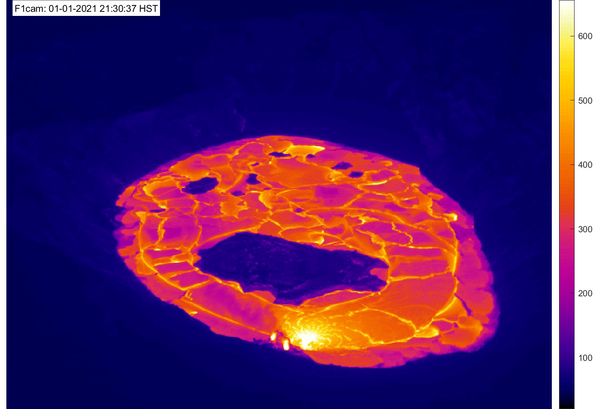
April 20 was the four-month anniversary of Kīlauea's ongoing summit eruption in Halema‘uma‘u. This animated GIF features approximately one thermal image for each day of the eruption and demonstrates eruptive activity over the past four months. At 9:30 p.m.
April 20 was the four-month anniversary of Kīlauea's ongoing summit eruption in Halema‘uma‘u. This animated GIF features approximately one thermal image for each day of the eruption and demonstrates eruptive activity over the past four months. At 9:30 p.m.

April 16, 2021: Overview of Halema‘uma‘u lava lake western portion
April 16, 2021: Overview of Halema‘uma‘u lava lake western portionDuring a Kīlauea summit helicopter overflight on Friday, April 16, an HVO scientist captured this photo of the erupting western fissure and surrounding lava lake within Halema‘uma‘u. The active western potion of the lava lake, as seen here, measured approximately 300 m (984 ft) from end-to-end at the time. USGS image.
April 16, 2021: Overview of Halema‘uma‘u lava lake western portion
April 16, 2021: Overview of Halema‘uma‘u lava lake western portionDuring a Kīlauea summit helicopter overflight on Friday, April 16, an HVO scientist captured this photo of the erupting western fissure and surrounding lava lake within Halema‘uma‘u. The active western potion of the lava lake, as seen here, measured approximately 300 m (984 ft) from end-to-end at the time. USGS image.