U.S. flag

An official website of the United States government

Images

Hawaiian Volcano Observatory images of eruptive activity, field work, and more.

Filter Total Items: 3867
Color photograph of vegetated mountain
August 9, 2023 — View of Rainmaker Mountain near Pago Pago harbor, American Samoa

A view of Rainmaker Mountain to the east of Pago Pago harbor on Tutuila Island, American Samoa. Rainmaker Mountain was mapped in the 1940s as a trachyte plug by geologist Harold Stearns. Dense jungle, the highest annual rainfall in American Samoa, and its steep cliffs make it a formidable mountain to summit. USGS photo by D. Downs.

A view of Rainmaker Mountain to the east of Pago Pago harbor on Tutuila Island, American Samoa. Rainmaker Mountain was mapped in the 1940s as a trachyte plug by geologist Harold Stearns. Dense jungle, the highest annual rainfall in American Samoa, and its steep cliffs make it a formidable mountain to summit. USGS photo by D. Downs.

Color photographs of scientist repairing instrument
HVO field engineers repair UWE tiltmeter

On August 8, 2023, HVO field engineers visited the UWE tiltmeter station near Kīlauea summit. Field engineers serviced the instrument, which was experiencing temporary date outages. USGS photo by M. Cappos.

On August 8, 2023, HVO field engineers visited the UWE tiltmeter station near Kīlauea summit. Field engineers serviced the instrument, which was experiencing temporary date outages. USGS photo by M. Cappos.

Color photograph of coast at sunset
August 7, 2023 — Photo of Ofu, Olosega, and Taʻū islands, American Samoa

Early morning photo of the three islands that make up the Manuʻa Islands in American Samoa. Ofu Island is in the foreground, Olosega Island in the middle ground, and Taʻū Island is in the background. Ofu-Olosega islands and Taʻū Island are the tops of volcanoes, most of which are under the ocean surface. USGS photo by D. Downs.

Early morning photo of the three islands that make up the Manuʻa Islands in American Samoa. Ofu Island is in the foreground, Olosega Island in the middle ground, and Taʻū Island is in the background. Ofu-Olosega islands and Taʻū Island are the tops of volcanoes, most of which are under the ocean surface. USGS photo by D. Downs.

Color photograph of island and ocean
August 7, 2023 — View of the northwest side of Taʻū Island, American Samoa

A view of the northwest side of Taʻū Island in American Samoa. This island is a shield volcano with small scoria cones on its upper flanks and tuff cones at sea level. The history of this volcano is currently being studied to better understand the eruptions that built it. The light brown material in the foreground at sea level is part of a tuff cone at Faleāsao.

A view of the northwest side of Taʻū Island in American Samoa. This island is a shield volcano with small scoria cones on its upper flanks and tuff cones at sea level. The history of this volcano is currently being studied to better understand the eruptions that built it. The light brown material in the foreground at sea level is part of a tuff cone at Faleāsao.

Color photograph of island and ocean
August 7, 2023 — View of Olosega Island with Ofu Island in the background, American Samoa

A view of the southeast side of Olosega Island (foreground), with Ofu Island visible in the background. These volcanoes have steep cliffs and are separated by a 50-foot (15 meter) channel. The steep cliff in the photo is a dike sticking out into the ocean that has been more resistant to weathering than surrounding lava flows. USGS photo by D. Downs.

A view of the southeast side of Olosega Island (foreground), with Ofu Island visible in the background. These volcanoes have steep cliffs and are separated by a 50-foot (15 meter) channel. The steep cliff in the photo is a dike sticking out into the ocean that has been more resistant to weathering than surrounding lava flows. USGS photo by D. Downs.

Color photograph of coast
August 5, 2023 — View of the basalt lava cliffs along the southwest part of Tutuila, American Samoa

A view looking at the basalt lava flows that make cliffs along the southwestern part of Tutuila Island, American Samoa. These flows are part of the Leone volcanic series and form the flattest part of Tutuila Island, where the airport and population center of Tafuna are located. USGS photo by D. Downs.

A view looking at the basalt lava flows that make cliffs along the southwestern part of Tutuila Island, American Samoa. These flows are part of the Leone volcanic series and form the flattest part of Tutuila Island, where the airport and population center of Tafuna are located. USGS photo by D. Downs.

Color photograph of cliffs and ocean
August 4, 2023 — Eastern end of Tutuila and Aunuʻu islands in American Samoa

The view looks south along the basalt cliffs and beaches at Tula point on the eastern end of Tutuila Island, American Samoa. Tutuila Island is a shield volcano, formed by basalt flows that are 1-1.5 million years old.

The view looks south along the basalt cliffs and beaches at Tula point on the eastern end of Tutuila Island, American Samoa. Tutuila Island is a shield volcano, formed by basalt flows that are 1-1.5 million years old.

Color photograph of crack in the ground surface
Low-angle aerial view of the Great Crack

Low-angle aerial view of the Great Crack and surrounding 1823 lava flows (dark gray) along Kīlauea’s lower Southwest Rift Zone. The crack is about 50 feet (15 meters) wide in this area with similar but variable depth, depending on the amount of rock rubble filling the opening. USGS photo by D. Downs.

Low-angle aerial view of the Great Crack and surrounding 1823 lava flows (dark gray) along Kīlauea’s lower Southwest Rift Zone. The crack is about 50 feet (15 meters) wide in this area with similar but variable depth, depending on the amount of rock rubble filling the opening. USGS photo by D. Downs.

Color graphic of volcano monitoring using UAS
Image of monitoring a jetting eruption at Stromboli volcano, Italy

Image of jetting eruption at Stromboli volcano Italy (left), the orientation of the sensor compared to the eruption direction (center) and a close image of the hovering UAS with sensor on tether below (right-Image courtesy David Fee).   

Image of jetting eruption at Stromboli volcano Italy (left), the orientation of the sensor compared to the eruption direction (center) and a close image of the hovering UAS with sensor on tether below (right-Image courtesy David Fee).   

Color photograph of crater
Makaopuhi Crater
Makaopuhi Crater
Makaopuhi Crater

A panoramic photograph of Makaopuhi Crater on the middle East Rift Zone of Kīlauea. Makapohi Crater is located between Maunaulu and Puʻuʻōʻō, two lava shields that formed during long-lived (years) eruptions on the middle East Rift Zone.

A panoramic photograph of Makaopuhi Crater on the middle East Rift Zone of Kīlauea. Makapohi Crater is located between Maunaulu and Puʻuʻōʻō, two lava shields that formed during long-lived (years) eruptions on the middle East Rift Zone.

Color photograph of crater floor
Makaopuhi Crater
Makaopuhi Crater
Makaopuhi Crater

A panoramic photograph of Makaopuhi Crater on the middle East Rift Zone of Kīlauea. Makapohi Crater is located between Maunaulu and Puʻuʻōʻō; lava flows from the Maunaulu eruption (1969-1974) traveled east and cascaded into Makaopuhi Crater, partially paving the floor of the crater with new lava (dark gray material in the foreground of the photo).

A panoramic photograph of Makaopuhi Crater on the middle East Rift Zone of Kīlauea. Makapohi Crater is located between Maunaulu and Puʻuʻōʻō; lava flows from the Maunaulu eruption (1969-1974) traveled east and cascaded into Makaopuhi Crater, partially paving the floor of the crater with new lava (dark gray material in the foreground of the photo).

Color map of the Manuʻa Islands, American Samoa
July 2023—Topography and bathymetry of the Manuʻa Islands, American Samoa

This reference map depicts the volcanoes in the Manuʻa Islands, American Samoa, the site of seismic unrest between July and September 2022. Marked on the map are the locations of Hawaiian Volcano Observatory GPS and seismometers in the islands.

This reference map depicts the volcanoes in the Manuʻa Islands, American Samoa, the site of seismic unrest between July and September 2022. Marked on the map are the locations of Hawaiian Volcano Observatory GPS and seismometers in the islands.

Color photograph of scientist in the field
HVO geologist samples tephra

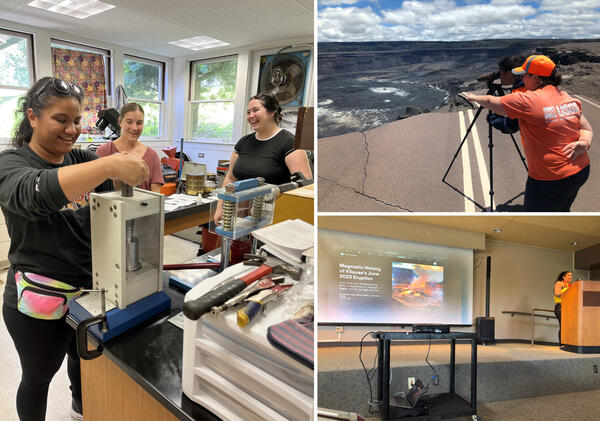
On July 27, 2023, an HVO geologist sampled tephra from one of Kīlauea's largest explosive eruptions (900 CE) that is preserved in soil found on the volcano's south flank near the coast.

On July 27, 2023, an HVO geologist sampled tephra from one of Kīlauea's largest explosive eruptions (900 CE) that is preserved in soil found on the volcano's south flank near the coast.

Color photograph of scientists hiking
Geologists hiking along the Hilina Pali Trail

Hawaiian Volcano Observatory geologists and a National Park Service archaeologist hike west along the Hilina Pali Trail on July 26, 2023. USGS photo by D. Downs. 

Hawaiian Volcano Observatory geologists and a National Park Service archaeologist hike west along the Hilina Pali Trail on July 26, 2023. USGS photo by D. Downs. 

map showing June 2023 eruption area
July 21, 2023—Reference map of recent Kīlauea summit eruption

This reference map depicts the Kīlauea summit region following the most recent eruption in June 2023. The provided statistics for that eruption were measured during a Hawaiian Volcano Observatory helicopter overflight just days after the June 19 eruptive pause.

This reference map depicts the Kīlauea summit region following the most recent eruption in June 2023. The provided statistics for that eruption were measured during a Hawaiian Volcano Observatory helicopter overflight just days after the June 19 eruptive pause.

Scientist tests intrument in the field
USGS scientist deploys electrode at temporary site

USGS scientists are deploying temporary sites on Kīlauea during July to conduct magnetotelluric (MT) sounding. At each site, electrodes and wire coils buried at shallow depths will passively measure the electromagnetic (EM) energy generated by lightning strikes around the equator.

USGS scientists are deploying temporary sites on Kīlauea during July to conduct magnetotelluric (MT) sounding. At each site, electrodes and wire coils buried at shallow depths will passively measure the electromagnetic (EM) energy generated by lightning strikes around the equator.

Color photograph of scientist checking field site
Scientists temporarily deploy instruments to collect ground-based magnetotelluric (MT) data

USGS staff are deploying temporarily instruments to collect ground-based magnetotelluric (MT) data to image structure and fluids beneath the surface of Kīlauea.

Color photograph of instrument being deployed in the ground.
Scientists temporarily deploy instruments to collect ground-based magnetotelluric (MT) data

During July, HVO staff and collaborators install temporary instruments to collect magnetotelluric (MT) data on Kīlauea. At each location, electrodes, induction-coil magnetometers, and data loggers are deployed for about a month. This photo shows a magnetometer in the foreground being buried in a narrow and shallow trench to minimize wind noise.

During July, HVO staff and collaborators install temporary instruments to collect magnetotelluric (MT) data on Kīlauea. At each location, electrodes, induction-coil magnetometers, and data loggers are deployed for about a month. This photo shows a magnetometer in the foreground being buried in a narrow and shallow trench to minimize wind noise.

Color photograph of scientist in the field
Scientist tests instrument to collect ground-based magnetotelluric (MT) data

A USGS geophysicist measures contact resistance on electrodes at a temporary magnetotelluric site. The electrodes require electrical contact with the ground and are buried in shallow holes about the width and depth of a spade head. Data collected by the instruments will help to image the structure and fluids beneath the surface of Kīlauea.

A USGS geophysicist measures contact resistance on electrodes at a temporary magnetotelluric site. The electrodes require electrical contact with the ground and are buried in shallow holes about the width and depth of a spade head. Data collected by the instruments will help to image the structure and fluids beneath the surface of Kīlauea.

Photograph showing orange fountains of lava inside a crater with orange and black lava flows filling the crater.
Screen Shot 2023-07-14 at 9.52.56 AM.png

Web camera view of the onset of the June 7 eruption of Kīlauea volcano from the summit caldera.

Color graphics of earthquakes
Map of American Samoa volcano-monitoring network.

Map of the American Samoa volcano-monitoring network (top). Data from Wake Island hydrograph (located about 4,500 km, or 2,900 miles, northwest of Taʻū Island) shows the general trend in the number of events during the 2022 earthquake swarm (bottom left). Locations for larger earthquakes (M2.5 and greater) are available starting August 20, 2022 (bottom right).

Map of the American Samoa volcano-monitoring network (top). Data from Wake Island hydrograph (located about 4,500 km, or 2,900 miles, northwest of Taʻū Island) shows the general trend in the number of events during the 2022 earthquake swarm (bottom left). Locations for larger earthquakes (M2.5 and greater) are available starting August 20, 2022 (bottom right).

Was this page helpful?