U.S. flag

An official website of the United States government

Images

Images related to Yellowstone Volcano Observatory.

Filter Total Items: 704
Comparison between the velocity structures outlining the Yellowstone’s upper-crustal magma reservoir at 5 km (3 mi) depth based on sparse (left) and dense (right) seismic networks
Velocity structures outlining the Yellowstone’s upper-crustal magma reservoir based on sparse (left) and dense (right) seismic networks

Comparison between the velocity structures outlining the Yellowstone’s upper-crustal magma reservoir at 5 km (3 mi) depth based on sparse (left) and dense (right) seismic networks. The open squares denote the locations of seismic sensors. Warmer color indicates lower velocity, representing higher melt fraction within the medium.

Earthquake Lake and the Madison slide

Earthquake Lake, which formed when the Madison River was blocked by a landslide that occurred as a consequence of the Hebgen Lake earthquake in 1959.  The lake inundated existing forest, now marked by standing dead trees in the lake water. The landslide scar is visible on the side of the mountain at the far end of the lake.

Earthquake Lake, which formed when the Madison River was blocked by a landslide that occurred as a consequence of the Hebgen Lake earthquake in 1959.  The lake inundated existing forest, now marked by standing dead trees in the lake water. The landslide scar is visible on the side of the mountain at the far end of the lake.

Map of Geyser Hill, Upper Geyser Basin, Yellowstone National Park, with selected thermal features

Map of Geyser Hill, Upper Geyser Basin, Yellowstone National Park, showing selected thermal features, including new and reactivated features that were active during the May-June 2023 thermal unrest.  Map prepared by by Kiernan Folz-Donahue, Yellowstone National Park.

Green circular pool surrounded by barren ground and then trees beyond under a mostly cloudy sky
Hydrothermal explosion crater that has existed since at least 1954 located just southwest of The Gap in Norris Geyser Basin, Yellowstone National Park

Hydrothermal explosion crater that has existed since at least 1954 located just southwest of The Gap in Norris Geyser Basin, Yellowstone National Park. Photo taken in June 2023 by Lauren Harrison.

A small snake extends out from tall green grass over a stream.
Garter snake along Violet Creek near the Mary Mountain Trail in Hayden Valley, Yellowstone National Park

A garter snake along Violet Creek near the Mary Mountain Trail in Hayden Valley, Yellowstone National Park. This snake used the geothermally warmed creek to thermoregulate during near-freezing overnight conditions. USGS photo by Stanley Mordensky, June 2023.

A small snake extends out from tall green grass over a stream.
Garter snake along Violet Creek near the Mary Mountain Trail in Hayden Valley, Yellowstone National Park

A garter snake along Violet Creek near the Mary Mountain Trail in Hayden Valley, Yellowstone National Park. This snake used the geothermally warmed creek to thermoregulate during near-freezing overnight conditions. USGS photo by Stanley Mordensky, June 2023.

Map of ground deformation monitoring network in the Yellowstone region

Map of continuous Global Positioning System (GPS), semipermanent GPS, borehole strainmeters, and borehole tiltmeters that provide surface deformation monitoring capability in and around Yellowstone National Park. Red line denotes boundary of Yellowstone Caldera.

Map of continuous Global Positioning System (GPS), semipermanent GPS, borehole strainmeters, and borehole tiltmeters that provide surface deformation monitoring capability in and around Yellowstone National Park. Red line denotes boundary of Yellowstone Caldera.

Thermal feature UNNG-GHG-17a, Upper Geyser Basin, Yellowstone National Park, on May 31, 2023

Thermal feature UNNG-GHG-17a, not far from Sponge Geyser on Geyser Hill in Upper Geyser Basin, Yellowstone National Park.  The feature formed during a period of thermal unrest that began in May 2023 and threw debris and hot water onto the adjacent boardwalk, which was closed for safety.  National Park Service photo by Kiernan Folz-Donahue, May 31, 2023.

Thermal feature UNNG-GHG-17a, not far from Sponge Geyser on Geyser Hill in Upper Geyser Basin, Yellowstone National Park.  The feature formed during a period of thermal unrest that began in May 2023 and threw debris and hot water onto the adjacent boardwalk, which was closed for safety.  National Park Service photo by Kiernan Folz-Donahue, May 31, 2023.

A corner reflector, designed to reflect satellite radar signals
Corner reflector, designed to reflect satellite radar signals

A corner reflector, designed to reflect satellite radar signals and useful for calibrating radar data, with GPS station PEA1 (and the San Andreas fault) in the background. Photo by Scott Johnson, EarthScope Consortium, on May 2, 2023.

A corner reflector, designed to reflect satellite radar signals and useful for calibrating radar data, with GPS station PEA1 (and the San Andreas fault) in the background. Photo by Scott Johnson, EarthScope Consortium, on May 2, 2023.

Borehole station B945, near Panther Meadow between Mammoth Hot Springs and Norris Geyser Basin in Yellowstone National Park

Borehole station B945, near Panther Meadow between Mammoth Hot Springs and Norris Geyser Basin in Yellowstone National Park.  Left (“before”) panel shows old VSAT satellite communication network, with a large, round antenna (photo by Scott Johnson, EarthScope Consortium, on May 13, 2022).  Right (“after”) panel shows the station with a new Starlink antenna

Borehole station B945, near Panther Meadow between Mammoth Hot Springs and Norris Geyser Basin in Yellowstone National Park.  Left (“before”) panel shows old VSAT satellite communication network, with a large, round antenna (photo by Scott Johnson, EarthScope Consortium, on May 13, 2022).  Right (“after”) panel shows the station with a new Starlink antenna

Distribution of hydrothermal features in Yellowstone as a function of their pH

Distribution of hydrothermal features in Yellowstone as a function of their pH (modified and updated from Nordstrom et al., 2009). There are two distinct groupings: one is more acidic, and the other neutral to basic.

Front cover of the Yellowstone Volcano Observatory 2022 annual report

Front cover of the Yellowstone Volcano Observatory 2022 annual report, which includes a summary of earthquake, deformation, and geyser activity, as well as research investigations and other information.

Soil carbon dioxide concentration and temperature at a new thermal area near Tern Lake in Yellowstone National Park

Soil carbon dioxide concentration and temperature measured at a new thermal area near Tern Lake in Yellowstone National Park on the east side of Yellowstone Caldera. A, Map of soil carbon dioxide flux simulated based on measurements made at the black dots in September 2022. B, Map of soil temperature at a depth of 20 centimeters (8 inches).

Soil carbon dioxide concentration and temperature measured at a new thermal area near Tern Lake in Yellowstone National Park on the east side of Yellowstone Caldera. A, Map of soil carbon dioxide flux simulated based on measurements made at the black dots in September 2022. B, Map of soil temperature at a depth of 20 centimeters (8 inches).

Geologic map of the Timber Hill basalt Sweetwater Hills, Montana

Simplified geologic map of the Timber Hill basalt and underlying geology in the Sweetwater Hills. The Sweetwater Road is shown by red. Note the basalt flow generally rests on poorly cemented sediments of the Sixmile Creek Formation shown in orange.  Map by Jesse Mosolof (Montana Bureau of Mines and Geology).

Simplified geologic map of the Timber Hill basalt and underlying geology in the Sweetwater Hills. The Sweetwater Road is shown by red. Note the basalt flow generally rests on poorly cemented sediments of the Sixmile Creek Formation shown in orange.  Map by Jesse Mosolof (Montana Bureau of Mines and Geology).

Simplified map of the Wyoming Province

Simplified map of the Wyoming Province—a craton composed of Archean-age continental crust. Archean- and Proterozoic-age rocks outcrop in many places within the Wyoming Province and are shown as dark grey blobs. The yellow blob highlights the location of the Hellroaring and Crevice plutons, a small portion of which are exposed in northern Yellowstone National Park.

Simplified map of the Wyoming Province—a craton composed of Archean-age continental crust. Archean- and Proterozoic-age rocks outcrop in many places within the Wyoming Province and are shown as dark grey blobs. The yellow blob highlights the location of the Hellroaring and Crevice plutons, a small portion of which are exposed in northern Yellowstone National Park.

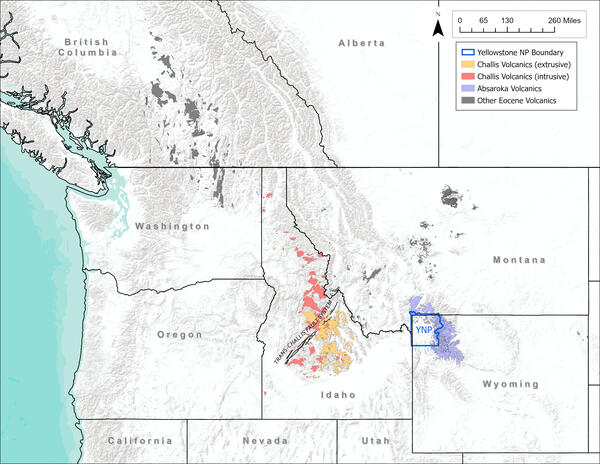
Map of Timber Hill basalt in the context of the Yellowstone hotspot track

Map of the northwestern U.S., showing the approximate locations of the Yellowstone hotspot volcanic fields (orange) and Columbia River Basalts (gray).  Boundary of Yellowstone National Park is shown in yellow.  Inset shows physiographic map of southwest Montana and central Idaho.

Map of the northwestern U.S., showing the approximate locations of the Yellowstone hotspot volcanic fields (orange) and Columbia River Basalts (gray).  Boundary of Yellowstone National Park is shown in yellow.  Inset shows physiographic map of southwest Montana and central Idaho.

Photos showing scientists working on ice-covered Henrys Lake (Idaho) to collect sediment cores.
Geologists work to collect sediment cores from ice-covered Henrys Lake, Idaho

USGS scientists work to recover sediment cores from Henrys Lake, Idaho. (Left): geologists traverse frozen Henrys Lake with coring supplies. USGS photo by Sylvia Nicovich, March 30, 2023.  (Right) Geologists lower the corer into the lake through a hole augured through the ice. USGS photo by Chris DuRoss, March 31, 2023.

USGS scientists work to recover sediment cores from Henrys Lake, Idaho. (Left): geologists traverse frozen Henrys Lake with coring supplies. USGS photo by Sylvia Nicovich, March 30, 2023.  (Right) Geologists lower the corer into the lake through a hole augured through the ice. USGS photo by Chris DuRoss, March 31, 2023.

A small lake surrounded by scrubby green vegetation under a partly cloudy sky.  The right side of the lake shore includes a tall mass of partly vegetated rock.
Frying Pan Lake, New Zealand

Frying Pan Lake (also called Waimangu Cauldron), in New Zealand, sits within Echo Crater, which formed during the 1886 eruption of Tarawera.  A hydrothermal explosion from the crater in 1917 resulted in the formation of the hot spring "lake" by 1918.

Frying Pan Lake (also called Waimangu Cauldron), in New Zealand, sits within Echo Crater, which formed during the 1886 eruption of Tarawera.  A hydrothermal explosion from the crater in 1917 resulted in the formation of the hot spring "lake" by 1918.

Map of the distribution of pH for thermal pools within Norris Geyser Basin, Yellowstone National Park

Map of the distribution of pH for thermal pools within Norris Geyser Basin, Yellowstone National Park.  Cool colors are acidic, and warm colors are neutral to slightly basic.  These data were collected and organized using Geographic Information System (GIS) tools. Map by Jefferson Hungerford and Kiernan Folz-Donahue, Yellowstone National Park.

Map of the distribution of pH for thermal pools within Norris Geyser Basin, Yellowstone National Park.  Cool colors are acidic, and warm colors are neutral to slightly basic.  These data were collected and organized using Geographic Information System (GIS) tools. Map by Jefferson Hungerford and Kiernan Folz-Donahue, Yellowstone National Park.

Volcanic deposits associated with the Absaroka volcanic province along the eastern and northern boundaries of Yellowstone National Park

Volcanic deposits associated with the Absaroka volcanic province along the eastern and northern boundaries of Yellowstone National Park. The left panel shows the spread of the Absaroka Volcanic Supergroup (AVS) throughout Wyoming and Montana.

Isotopic composition of units within the Absaroka volcanic province

Isotopic composition of the primary volcanic groups of the Absaroka volcanic province (the Washburn, Sunlight, and Thorofare groups) and two volcaniclastic units, the Sepulcher formation and the Daly formation.

Isotopic composition of the primary volcanic groups of the Absaroka volcanic province (the Washburn, Sunlight, and Thorofare groups) and two volcaniclastic units, the Sepulcher formation and the Daly formation.

Was this page helpful?