



Publications
Scientific reports, journal articles, and information products produced by USGS Pacific Coastal and Marine Science Center scientists.
USGS Pubs Warehouse
USGS Pubs Warehouse

Browse the USGS Publications Warehouse to broaden your search with enhanced filtering.
Sound Waves Newsletter
Sound Waves Newsletter
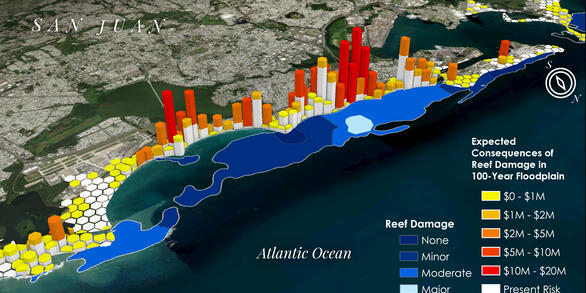
Browse issues of the Sound Waves newsletter, featuring coastal and marine research news from across the USGS.
Filter Total Items: 1466
Vegetation and substrate on aeolian landscapes in the Colorado River corridor, Cataract Canyon, Utah Vegetation and substrate on aeolian landscapes in the Colorado River corridor, Cataract Canyon, Utah
Vegetation and substrate data presented in this report characterize ground cover on aeolian landscapes of the Colorado River corridor through Cataract Canyon, Utah, in Canyonlands National Park. The 27-km-long Cataract Canyon reach has undergone less anthropogenic alteration than other reaches of the mainstem Colorado River. Characterizing ecosystem parameters there provides a basis...
Authors
Amy E. Draut, Elizabeth R. Gillette
Identification of tsunami deposits in the geologic record; developing criteria using recent tsunami deposits Identification of tsunami deposits in the geologic record; developing criteria using recent tsunami deposits
There is a need for a clear procedure to identify tsunami deposits in the geologic record. Data from published studies documenting recent tsunami deposits provide a means of developing identification criteria based on the sedimentary characteristics of unequivocal tsunami deposits. Recent tsunami deposits have many sedimentary characteristics in common. All had sharp or erosional basal...
Authors
Robert Peters, Bruce Jaffe
Seamounts and ferromanganese crusts within and near the U.S. EEZ off California - Data for RV Farnella cruise F7-87-SC Seamounts and ferromanganese crusts within and near the U.S. EEZ off California - Data for RV Farnella cruise F7-87-SC
The purpose of this report is to present and briefly describe ship-board and laboratory data for a U.S. Geological Survey (USGS) research cruise aboard the RV Farnella that took place December 3-21, 1987 (cruise F7-87-SC). The purpose of the cruise was to survey seamounts and ferromanganese crusts within and near the U.S. Exclusive Economic Zone (EEZ) off California. Eight seamounts were...
Authors
James R. Hein, Jane A. Reid, Tracey A. Conrad, Rachel E. Dunham, David A. Clague, Marjorie S. Schulz, Alice S. Davis
Coastal circulation and sediment dynamics in Maunalua Bay, Oahu, Hawaii: Measurements of waves, currents, temperature, salinity, and turbidity: November 2008-February 2009 Coastal circulation and sediment dynamics in Maunalua Bay, Oahu, Hawaii: Measurements of waves, currents, temperature, salinity, and turbidity: November 2008-February 2009
High-resolution measurements of waves, currents, water levels, temperature, salinity and turbidity were made in Maunalua Bay, southern Oahu, Hawaii, during the 2008–2009 winter to better understand coastal circulation, water-column properties, and sediment dynamics during a range of conditions (trade winds, kona storms, relaxation of trade winds, and south swells). A series of bottom...
Authors
Curt D. Storlazzi, M. Katherine Presto, Joshua B. Logan, Michael E. Field
Database of recent tsunami deposits Database of recent tsunami deposits
This report describes a database of sedimentary characteristics of tsunami deposits derived from published accounts of tsunami deposit investigations conducted shortly after the occurrence of a tsunami. The database contains 228 entries, each entry containing data from up to 71 categories. It includes data from 51 publications covering 15 tsunamis distributed between 16 countries. The...
Authors
Robert Peters, Bruce E. Jaffe
Surface-wave site characterization at 52 strong-motion recording stations affected by the Parkfield, California, M6.0 earthquake of 28 September 2004 Surface-wave site characterization at 52 strong-motion recording stations affected by the Parkfield, California, M6.0 earthquake of 28 September 2004
We present one-dimensional shear-wave velocity (VS) profiles at 52 strong-motion sites that recorded the 28 September 2004 Magnitude 6.0 Parkfield, Calif., earthquake. We estimate the VS profiles with the Spectral Analysis of Surface-Waves (SASW) method. The SASW method is a noninvasive method that indirectly estimates the VS at depth from variations in the Rayleigh wave phase velocity...
Authors
Eric M. Thompson, Robert E. Kayen, Brad Carkin, Hajime Tanaka
Coast Salish and U.S. Geological Survey 2009 Tribal Journey water quality project Coast Salish and U.S. Geological Survey 2009 Tribal Journey water quality project
The Salish Sea, contained within the United States and British Columbia, Canada, is the homeland of the Coast Salish Peoples and contains a diverse array of marine resources unique to this area that have sustained Coast Salish cultures and traditions for millennia. In July 2009, the Coast Salish People and U.S. Geological Survey conducted a second water quality study of the Salish Sea to...
Authors
Sarah K. Akin, Eric E. Grossman
Description of extreme-wave deposits on the northern coast of Bonaire, Netherlands Antilles Description of extreme-wave deposits on the northern coast of Bonaire, Netherlands Antilles
To develop a better understanding of the origins of extreme-wave deposits and to help assess the potential risk of future overwash events, a field mapping survey was conducted in November 2006 on the northern coast of Bonaire, Netherlands Antilles. Deposits were mapped and analyzed to help develop a systematic sedimentological approach to distinguish the type of extreme-wave event...
Authors
Steven G. Watt, Bruce E. Jaffe, Robert A. Morton, Bruce M. Richmond, Guy Gelfencaum
2009 weather and aeolian sand-transport data from the Colorado River corridor, Grand Canyon, Arizona 2009 weather and aeolian sand-transport data from the Colorado River corridor, Grand Canyon, Arizona
This report presents measurements of weather parameters and aeolian sand transport made in 2009 near selected archeological sites in the Colorado River corridor through Grand Canyon, Ariz. The quantitative methods and data discussed here form a basis for monitoring ecosystem processes that affect archeological-site stability. Combined with forthcoming work to evaluate landscape evolution...
Authors
Amy E. Draut, Hoda A. Sondossi, Timothy P. Dealy, Joseph E. Hazel, Helen C. Fairley, Christopher R. Brown
Estuarine sedimentation, sediment character, and foraminiferal distribution in central San Francisco Bay, California Estuarine sedimentation, sediment character, and foraminiferal distribution in central San Francisco Bay, California
Central San Francisco Bay is the deepest subembayment in the San Francisco Bay estuary and hence has the largest water volume of any of the subembayments. It also has the strongest tidal currents and the coarsest sediment within the estuary. Tidal currents are strongest over the west-central part of central bay and, correspondingly, this area is dominated by sand-size sediment. Much of...
Authors
John L. Chin, Donald L. Woodrow, Mary McGann, Florence L. Wong, Theresa A. Fregoso, Bruce E. Jaffe
High-resolution seismic-reflection data offshore of Dana Point, southern California borderland High-resolution seismic-reflection data offshore of Dana Point, southern California borderland
The U.S. Geological Survey collected high-resolution shallow seismic-reflection profiles in September 2006 in the offshore area between Dana Point and San Mateo Point in southern Orange and northern San Diego Counties, California. Reflection profiles were located to image folds and reverse faults associated with the San Mateo fault zone and high-angle strike-slip faults near the shelf...
Authors
Ray W. Sliter, Holly F. Ryan, Peter J. Triezenberg
Terrigenous sediment provenance from geochemical tracers, south Molokai reef flat, Hawaii Terrigenous sediment provenance from geochemical tracers, south Molokai reef flat, Hawaii
Land-derived runoff is one of the greatest threats to coral-reef health. Identification of runoff sources is an important step in erosion mitigation efforts. A geochemical sediment provenance study was done in uplands and across the adjacent fringing reef on the southeast shore of Molokai, Hawaii, to determine whether sediment runoff originated from hillsides or gulches. Source-region
Authors
R.K. Takesue