



Graphic shows the earthquake swarm from June-July, 2019, compared to previous swarms detected in March 2019, 2017, 2016, and in 2014. The activity is likely the result of small-scale underground movements of hydrothermal fluids or gas — a sign that Mount St. Helens remains an active volcano.
All Multimedia
Access all multimedia to include images, video, audio, webcams, before-after imagery, and more. Filter and explore with filtering options to refine search.
Filter Total Items: 24981

Earthquake swarms at Mount St. Helens
Graphic shows the earthquake swarm from June-July, 2019, compared to previous swarms detected in March 2019, 2017, 2016, and in 2014. The activity is likely the result of small-scale underground movements of hydrothermal fluids or gas — a sign that Mount St. Helens remains an active volcano.

How Does Carbon Get Into the Atmosphere?
A short video on how carbon can get into the atmosphere.
A short video on how carbon can get into the atmosphere.

Morro Bay from the air
Passing Morro Bay during an aerial photographic survey.
The Seabird Studies Team at the USGS Western Ecological Research Center is conducting aerial photographic surveys of the ocean off central and southern California to create comprehensive maps of seabird and marine mammal distributions.
Passing Morro Bay during an aerial photographic survey.
The Seabird Studies Team at the USGS Western Ecological Research Center is conducting aerial photographic surveys of the ocean off central and southern California to create comprehensive maps of seabird and marine mammal distributions.

Why are coral reefs in peril and what is being done to protect them?
Why are coral reefs in peril and what is being done to protect them?A short video on information related to coral reefs and the USGS.
Why are coral reefs in peril and what is being done to protect them?
Why are coral reefs in peril and what is being done to protect them?A short video on information related to coral reefs and the USGS.

Why is the ocean salty?
A short video on why the ocean is salty.
A short video on why the ocean is salty.

GeoPulse Boomer Plates
The boomer plate produces a repeatable pulse in the 1-6kHz frequency range using an electrodynamic transducer that can be powered by a capacitor discharge system.
The boomer plate produces a repeatable pulse in the 1-6kHz frequency range using an electrodynamic transducer that can be powered by a capacitor discharge system.

Ocean and California coast from the air
Low clouds over land, but clears skies over the ocean during a test flight in March 2019.
The Seabird Studies Team at the USGS Western Ecological Research Center is conducting aerial photographic surveys of the ocean off central and southern California to create comprehensive maps of seabird and marine mammal distributions.
Low clouds over land, but clears skies over the ocean during a test flight in March 2019.
The Seabird Studies Team at the USGS Western Ecological Research Center is conducting aerial photographic surveys of the ocean off central and southern California to create comprehensive maps of seabird and marine mammal distributions.

Passing Diablo Canyon Power Plant during aerial survey test flight
Passing Diablo Canyon Power Plant during aerial survey test flightPassing Diablo Canyon Power Plant during a test flight in March 2019, in preparation for aerial photographic surveys.
Passing Diablo Canyon Power Plant during aerial survey test flight
Passing Diablo Canyon Power Plant during aerial survey test flightPassing Diablo Canyon Power Plant during a test flight in March 2019, in preparation for aerial photographic surveys.

Camera set-up for an aerial photographic survey
Camera set-up in the plane before belly port doors are opened for an aerial photographic survey.
The Seabird Studies Team at the USGS Western Ecological Research Center is conducting aerial photographic surveys of the ocean off central and southern California to create comprehensive maps of seabird and marine mammal distributions.
Camera set-up in the plane before belly port doors are opened for an aerial photographic survey.
The Seabird Studies Team at the USGS Western Ecological Research Center is conducting aerial photographic surveys of the ocean off central and southern California to create comprehensive maps of seabird and marine mammal distributions.

Gear used for aerial photographic surveys
Mount with black-out curtain used to hold a wireless monitor. This set-up allows technicians to interface with four mini-PCs in real time, allowing them to check data and image quality, and make adjustments when necessary.
Mount with black-out curtain used to hold a wireless monitor. This set-up allows technicians to interface with four mini-PCs in real time, allowing them to check data and image quality, and make adjustments when necessary.

Measuring wildlife mortality
Scientists collect carcasses at a wind energy facility to estimate total wildlife mortality at a site.
Scientists collect carcasses at a wind energy facility to estimate total wildlife mortality at a site.

Melting snow created measurable flow in Reservation Creek
Melting snow created measurable flow in Reservation CreekMelting snow near Miles City created measurable flow in Reservation Creek. This site is only visited when there are high flows,
Melting snow created measurable flow in Reservation Creek
Melting snow created measurable flow in Reservation CreekMelting snow near Miles City created measurable flow in Reservation Creek. This site is only visited when there are high flows,

3D Model of Pu`u `Ō`ō
This 3D model of the Pu‘u ‘Ō‘ō crater was constructed from thermal images taken during a recent helicopter overflight. White areas show warm spots in the crater. Despite the absence of active lava in Pu‘u ‘Ō‘ō, changes at the crater have continued since magma drained from beneath it on April 30, 2018.
This 3D model of the Pu‘u ‘Ō‘ō crater was constructed from thermal images taken during a recent helicopter overflight. White areas show warm spots in the crater. Despite the absence of active lava in Pu‘u ‘Ō‘ō, changes at the crater have continued since magma drained from beneath it on April 30, 2018.

3D model of the Pu‘u ‘Ō‘ō crater - March 18, 2019
This 3D model of the Pu‘u ‘Ō‘ō crater was constructed from thermal images taken during a recent helicopter overflight. White areas show warm spots in the crater. Despite the absence of active lava in Pu‘u ‘Ō‘ō, changes at the crater have continued since magma drained from beneath it on April 30, 2018.
This 3D model of the Pu‘u ‘Ō‘ō crater was constructed from thermal images taken during a recent helicopter overflight. White areas show warm spots in the crater. Despite the absence of active lava in Pu‘u ‘Ō‘ō, changes at the crater have continued since magma drained from beneath it on April 30, 2018.

Calvert Formation near Plum Point, MD
Northeast Region Photo Contest Winner | March 2019 | USGS at Work
Seth Sutton at an outcrop of the marine Calvert Formation near Plum Point, MD, on the western shore of the Chesapeake Bay
Northeast Region Photo Contest Winner | March 2019 | USGS at Work
Seth Sutton at an outcrop of the marine Calvert Formation near Plum Point, MD, on the western shore of the Chesapeake Bay

Spring 2019 Flooding - Big Sioux River
After record flooding on the Big Sioux River, USGS crews mobilized to take important water measurements.
After record flooding on the Big Sioux River, USGS crews mobilized to take important water measurements.

Spring 2019 Flooding - Big Sioux River, Akron, IA
After record flooding on the Big Sioux River, USGS crews mobilized to take important water measurements.
After record flooding on the Big Sioux River, USGS crews mobilized to take important water measurements.

USGS crews respond to flooding on the Big Sioux River
USGS crews respond to flooding on the Big Sioux RiverUSGS technician Chris Broz helps take water measurements on the Big Sioux River during record flooding in March, 2019.
USGS crews respond to flooding on the Big Sioux River
USGS crews respond to flooding on the Big Sioux RiverUSGS technician Chris Broz helps take water measurements on the Big Sioux River during record flooding in March, 2019.

USGS crews respond to flooding on the Big Sioux River
USGS crews respond to flooding on the Big Sioux RiverUSGS scientists and technicians took water measurements during flooding on the Big Sioux River near Hawarden, Iowa in March 2019.
USGS crews respond to flooding on the Big Sioux River
USGS crews respond to flooding on the Big Sioux RiverUSGS scientists and technicians took water measurements during flooding on the Big Sioux River near Hawarden, Iowa in March 2019.

USGS crews respond to flooding on the Big Sioux River
USGS crews respond to flooding on the Big Sioux RiverUSGS technician Chris Broz helps take water measurements on the Big Sioux River during record flooding in March, 2019.
USGS crews respond to flooding on the Big Sioux River
USGS crews respond to flooding on the Big Sioux RiverUSGS technician Chris Broz helps take water measurements on the Big Sioux River during record flooding in March, 2019.
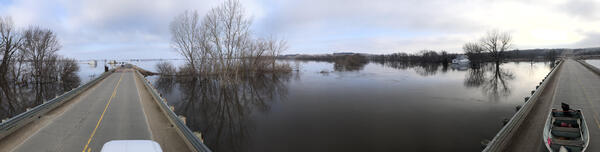
USGS takes water measurements during Big Sioux flooding
USGS takes water measurements during Big Sioux floodingUSGS scientists and technicians took water measurements during flooding on the Big Sioux River near Jefferson, SD in March 2019. Measurements for this site were 52,000 cfs at a gage height of 40.14 ft.
USGS takes water measurements during Big Sioux flooding
USGS takes water measurements during Big Sioux floodingUSGS scientists and technicians took water measurements during flooding on the Big Sioux River near Jefferson, SD in March 2019. Measurements for this site were 52,000 cfs at a gage height of 40.14 ft.