U.S. flag

An official website of the United States government

All Multimedia

Access all multimedia to include images, video, audio, webcams, before-after imagery, and more. Filter and explore with filtering options to refine search. 

Filter Total Items: 24939
image related to volcanoes. See description
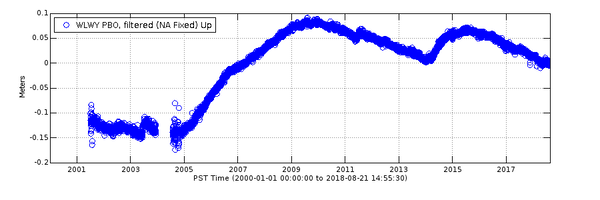
Vertical deformation at GPS station WLWY during 2001-2018

Data from continuous GPS stations indicate how the ground is moving over time. Station WLWY, near White Lake on the Sour Creek resurgent dome in Yellowstone caldera, has been operating since 2001. This plot shows vertical ground motion recorded at the site.

Data from continuous GPS stations indicate how the ground is moving over time. Station WLWY, near White Lake on the Sour Creek resurgent dome in Yellowstone caldera, has been operating since 2001. This plot shows vertical ground motion recorded at the site.

Collapse at Kīlauea (July 24, 2018)

A collapse event occurred at the summit of Kīlauea this morning (July 24, 2018) at 6:41 a.m. HST, releasing energy equivalent to a magnitude-5.3 earthquake, which is similar to that released by previous collapse events. In this video, watch as today's event unfolds from the perspective of HVO's live-stream camera.

A collapse event occurred at the summit of Kīlauea this morning (July 24, 2018) at 6:41 a.m. HST, releasing energy equivalent to a magnitude-5.3 earthquake, which is similar to that released by previous collapse events. In this video, watch as today's event unfolds from the perspective of HVO's live-stream camera.

image related to volcanoes. See description
Conditions evolve at ocean entry, in Kīlauea Volcano's lower East Rift Zone

View from this morning's helicopter overflight of the Pohoiki boat ramp at Isaac Hale Park shows black sand, transported to the southwest by longshore currents, blocking the entrance to the small boat harbor.

Schematic of drawdown as a result of overpumping
Cone of depression: Pumping a well can cause water level lowering

Groundwater occurs in the saturated soil and rock below the water table. If the aquifer is shallow enough and permeable enough to allow water to move through it at a rapid-enough rate, then people can drill wells into it and withdraw water.

Groundwater occurs in the saturated soil and rock below the water table. If the aquifer is shallow enough and permeable enough to allow water to move through it at a rapid-enough rate, then people can drill wells into it and withdraw water.

image related to volcanoes. See description
Echinus temperature record during October 17-20, 2017

Temperature record from Echinus geyser outflow channel for October 17–20, 2017. The plot captures a time when the geyser went from occasional eruptions to semi-regular eruptions (signified by temperature spikes after about 12:00 on October 18) occurring about every 2 hours.

Temperature record from Echinus geyser outflow channel for October 17–20, 2017. The plot captures a time when the geyser went from occasional eruptions to semi-regular eruptions (signified by temperature spikes after about 12:00 on October 18) occurring about every 2 hours.

image related to volcanoes. See description
A sand bar has built up at the end of the Pohoiki boat ramp, but the ramp itself

A sand bar has built up at the end of the Pohoiki boat ramp, but the ramp itself remains intact and there has been no significant lava advance toward the ramp in recent days.

Edge of the Kīlauea vog plume near Waikoloa Village

Edge of the Kīlauea vog plume near Waikoloa Village on the west side of Hawai‘i Island as it is blown by trade winds across the island and toward the Pacific Ocean. For more information on sulfur dioxide emissions and vog, see https://vog.ivhhn.org/.

Edge of the Kīlauea vog plume near Waikoloa Village on the west side of Hawai‘i Island as it is blown by trade winds across the island and toward the Pacific Ocean. For more information on sulfur dioxide emissions and vog, see https://vog.ivhhn.org/.

Image of the Week - Deadly Mudslides in Japan

Torrential rainfall swamped western Japan in July of 2018. The rain caused mudslides that flooded cities, damaged buildings and rattled the

nation’s infrastructure. More than 170 people died.


Torrential rainfall swamped western Japan in July of 2018. The rain caused mudslides that flooded cities, damaged buildings and rattled the

nation’s infrastructure. More than 170 people died.


John Mullaney
Water quality at the Salmon River

Installing dissolved oxygen sensors at the Salmon River near East Hampton, Connecticut

Installing dissolved oxygen sensors at the Salmon River near East Hampton, Connecticut

image related to volcanoes. See description
Kīlauea lower East Rift Zone remains quiet

Today's morning overflight saw no new activity at any of the fissures in the lower East Rift Zone. Fissure 8 had only a sluggish lava puddle remaining in the cone, and other fissures, though steaming, showed no signs of reactivation.

Today's morning overflight saw no new activity at any of the fissures in the lower East Rift Zone. Fissure 8 had only a sluggish lava puddle remaining in the cone, and other fissures, though steaming, showed no signs of reactivation.

image related to volcanoes. See description
Monitoring old ground cracks

Fissure 8 may have slowed down, but HVO scientists are still on the ground in Leilani Estates, monitoring old ground cracks and marking ones that haven't been surveyed before. Monitoring these cracks over multiple days could detect any new signs of magma movement beneath the ground, one of the indicators that fissures might reactivate.

Fissure 8 may have slowed down, but HVO scientists are still on the ground in Leilani Estates, monitoring old ground cracks and marking ones that haven't been surveyed before. Monitoring these cracks over multiple days could detect any new signs of magma movement beneath the ground, one of the indicators that fissures might reactivate.

Ocean Entry of Lava Near Ahalanui

During HVO's early morning helicopter overflight along the coastline, orange streams of lava were entering the ocean in the vicinity of Ahalanui. Strong trade winds were pushing the white laze plumes inland.

During HVO's early morning helicopter overflight along the coastline, orange streams of lava were entering the ocean in the vicinity of Ahalanui. Strong trade winds were pushing the white laze plumes inland.

image related to volcanoes. See description
Thermal map of fissure system and lava flows

This thermal map shows the fissure system and lava flows as of 6 am on Saturday, August 11. Residual lava in the Fissure 8 flow continues to drain, feeding numerous small ocean entries (shown in main map). In the Fissure 8 cone there were two small lava ponds (shown in small inset map). The black and white area is the extent of the thermal map.

This thermal map shows the fissure system and lava flows as of 6 am on Saturday, August 11. Residual lava in the Fissure 8 flow continues to drain, feeding numerous small ocean entries (shown in main map). In the Fissure 8 cone there were two small lava ponds (shown in small inset map). The black and white area is the extent of the thermal map.

image related to volcanoes. See description
Volcanic activity diminished on Kīlauea's lower East Rift Zone

The UAS team (Unmanned Aircraft Systems) flew a mission over fissure 8 to assess conditions within the cinder cone. As shown, fissure 8 contains two small ponds deep within its crater. One pond slowly circulates with an incandescent surface while the other pond is stagnant with a crusted top.

The UAS team (Unmanned Aircraft Systems) flew a mission over fissure 8 to assess conditions within the cinder cone. As shown, fissure 8 contains two small ponds deep within its crater. One pond slowly circulates with an incandescent surface while the other pond is stagnant with a crusted top.

image related to volcanoes. See description
Kīlauea summit
Kīlauea summit
Kīlauea summit

Clear weather this afternoon afforded a stunning view of Kīlauea's summit, which has been "quiet" since August 4, with no significant subsidence or collapses. The flat ledge shown here (center) is part of the former Halema‘uma‘u crater floor, which dropped precipitously between mid-May and early August.

Clear weather this afternoon afforded a stunning view of Kīlauea's summit, which has been "quiet" since August 4, with no significant subsidence or collapses. The flat ledge shown here (center) is part of the former Halema‘uma‘u crater floor, which dropped precipitously between mid-May and early August.

image related to volcanoes. See description
Kīlauea's lower East Rift Zone lava flows and fissures, August 9, 2:00 p.m.

Map as of 2:00 p.m. HST, August 9, 2018. Given the dynamic nature of Kīlauea's lower East Rift Zone eruption, with changing vent locations, fissures starting and stopping, and varying rates of lava effusion, map details shown here are accurate as of the date/time noted. Shaded purple areas indicate lava flows erupted in 1840, 1955, 1960, and 2014-2015.

Map as of 2:00 p.m. HST, August 9, 2018. Given the dynamic nature of Kīlauea's lower East Rift Zone eruption, with changing vent locations, fissures starting and stopping, and varying rates of lava effusion, map details shown here are accurate as of the date/time noted. Shaded purple areas indicate lava flows erupted in 1840, 1955, 1960, and 2014-2015.

image related to volcanoes. See description
Kīlauea Summit
Kīlauea Summit
Kīlauea Summit

As the Halema‘uma‘u Crater has collapsed, geologists have been able to see older volcanic deposits and features buried beneath decades of lava flows. For instance, two lava tubes were spotted in the southwestern wall of the collapse crater.

As the Halema‘uma‘u Crater has collapsed, geologists have been able to see older volcanic deposits and features buried beneath decades of lava flows. For instance, two lava tubes were spotted in the southwestern wall of the collapse crater.

A Northern Fulmar flying in Lower Cook Inlet, Alaska

Northern Fulmars, Black-legged Kittiwakes, and Common Murres have all been tested for and contained harmful algal bloom (HAB) toxins. Since 2015, the USGS has worked with a variety of stakeholders to develop testing methods and research projects to better understand the geographic extent, timing and impacts of algal toxins in Alaska marine ecosystems.

Northern Fulmars, Black-legged Kittiwakes, and Common Murres have all been tested for and contained harmful algal bloom (HAB) toxins. Since 2015, the USGS has worked with a variety of stakeholders to develop testing methods and research projects to better understand the geographic extent, timing and impacts of algal toxins in Alaska marine ecosystems.

image related to volcanoes. See description
Death Gulch in 1899
Death Gulch in 1899
Death Gulch in 1899

The carcass of a large silver-tipped grizzly bear, which succumbed to poisonous gases in the area known as "Death Gulch" in Yellowstone National Park in 1897. Image from Popular Science Monthly Volume 54, Public Domain, accessed from https://commons.wikimedia.org/w/index.php?curid=15271684.

The carcass of a large silver-tipped grizzly bear, which succumbed to poisonous gases in the area known as "Death Gulch" in Yellowstone National Park in 1897. Image from Popular Science Monthly Volume 54, Public Domain, accessed from https://commons.wikimedia.org/w/index.php?curid=15271684.

Was this page helpful?