



Aerial view of the fissure 8 cone and spillway captured by Civil Air Patrol during their overflight on August 7, 2018. View is toward the south.
All Multimedia
Access all multimedia to include images, video, audio, webcams, before-after imagery, and more. Filter and explore with filtering options to refine search.
Filter Total Items: 24981

Aerial view of the fissure 8 cone
Aerial view of the fissure 8 cone and spillway captured by Civil Air Patrol during their overflight on August 7, 2018. View is toward the south.

Kīlauea 2018 events mark a watershed for volcano science
Kīlauea 2018 events mark a watershed for volcano scienceThese two plots show summit tilt (ground deformation) and seismicity (earthquake counts) on Kīlauea Volcano between July 15 and August 5, 2018. A regular pattern emerged in which seismicity gradually increased over 1-3 days (bottom), until the caldera floor suddenly dropped several meters (yards) in a matter of seconds.
Kīlauea 2018 events mark a watershed for volcano science
Kīlauea 2018 events mark a watershed for volcano scienceThese two plots show summit tilt (ground deformation) and seismicity (earthquake counts) on Kīlauea Volcano between July 15 and August 5, 2018. A regular pattern emerged in which seismicity gradually increased over 1-3 days (bottom), until the caldera floor suddenly dropped several meters (yards) in a matter of seconds.

Lava Fountaining at Fissure 8
During this morning's overflight, HVO geologists observed low levels of lava fountaining within the fissure 8 spatter cone and crusted lava in the spillway and channel downstream. The significance of this change is not yet clear. Eruptions can wax and wane or pause for days to weeks before returning to high levels of lava discharge.
During this morning's overflight, HVO geologists observed low levels of lava fountaining within the fissure 8 spatter cone and crusted lava in the spillway and channel downstream. The significance of this change is not yet clear. Eruptions can wax and wane or pause for days to weeks before returning to high levels of lava discharge.

New outcrops make good geology
This aerial view of the western part of Kīlauea Volcano's caldera was taken on August 6, 2018. The down-dropped block is faulted about 120 m (400 feet) below the caldera floor. Many 19th-century lava flows are exposed in the fault scarps. Halema‘uma‘u (not visible) is to the left of this photo.
This aerial view of the western part of Kīlauea Volcano's caldera was taken on August 6, 2018. The down-dropped block is faulted about 120 m (400 feet) below the caldera floor. Many 19th-century lava flows are exposed in the fault scarps. Halema‘uma‘u (not visible) is to the left of this photo.

Overflight of Kīlauea Summit
Between mid-May and early August, 2018, the depth of Halema‘uma‘u more than tripled and its diameter more than doubled as magma from Kīlauea's shallow summit reservoir moved into the lower East Rift Zone. Evidence of subsidence is visible in this video, taken during an early morning helicopter overflight on August 6, 2018.
Between mid-May and early August, 2018, the depth of Halema‘uma‘u more than tripled and its diameter more than doubled as magma from Kīlauea's shallow summit reservoir moved into the lower East Rift Zone. Evidence of subsidence is visible in this video, taken during an early morning helicopter overflight on August 6, 2018.
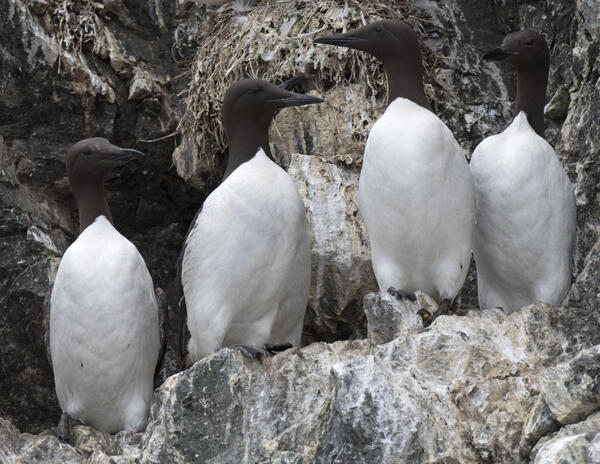
Skinny Common Murre with keel protruding (second from the left)
Skinny Common Murre with keel protruding (second from the left)Skinny Common Murre with keel protruding (second from the left) contrasted by normal murres. Lower Cook Inlet, Alaska.
Skinny Common Murre with keel protruding (second from the left)
Skinny Common Murre with keel protruding (second from the left)Skinny Common Murre with keel protruding (second from the left) contrasted by normal murres. Lower Cook Inlet, Alaska.

Tree Growth - soil acidified by acid rain
Peggy Phillips measures a young red maple in an Adirondack watershed to see if liming has improved tree growth in a watershed where acid rain severely acidified the soil.
Peggy Phillips measures a young red maple in an Adirondack watershed to see if liming has improved tree growth in a watershed where acid rain severely acidified the soil.

UAS pilots in the field
Woods Hole Coastal and Marine Science Center unmanned aerial systems (uas) pilots conduct drone flights at Sandy Neck Beach, Cape Cod, MA
Woods Hole Coastal and Marine Science Center unmanned aerial systems (uas) pilots conduct drone flights at Sandy Neck Beach, Cape Cod, MA

Aftershocks of the 2018 magnitude-6.9 earthquake expected to continue
Aftershocks of the 2018 magnitude-6.9 earthquake expected to continueThe inferred rupture area (white dashed line) of the May 4, 2018, magnitude-6.9 earthquake, with its foreshocks and first 10 days of aftershocks, spans an area of about 800 sq km (300 sq mi). Circle size indicates earthquake magnitude; color indicates earthquake depth. Magnitudes for some of the larger events are labeled.
Aftershocks of the 2018 magnitude-6.9 earthquake expected to continue
Aftershocks of the 2018 magnitude-6.9 earthquake expected to continueThe inferred rupture area (white dashed line) of the May 4, 2018, magnitude-6.9 earthquake, with its foreshocks and first 10 days of aftershocks, spans an area of about 800 sq km (300 sq mi). Circle size indicates earthquake magnitude; color indicates earthquake depth. Magnitudes for some of the larger events are labeled.

Fishing Cone, West Thumb
Fishing cone, a hot springs on the floor of Yellowstone Lake. The hot spring rim sits at lake level.
Fishing cone, a hot springs on the floor of Yellowstone Lake. The hot spring rim sits at lake level.

GPS station P361, on Sawtell Peak
GPS station P361, on Sawtell Peak, on a nice clear day. Electrical storms destroyed multiple antennas, including the GPS antenna--here under a protective plastic dome--and three communications antennas on the tower. Data from P361, along with data from other stations in the Yellowstone region, are sent to UNAVCO for free and open distribution.
GPS station P361, on Sawtell Peak, on a nice clear day. Electrical storms destroyed multiple antennas, including the GPS antenna--here under a protective plastic dome--and three communications antennas on the tower. Data from P361, along with data from other stations in the Yellowstone region, are sent to UNAVCO for free and open distribution.

Mount Baker and Glacier Peak - Active Volcanoes
Are you ready for an eruption? Mount Baker dominates the skyline of northwestern Washington and southwestern British Columbia. Glacier Peak is mostly hidden from view. Both volcanoes have erupted in recent centuries and will erupt again, disrupting the landscape and the lives of people downstream and downwind. Learn what to do and where to get information.
Are you ready for an eruption? Mount Baker dominates the skyline of northwestern Washington and southwestern British Columbia. Glacier Peak is mostly hidden from view. Both volcanoes have erupted in recent centuries and will erupt again, disrupting the landscape and the lives of people downstream and downwind. Learn what to do and where to get information.

Mount Rainier is an active volcano. Are you Ready for an Eruption?
Mount Rainier is an active volcano. Are you Ready for an Eruption?Mount Rainier is much more than a mountain in the sky. Constructed of hundreds of lava flows, and capped by as much glacier ice as all other Cascade volcanoes combined, Rainier's steep rubbly slopes and abundant water make it prone to landslides and lahars, especially during eruptions. Are you ready for an eruption?
Mount Rainier is an active volcano. Are you Ready for an Eruption?
Mount Rainier is an active volcano. Are you Ready for an Eruption?Mount Rainier is much more than a mountain in the sky. Constructed of hundreds of lava flows, and capped by as much glacier ice as all other Cascade volcanoes combined, Rainier's steep rubbly slopes and abundant water make it prone to landslides and lahars, especially during eruptions. Are you ready for an eruption?

UNAVCO field engineer Dylan Cembalski replaces damaged antennas on the communica
UNAVCO field engineer Dylan Cembalski replaces damaged antennas on the communicaUNAVCO field engineer Dylan Cembalski replaces damaged antennas on the communications tower at Sawtell Peak. The tower is shared by multiple groups that use this regional high point to relay data. (UNAVCO Photo by Summer Rhoades)
UNAVCO field engineer Dylan Cembalski replaces damaged antennas on the communica
UNAVCO field engineer Dylan Cembalski replaces damaged antennas on the communicaUNAVCO field engineer Dylan Cembalski replaces damaged antennas on the communications tower at Sawtell Peak. The tower is shared by multiple groups that use this regional high point to relay data. (UNAVCO Photo by Summer Rhoades)

Viscous lava hits ocean water
A viscous pāhoehoe flow from Kilauea Volcano, Hawaiʻi , entering the ocean near Isaac Hale Beach Park on the morning of August 5, 2018.
A viscous pāhoehoe flow from Kilauea Volcano, Hawaiʻi , entering the ocean near Isaac Hale Beach Park on the morning of August 5, 2018.

Volcano collapses mark the beginning and end of USGS scientist's career
Volcano collapses mark the beginning and end of USGS scientist's careerLeft: Horseshoe-shaped crater of Mount St. Helens in 1980, formed by a landslide that removed the top of the volcano. The crater is about 2 km (1.2 mi) wide and the floor is about 600 m (1,970 ft) below the crater rim. Right: Halema'uma'u nestled in the summit crater of Kīlauea Volcano on August 1, the day before the last collapse event.
Volcano collapses mark the beginning and end of USGS scientist's career
Volcano collapses mark the beginning and end of USGS scientist's careerLeft: Horseshoe-shaped crater of Mount St. Helens in 1980, formed by a landslide that removed the top of the volcano. The crater is about 2 km (1.2 mi) wide and the floor is about 600 m (1,970 ft) below the crater rim. Right: Halema'uma'u nestled in the summit crater of Kīlauea Volcano on August 1, the day before the last collapse event.

Before and after satellite images of Leilani Estates subdivision
Before and after satellite images of Leilani Estates subdivisionThis comparison shows satellite images of Leilani Estates subdivision before and after the May-August 2018 eruption. The image on the right, collected in early September 2018, shows that the eastern portion of the subdivision has been covered by lava. The Fissure 8 lava channel runs northeast, with the Fissure 8 cone at the start of the channel.
Before and after satellite images of Leilani Estates subdivision
Before and after satellite images of Leilani Estates subdivisionThis comparison shows satellite images of Leilani Estates subdivision before and after the May-August 2018 eruption. The image on the right, collected in early September 2018, shows that the eastern portion of the subdivision has been covered by lava. The Fissure 8 lava channel runs northeast, with the Fissure 8 cone at the start of the channel.

Before and after satellite images of the Fissure 8 area in Leilani Estates
Before and after satellite images of the Fissure 8 area in Leilani EstatesA close up comparison of the Fissure 8 area in Leilani Estates subdivision. Leilani Avenue runs right-left (east-west) through the center of the images. On the right side, the crater in the Fissure 8 cone is visible, with the Fissure 8 lava channel extending north.
Before and after satellite images of the Fissure 8 area in Leilani Estates
Before and after satellite images of the Fissure 8 area in Leilani EstatesA close up comparison of the Fissure 8 area in Leilani Estates subdivision. Leilani Avenue runs right-left (east-west) through the center of the images. On the right side, the crater in the Fissure 8 cone is visible, with the Fissure 8 lava channel extending north.

Multibeam processing
USGS scientist Pete Dartnell processes multibeam data collected from off the Pacific Northwest coast on a research cruise aboard NOAA ship Rainier.
USGS scientist Pete Dartnell processes multibeam data collected from off the Pacific Northwest coast on a research cruise aboard NOAA ship Rainier.

New Jersey Strata 1
Exposure of the Cape May Formation in the Kirkwood-Cohansey aquifer system.
Exposure of the Cape May Formation in the Kirkwood-Cohansey aquifer system.

New Jersey Strata 2
Exposure of the clay-sand facies of the Cohansey Formation in the Kirkwood-Cohansey aquifer system.
Exposure of the clay-sand facies of the Cohansey Formation in the Kirkwood-Cohansey aquifer system.